
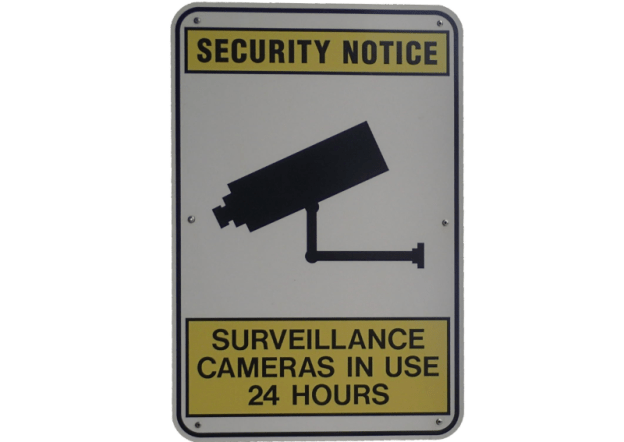
Today, in the Moonah and Glenorchy CBDs are over 25 closed circuit TVs in public spaces, mostly on light poles. Council uses its resources to manage and maintain them with no demonstrable benefit to the community.
Funded by the Commonwealth Government, installed and maintained by the Glenorchy City Council, and used by State Police, they record movement across our city. We are all accustomed to seeing CCTV on private property, particularly in business premises, but may not have noticed them in public spaces.
After years of increasing expressions of concern about graffiti by residents and businesses, Council in December 2010 finally decided on a by-law and policy to guide how Council would deal with graffiti on council property and elsewhere in the city. There is no evidence of systematic public consultation. Eight months later in July 2011, it decided to “facilitate in conjunction with all tiers of government and local businesses, through grants, other financial assistance and in kind assistance, the installation of closed circuit TV (CCTV) in the Glenorchy CBD as a pilot project“.
The opportunity to act on that decision arrived at the end of the year when the Commonwealth Government announced the Proceeds of Crime Funding Round for 2012, with a focus on Graffiti (prevention, reduction and/or removal). At its March 2012 meeting, Council decided to take advantage of the opportunity by applying for a grant. It received $123,687 — not bad for a “pilot project”.
But it took another twelve months before Council nailed down precisely how it would evaluate or assess the “pilot”. At its 12 February 2013 meeting it refined the objectives of the pilot to be:
- To reduce reported crime and incidents to Police;
- To reduce reported damage and graffiti within the Glenorchy City municipality; and
- To improve perception of safety and reduce fear of crime.
and listed nine statistics that would be collected as measures of the performance of the CCTV. Council also began to consider how the CCTV would be operated and managed, and what part it would play with crime prevention and detection strategies already in effect in Glenorchy.
The 1 September 2014 Council meeting saw answers to questions from our current Mayor (then Alderman Johnston) asking why reports, statistics, work plans and protocols had not yet appeared. Recent questions to Council revealed that Council has to this day never compiled those statistics, nor has Tasmania Police (to Council’s knowledge). Furthermore, Council has never reviewed the CCTV operation to determine whether it has achieved any of its original objectives.
What do we know of the current situation?
As far as I can tell, CCTV can now be found in these places.
- Barry Street at entrance to Mill Lane.
- Council Chambers roof.
- Glenorchy Bus Mall – Main Road end and Barry Street end.
- Northgate entrance on Main Road.
- Moonah Car Park.
- Moonah Post Office.
- Main Road opposite Moonah Hotel.
- GASP Pavilion on Wilkinsons Point.
None of the cameras are monitored; footage is downloaded if and when it is required.
The CCTV recording system operates on a 30 day rolling cycle. Only the previous 30 days of footage will be available: e.g., on day 31, it will record over day 1 of the 30day cycle.
Council’s CCTV system does not record audio; this conveniently removes any requirement to comply with the Listening Devices Act.
Council’s part in the CCTV operation appears to be to (a) house the recording equipment, (b) undertake an annual maintenance check on all CCTV equipment, (c) review CCTV footage, and (d) provide relevant footage to Tasmania Police if an incident is reported or the Police request the footage.
It is not clear whether Council has any control whatsoever over where CCTV is installed. Approval is required from TasNetworks for any installations or attachments to light poles.
But has the installed CCTV ever achieved its intended purposes? Has Council ever considered whether it does anything apart from making Glenorchy residents feel safe? Does it do even that?
As noted above, Council has never undertaken any evaluation to determine whether the CCTV operation achieved any of its original objectives.
Only Tasmania Police can tell us whether less crime is reported and vandalism has become rarer. But we read in the agenda of the November 2017 Council meeting that “formal correspondence with Tasmanian Police indicated that Police would be unwilling for operational reasons to release any data”.
As far as graffiti is concerned, the Council map website helpfully provides a graffiti page showing historical data. Extracting the raw data gives the following graph.
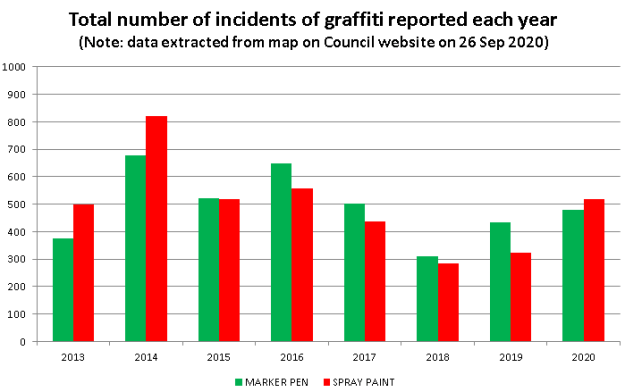
There is no evidence that the CCTV operation has improved crime prevention or detection in any way, disappointing given the Police Tasmania website says that the preferred role of CCTV systems is “to prevent or reduce the opportunity for crime to occur.”
But that may not matter. If the prime objective is in fact to make people feel safer and it costs little to maintain and operate the cameras, then they should stay. Whether they in fact reduce crime would be neither here nor there. On the other hand, they may be a complete waste of money.
 Glenorchy City Observer