
When developers encounter a planning scheme with an enormous amount of discretion in the hands of planning authorities, it is not surprising to find them pushing the envelope with their proposals, relying on the fuzziness of many of the performance criteria in the planning scheme.
Take no notice of those who speak as if they regard the planning scheme as if it were an algorithm that takes the details of the proposal and spits out the single correct recommendation for approval or rejection. Doubt those who dogmatically claim that a proposal is “within the planning scheme” where any discretions are involved.
For example, a proposal could be rejected on the grounds that it has “an unacceptable impact upon residential amenity on land within a residential zone by virtue of increased noise emissions”. There is no magic formula for calculating the impact of noise, for deciding whether it is acceptable or not. Two people could legitimately disagree.
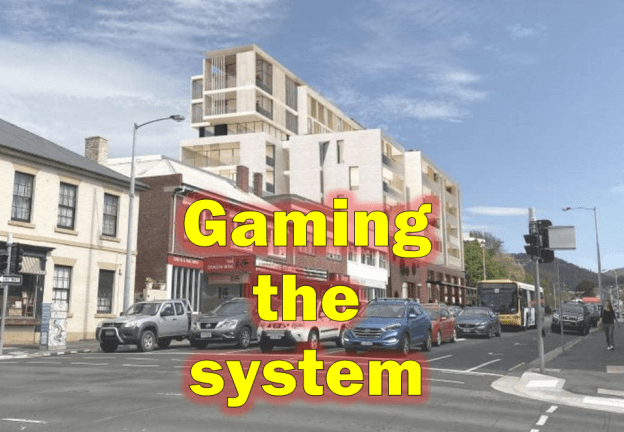
The Macquarie Street Apartments proposal rejected by Hobart City Council earlier this week was clearly a high risk proposal and the developers would have known it. It was double the height of all other buildings within hundreds of metres, and it has all the design aesthetics of a LEGO model made by a toddler.
The developers tried to game the system. They relied on the positive bias of Council staff who, believe it or not, try very hard to make proposals possible. Council staff work to find a set of conditions that makes the proposal acceptable: they very rarely fail particularly if the developer has had the good sense to discuss their proposal with the planners earlier. Only truly awful proposals are recommended for rejection!
In the system they’re trying to game, it makes sense to make the proposal an ambit claim.
Council approval would mean that the developer has what they need, and probably much more. The developer would react to Council rejection with an appeal to RMPAT where the first step is an attempted mediation. An ambit claim means they have something to give away during a negotiation. But they may still get more than they would have from a “safe” proposal at the start.
The developer does nothing illegal or unethical. The system is what it is — a structure created by government. Keep this in mind when reading or viewing material where they show surprise or disbelief that a council could possibly reject, or even question, their proposal. It is not that simple.
 Glenorchy City Observer