

In early February 2022 I asked Council some questions about impending roadway upgrades near the top of Marys Hope Road in Rosetta.
Council has given me permission to publish here in full the questions and answers.
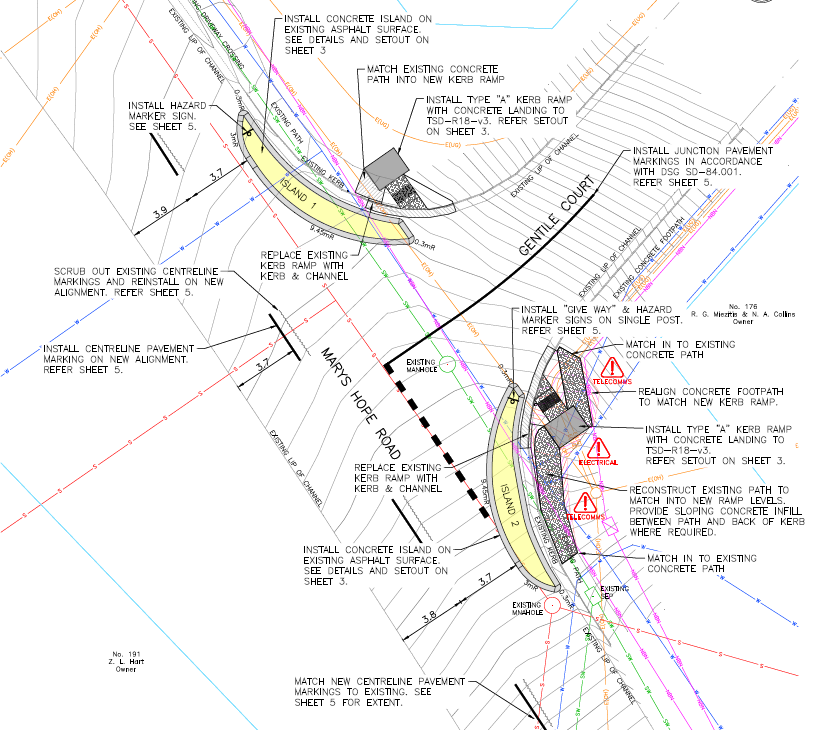
It seems that the approval of two large developments at 190 and 192 Marys Hope Road has increased the level of risk around Gentile Court so much that Council believes that a 60 km/h speed limit at that location is no longer safe. Council applied for a Black Spot Program grant for a project to prepare the nearby portion of Marys Hope Road for a reduction in speed limit. Council was successful and the tender for the roadworks at Gentile Court (and two other locations) closed at the beginning of February. You can view the drawings for the works at Gentile Court here.
Council has also helpfully provided a copy of its full submission to the Black Spot Program. Don’t worry; it’s only five pages. Council has permitted me to provide it on this website. Use this link to read the full document.
Get an insight into the Council thinking behind the project.

The questions and answers in full.
My question relates to a recent tender (contract #0869) for roadworks to be done at a number of locations in Glenorchy. One leapt off the page for me because it is not far from where I live. Titled “Marys Hope Road & Gentile Court Intersection Traffic Islands 2021/22 Blackspot Project”, it involved two small traffic islands at the intersection. Back in 2019 the advice from Council to the Planning Authority for the 190 Marys Hope Road DA was that the intersection was safe with adequate sight distances in both directions on Marys Hope Road.
Q1. Can Council please inform me why Council later submitted a request to the Black Spot Program for that location?
A. The developer of 190 Marys Hope Rod submitted a Traffic Impact Assessment which considered the safety of the intersection of Marys Hope Road and Gentile Court. It was concluded that the development would not have a detrimental effect on the safety of the intersection.
Marys Hope Road is very wide in the vicinity of this intersection and along this stretch of road which sets a road environment with a posted speed of 60km/h. Over time Council would like to reduce this speed limit due to developments in the area. However, before this can occur the road environment needs to be suitable for a 50 km/h speed limit.
To achieve this, the Black Spot project at the intersection involves the installation of kerb blisters at the intersection, as shown on the plan below. This will narrow the perception of Marys Hope Road to help reduce vehicle speeds. A similar treatment has been undertaken at the nearby intersection with Kilander Crescent. The project also has other benefits including increased sight lines at the intersection and improved pedestrian facilities. Upgraded kerb ramps will greatly improve the accessibility for pedestrians crossing Gentile Court.
Q2. Did Council have new advice?
A. No
Q3. Can I please have a copy of Council’s submission?
A. A copy of the report is attached.
Q4. What process does Council undertake to determine whether to submit requests to the Black Spot Program? Does it invite or accept public input?
Council reviews our road network and crash data annually to highlight any potential Black Spot projects. Black Spot projects can either be based on crash history or from a road safety audit perspective. Nominations for Black Spot locations are invited from state and territory governments, local councils, community groups, industry, and individuals.
More information about the Black Spot process and submissions can be found here on their website.
 Glenorchy City Observer