
If you walk into the council chambers through the front door, you will see directly ahead two small display cabinets containing interesting historical artefacts from council’s historical collection. Those coming in the back door won’t see them.

The collection has accumulated since the 1800s. Over the years, members of the public have asked questions about council’s historical collection but received little information – not the size of the collection, not a spreadsheet listing the contents, and certainly not photographs of the contents on a website.
A question asked of council last year revealed that an inventory does exist but that council was reluctant to publish because of fears that the heritage officer would be swamped by questions from the public.
Very few objects have been revealed to the public. Some are in poor condition or very fragile. The collection is currently stored in one location off-site with various bits and pieces scattered around council chambers.
Council has not been able to find a suitable space where the collection can be displayed ‒ safe, secure, climate-controlled, and easily accessible to the public – a museum.
But even if it found a location, the three-days-a-week heritage officer, the only council staff member with duties relating specifically to the collection, simply does not have the time to manage a museum (in addition to their statutory duties).
But even if they had the time, museum management requires a skill set quite different to that of a heritage officer.
But even if they had the skills, a museum would generate little income and simply be a financial overhead. Most of the public would see it as a drain on council funds.
Every now and then, council’s one and only heritage officer (part-time) will stock the cabinets with a new set of objects. That is probably the best display method we can hope for.
Council can do more. It should find a way to place the collection catalogue online, and attach photos of each item to the catalogue. They will not be swamped with requests for help or information. Even if they are, there may well be volunteers in the community who could assist in dealing with the requests (and possibly implementing the online catalog and gallery). Volunteers who could help with its design.
Next time you go to council, go in the front door and learn a little history.
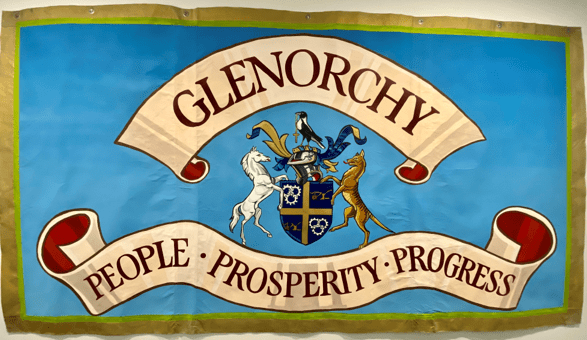
NOTE: the image for this post shows the photo of a banner was created by artist Chantale Delrue for ‘The Gathering’ Centenary of Federation event, Launceston, Sunday 2 December 2001. Currently located in Council Chambers.
 Glenorchy City Observer