
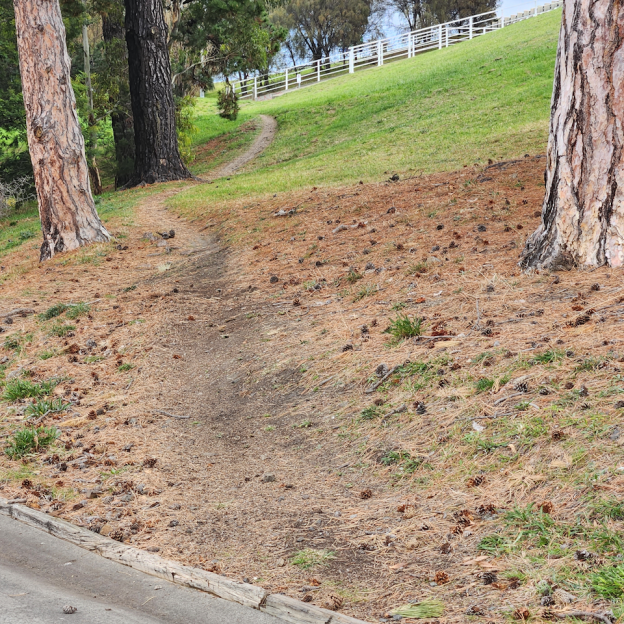
When pedestrians find existing pathways or roadways inconvenient or dangerous, they will naturally look for alternatives. When there is no marked path, people will work it out for themselves – and make their own path. We might call it a shortcut. But a path made that way is, in the jargon of urban design, called a desire line or desire path. The image for this post shows an example running down from McVilly Drive down to the Intercity Cycleway.
Maybe the architect or designer gave more thought to the aesthetics (or the cost) than to whether people would actually use them.
In some situations, designers build no path, wait to see where people walk, then build the path there.
I’ve written about desire lines here because the term appears in the agenda for the July 2023 GPA meeting (page 15). The agenda item concerns a proposed development at 72-74 Main Road, Claremont, and contains a few paragraphs arguing for no change to the service road for the new development. It is part of an attempt (perfunctory as usual) to consider the needs of pedestrians. It is as weak as dishwater.
It was really a token gesture because, as you can see below, the current service road provides no safety for pedestrians. And there is too little space on its verges to provide any.

In any case, it would be truly miraculous for the needs of pedestrians to be a serious part of any GPA discussion.
A desire line will usually be the shortest or quickest route from A to B. But not always. People can take account of details in the landscape. And there may be more than one desire line from A to B, with one going up and the other going down, depending on the terrain.
Next time you go walking, notice where you walk, and you will occasionally find yourself on a desire line (possibly even starting a new one).
For more information
- Desire paths: the illicit trails that defy the urban planners from the Guardian.
- Desire lines: to pave or not to pave? from the University of New South Wales.
- Desire lines: signs of bad design? from Daniel Bowen.
- What desire paths can tell us about how to design safer, better public spaces from the ABC (Australia).
Note
The image for this post is the desire path running down from McVilly Drive
to Intercity Cycleway in Hobart near the Regatta Ground. Photo taken 27 July 2023.
 Glenorchy City Observer