
On Monday 18 March 2024 the Glenorchy Planning Authority (GPA) rejected a Development Application (DA) proposing a small business development on a private property almost at the end of Fairy Glen Road in Collinsvale. The vote was 3 for, 2 against – as close as it gets.
The rejection had in fact been recommended by council staff who were not persuaded by the conclusions of a Traffic Impact Assessment (TIA) commissioned by the proponent.
I should start by saying that virtually every member of the GPA said at some point that they felt “conflicted” as they decided how they would vote. Disagreeing with the recommendation of planning staff has historically been very rare. It can create difficulties later in the decision-making process. One is finding a planning expert willing to defend the GPA decision should the proponent or any representor decide to appeal.
Most of the “confliction” related to the safety of people driving along the single lane road (gravel-covered track?) which provides the only vehicular access to properties on Fairy Glen Road.
For most of its length, it winds along a steep hillside. The downhill side of the road generally has a soft verge, so much so that council has placed a load limit on vehicles using the road. That means that Veolia waste collection does not happen on this road.
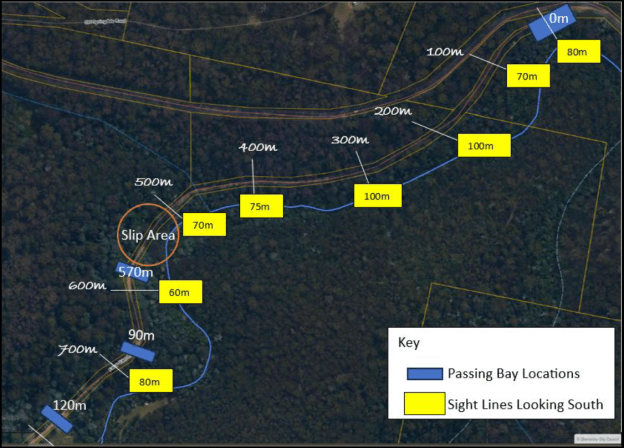
For a 570 metre stretch of the road, there is nothing that could be described as a “passing bay”. Council staff made it very clear that the construction of anything along like a passing bay, even it were possible (which they doubt), would be extremely expensive. And attempting to pass on the soft verge is very risky business.
Clearly those who live in the eight or so residences along the road have found a way to cope with the limitations of the road. They have adapted. The proposal involved the use of a minibus to bring tourists to the development, ostensibly to reduce traffic. The more likely reason is to reduce the likelihood of tourists with no knowledge of the local circumstances having to deal with risky situations or poor road conditions.
Despite what you might hear from property developers, outright rejection of development applications is rare. There is in fact a slight positive bias toward development. Council staff will work hard to find ways to make development possible. Staff advise developers on aspects of a design that may be problematic. Staff will try to find a set of conditions to attach to the permit which make the development compliant.
In this case, the critical issue is the dangerous 570 metres; dangerous because of lack of passing, dangerous because of soft verges, dangerous because of slippery surface when wet.
In conclusion, providing the GPA decision is upheld on any appeal, this decision makes me wonder about the long-term future of Fairy Glen Road, residential or business. The arguments used for this DA could equally apply to any future development. A subdivision would introduce additional regulation. But suppose current residents proposed infill development inside their properties. How would the GPA react?
Council is between a rock and a hard place. As a public road, Council has responsibility for its upkeep. The current road infrastructure is substandard but Council does not have the funds or resources to make it standard. It would be unfair to expect current residents to move away; they seem in any case to have adapted. The most equitable approach is to leave the situation as it is but not allow further development that would make it worse, say by increasing traffic.
The map accompanying this post summarizes the results of the site inspection of problematic 570m. Source: p33 of meeting agenda.
 Glenorchy City Observer