
Now that the efforts of Council and others appear to have finally persuaded the State Government to make the Montrose Bay Park entrance safer for drivers, maybe it can do the same for those who do not drive.
The State Government allocated funds for a project to improve safety at the intersection. The Department of State Growth (DSG) have had a draft design for the intersection to make it controlled by traffic lights. They’ve had that design on their books for years. Enquiries to DSG have always elicited the same response – “we’re waiting for the funds”.
The State Government (and many others) will claim that the proposed traffic lights will make the intersection safe for those on foot, on bike, on scooter, or on skateboard – in other words, for what is now called “active transport”.
Most who have attempted to cross the Brooker Highway on foot will tell a story of being extremely cautious, extremely nervous, extremely tentative. And they will say that using traffic lights does little to reduce the tension.
Any reasonable person could easily come to the conclusion that the Brooker Highway has one prime purpose – to allow traffic to enter and leave Greater Hobart as quickly as possible. It is a facility for traffic. It is utterly ludicrous to suggest that the Highway was in any way designed for the safety of people moving around in any other way, certainly not on foot.
So the proposed traffic lights may help drivers feel safer at Montrose Bay but will do little for pedestrians.
Which brings me to the pedestrian overpass at Montrose Bay High School. The only place in a two kilometre stretch of highway where you can cross without walking on the road surface.
A passing glance at the overpass might fool a casual observer that the overpass is the solution. And it is in roughly the right place, not too far from the school and Montrose Bay Park.

But on a second glance, the sets of stairs on each side of the highway will become evident. Those stairs are an impassable barrier for anyone with any significant mobility issues.
That problem has been recognized officially. That overpass is not DDA-compliant, in other words, not compliant with the Commonwealth Disability Discrimination Act 1992. This is after all what the State Govt’s own Brooker Highway Transport Plan said back in February 2011.
You might look at its title and think that the DDA is just for the disabled. Not so. It is all about access. It is about everyone having the right to “have access to places used by the public”.
To learn more about the DDA, take a look at the website of the Australian Human Rights Commission.
To see an aerial view of a compliant overpass you need go no further than Bellerive.
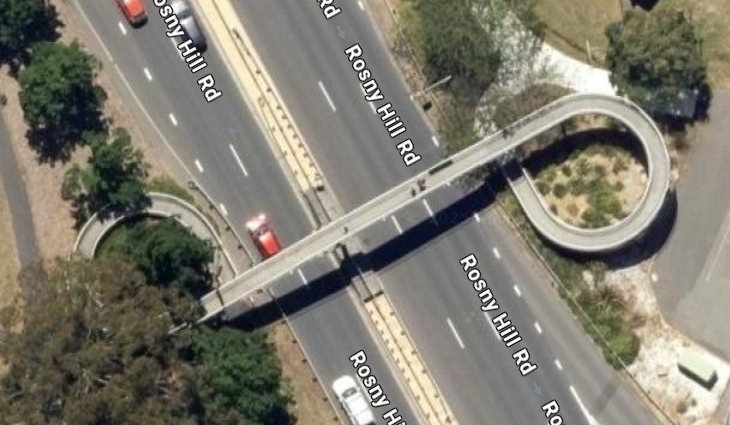
It has become clear over many years that no state government of any political persuasion has had any interest in the safety of pedestrians on or around the Brooker Highway. Their strategy has been to stonewall any request for change and rely on lobbyists giving up in frustration.
Council must now add the provision of a DDA compliant overpass to its priority list for funding.
It must not put up the white flag on the safety of its residents – and everyone else from the region – who go to the high school or park.
 Glenorchy City Observer