Author Archives: Eddy Steenbergen

Unknown's avatar

About Eddy Steenbergen

A Tasmanian IT professional who was in the business far longer than he cares to admit, and now uses those skills to support family history research, manage web sites, and write about Glenorchy matters.

Giving Glenorchy a civic heartbeat

Our Council has dedicated half the $5m loan from the State Government to the Cityscape Project. It has told us virtually nothing about its objectives.

In the Nov 14 Mercury we read a public notice titled “Request for Tender No 0801 – 2020 – Consultant Services – Development and Delivery of a Sub-precinct Masterplan CityScape Project – Phase 2”.

Only the most observant would have noticed the word CityScape in this verbose title. The documents for the tender give the public its first impression of what CityScape is really all about.

The tender encompasses the entire city block containing the Council Chambers, referred to as the “civic heart”.

It calls for “concept designs for a modern, efficient, all-abilities facility that will house commercial tenancies, Council Chambers and other government services as well as concept designs for the external open public spaces surrounding the facility.”

Yes – another masterplan.

The masterplan “will provide Council with the necessary information to attract investment and funding from private, State and Federal Government funding sources”. And Council will find it useful when funding opportunities arise unexpectedly.

Council is clearly completely comfortable with co-locating with other functions, commercial or community-focused, hoping that more people will use the facilities.

The tender expects the project to last about six months starting early in 2021.

Council is to be applauded for searching for ways to make council premises more efficient and inviting, and services more convenient and comfortable. Aldermen have already participated in two workshops – “Layout and configuration of Council Chambers” on September 14, and “Council Chambers reconfiguration” on November 9.

But I do hope that the masterplan does not reduce the amount of vegetation in the block (gardens, lawn, trees, etc) as every other Council development seems to.

According to its Project Management Plan (PMP), CityScape will have a strictly advisory External Stakeholder Reference Group (ESRG). It seems that project updates presented to the ESRG will then “be circulated to stakeholders and the community“.

Glenorchy residents will have to wait for the masterplan to see details of CityScape, a project projected to consume half the $5m loan.

Curiously, it may well be the cheapest economic recovery project, Activity City, that returns tangible results first. Many of us have probably learned of interesting businesses we were not aware of before.


PS 16 December 2020

On December 11, the closing date was put back to January 6.

On December 15, the specification of the deliverable was extended as follows

“This masterplan will not only provide for Glenorchy City Councils’ and adjoining businesses current and future accommodation needs but will also provide the mechanism to explore further commercial opportunities for the precinct. As part of the design process, it is expected that the consultancy team will explore various iterations of building form, massing and maximum permissible building envelopes. This exercise will allow the exploration of potential for additional floor space (over and above the basic masterplan requirements) that may be suitable for commercial or retail leasing purposes. This additional floor space can then be analysed for potential rental yields and developed into an Investment Case Report exploring various options for Council to consider. An example Report from the City of Melbourne has been attached.”

Council is clearly looking for opportunities for income generation. This adds significantly to the scope of the project, certainly increasing its cost and its duration.


Closed yes, secret NO

As a general rule each Council meeting starts with a public or open meeting and finishes with a closed session where aldermen discuss matters without the public present.

All the public is told about the closed session is at the end of the main agenda document. For each matter we are given a title like

“Exemption to enter into an agreement for the provision of commingled processing”

followed by a sentence starting with the words

“This item is to be considered at a closed meeting of the Council by authority of the Local Government (Meeting Procedures) Regulations 2015 Regulation 15(2)…”

which simply tells you which regulation(s) Council is using to justify discussing that matter without the public present.

In normal circumstances, that is all we will ever know about that agenda item, the information aldermen will consider and the decision they make, unless the decision is particularly newsworthy or casts Council in a positive light (when we receive the heavily filtered results of a media event).

The public has a right to know more about

  • how Council justifies discussing a particular matter in closed session,
  • the substance of the matter being discussed, and
  • the results of that discussion, usually a motion passed (or rarely rejected).

……………………………………

Let’s start with how a matter gets into the closed session. The General Manager has final responsibility for preparing the agenda, and must determine which items will appear in the closed session (presumably in close consultation with the Mayor). Local Government regulations provide Council with a list of permitted justifications that you can read here. But the regulation does not force Council to consider those matters in closed session; it says that Council may do so, not that it must!

In any case, the process for agenda production is entirely opaque and the bare references to regulations provides too little information to be useful.

……………………………………

Next, the agenda provides so little information for each item that it is impossible for ratepayers and residents to exercise their democratic right to lobby aldermen.It is far too easy for Council to make a blanket judgement that every detail of an agenda item must not be made public.

The current policy of providing the public with only a bare bones agenda for a closed session is un-necessarily restrictive. There is a great deal that could be released to the public without creating any commercial advantage or disadvantage to entities party to the decisions. The current ad hoc approach ensures that the public learns nothing of controversial matter.

This document makes a case for including with each item those portions of the report considered by aldermen which do not breach any RTI, privacy or confidentiality issues. Aldermen will have their full agenda and reports. The public will have an agenda containing information they are permitted to read. Nothing in the Local Government (Meeting Procedures) Regulations prohibits that.

……………………………………

Finally, why can’t the public routinely be provided information about the outcomes of the closed session?

This document makes a case for requesting Council to provide a report of each closed Council meeting as soon as practicable after the closed session ends. The Mayor has on occasion issued media releases or conducted media interviews immediately after a closed session. This seems to take place where a decision is regarded as newsworthy or casts a positive light on Council. Clearly, for some matters there is no need to wait for minutes to be confirmed before the decision can be announced. And for those matters, it appears to be no problem producing a summary. So why not every decision?

The “report” should contain at least a summary of decisions made.

If the motions were worded to exclude private or confidential information then the report could simply be the minutes. There is no reason why motions and the result of their votes cannot be shared provided private and confidential information is excluded.

For example, instead of

“Resolved to accept response of $52,000 from John Smith P/L for tender for footpath repairs in Howard Street (tender# 9999)”

write

“Resolved to accept response from John Smith P/L for tender for footpath repairs in Howard Street (tender# 9999) at terms indicated in report provided to meeting by Council”

or

“Resolved to accept response from John Smith P/L for tender for footpath repairs in Howard Street (tender# 9999) at terms indicated in meeting agenda”

The “report” must not take the form of a media release produced with a PR objective.

It will not for example exclude information that Council may find inconvenient to have in the public arena. It should only exclude what must be excluded for privacy or confidentiality.

Some agenda items contain a motion of the form “That the recommendations of the report be adopted”. The “report” should not simply mention the motion; that would provide no information whatsoever. It must provide some indication of the content of the recommendations.

……………………………………

The Local Government (Meeting Procedures) Regulations 2015 contain a regulation (no 34) which controls aspects of the minutes of closed meetings. Regulation 32 discusses minutes in general. Nothing in those regulations, or the Council’s own policy relating to Meeting Procedures, appears to limit the ability of the Mayor to produce media releases and conduct media interviews on Council decisions. The regulations and the policy treat privacy and confidentiality as sacrosanct as do I.

……………………………………

The report could be produced by Council staff in the same way that meeting agendas are produced, a routine document that could be produced by any staff member given the rules for its compilation.

DPAC’s published guidelines state “During a closed meeting, the council decides whether discussions, reports or documents and outcomes relating to the closed meeting need to be kept confidential or can be made public.”

Transparency was a term often used in the early days of this Council. Legislation gives Council a great deal of discretion in the management of closed sessions. Providing the public with more information about (a) allocation of items to closed session, (b) the substance of each agenda item, and (c) a summary of the outcomes of closed meetings, would be a step in the right direction.

……………………………………

References

Here are a few items you might like to read.

A short item from Lindsay Taylor Lawyers “Easier Access To Agendas And Minutes Of Closed Part Of Council Meetings”

Calgary City Council (Canada) – “City staff make recommendations to improve transparency surrounding closed-door council meetings”.

City of Guelph (Canada) Closed Meeting Protocol.

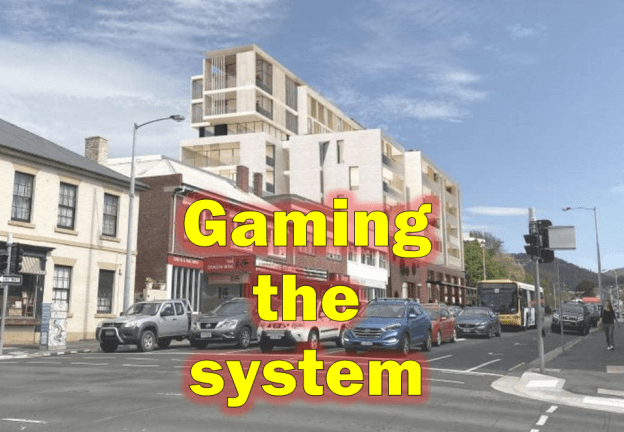
Gaming the system

When developers encounter a planning scheme with an enormous amount of discretion in the hands of planning authorities, it is not surprising to find them pushing the envelope with their proposals, relying on the fuzziness of many of the performance criteria in the planning scheme.

Take no notice of those who speak as if they regard the planning scheme as if it were an algorithm that takes the details of the proposal and spits out the single correct recommendation for approval or rejection. Doubt those who dogmatically claim that a proposal is “within the planning scheme” where any discretions are involved.

For example, a proposal could be rejected on the grounds that it has “an unacceptable impact upon residential amenity on land within a residential zone by virtue of increased noise emissions”. There is no magic formula for calculating the impact of noise, for deciding whether it is acceptable or not. Two people could legitimately disagree.

The Macquarie Street Apartments proposal rejected by Hobart City Council earlier this week was clearly a high risk proposal and the developers would have known it. It was double the height of all other buildings within hundreds of metres, and it has all the design aesthetics of a LEGO model made by a toddler.

The developers tried to game the system. They relied on the positive bias of Council staff who, believe it or not, try very hard to make proposals possible. Council staff work to find a set of conditions that makes the proposal acceptable: they very rarely fail particularly if the developer has had the good sense to discuss their proposal with the planners earlier. Only truly awful proposals are recommended for rejection!

In the system they’re trying to game, it makes sense to make the proposal an ambit claim.

Council approval would mean that the developer has what they need, and probably much more. The developer would react to Council rejection with an appeal to RMPAT where the first step is an attempted mediation. An ambit claim means they have something to give away during a negotiation. But they may still get more than they would have from a “safe” proposal at the start.

The developer does nothing illegal or unethical. The system is what it is — a structure created by government. Keep this in mind when reading or viewing material where they show surprise or disbelief that a council could possibly reject, or even question, their proposal. It is not that simple.

CBD speed limit changes symbolic

Glenorchy City Council announced last week (September 2) that it would reduce speed limits from 50kph to 40kph in some streets in the Glenorchy CBD.

According to the Council’s announcement of their decision, the primary purpose is to “increase safety for motorists and pedestrians as well as contributing to a calmer and slower environment where shoppers can relax and enjoy spending time in Glenorchy“.

But Council’s focus on speed limits bears closer examination.

If the intended aim is to slow traffic, changing speed limits appears to be a cheap option; simply install some signs. But without enforcement (which does cost), they will have little effect.

Council should have given greater consideration to traffic calming measures such as wombat crossings (we already have one in Terry Street). Council has already made a start with some traffic islands in the centre of Main Road, and planned ramps around the section outside Northgate. Traffic calming infrastructure will calm traffic 24/7, with no change to speed limits and no need for enforcement.

If the intended aim is to improve safety, Council could have made Main Road outside Northgate one-way, or even closed it off altogether. Historically, business has always claimed that removing parking outside their business will be bad for their business but most evidence refutes those claims. Read these reports from Sweden and Brisbane (Australia).

We don’t know how fast traffic travels now. Council has published no statistics. While the current speed limit is 50kph, it is very likely that little current traffic exceeds 40kph. Traffic volumes during the day already make 50kph difficult to achieve. And drivers in a CBD street are generally so focused on other traffic, finding parking spaces, noticing changes in traffic lights, and anticipating movements by pedestrians, that a speed limit sign on the roadside will not be noticed.

I did learn from the map in the Council’s announcement that there are already a couple of streets in the CBD with 40kph speed limits (note the blue streets on the map). I doubt any driver noticed. I’ve driven those streets hundreds of times over the years and I certainly didn’t. But then again, I suspect I didn’t break the speed limit.

Interested readers may wish to view a discussion by the Infrastructure Committee (starts at 27:45) of the Hobart City Council on June 24 (2020) about a proposal to reduce speed limits in Hobart. After stating the universally accepted assertion that higher speeds result in more serious accidents, he became considerably more vague repeatedly indicating that “road engineers” would know what speed would be appropriate for each street. In essence, he asserted that the slower the speed, the less serious the accident. No science!

There is a great deal of evidence that we can’t regulate our way to safety. We must design our streets to be safe. Here is just one short article illustrating that proposition.

In summary, while the speed limit changes will probably have no effect on traffic speeds, the announcement of the changes will certainly create a perception amongst the public of increased safety. And if that is the primary purpose, well and good. But let’s not kid ourselves, the changes are symbolic.

References

“The impact of lowered speed limits in urban areas”, Monash University Accident Research Centre, 2008.

Buses matter. Does Council care?

Readers may recall those Community Yarns events in 2019. During a discussion at one of those meetings I asked about the relationship between Council and Metro Tasmania. The alderman leading my group did not react well, quickly moving the discussion on. What’s going on? Just how bad or unproductive is the relationship between Council and Metro Tasmania? And why?

This is no small matter. Glenorchy is a city in which it is virtually impossible to live a full and active life without independent transport. Inadequate public transport forces many to spend limited incomes on a vehicle when they would prefer to use public transport. Those without their own vehicle have great difficulty getting around, particularly at weekends and outside normal working hours.


As the Hobart City Deal neared finalisation last November, four councils — Glenorchy, Clarence, Hobart and Kingborough — quietly made a joint public transport submission to the State government budget process. Read that submission. It very politely asks (without any obvious sense of urgency) the State Government to take three key action:

  1. Increase government spending on public transport services so Tasmania no longer has the lowest per capita expenditure in the nation, and we can achieve our aims of reducing congestion and increasing the use of public transport; and
  2. Establish a Public Transport Authority, to enable the development of coordinated, strategic public transport policy and provide support to Metro Tasmania and other contractors to increase the frequency, reliability, affordability and accessibility of buses; and
  3. Clarify responsibility, and increase funding, for bus shelters to help encourage people into public transport and ensure compliance with the Disability Discrimination Act 1992 by the deadline of 2022.

The submission calls for actions that would be dramatic and far-reaching in their effect. For example, Tasmania’s per capita spending on public transport is so low that even if it was doubled, we would still only come fifth amongst the states (ahead only of South Australia). Yes, it’s that low.

The only visible attempt to garner public support for the submission was a Bus Challenge by the mayors of Hobart and Glenorchy in February 2020. This was seen by many of the public as a month-long photo opportunity. In the post-challenge breakfast radio interview on March 5, it was revealed that in the entire month of February Kristie Johnston (Glenorchy) caught 11 buses and Anna Reynolds (Hobart) 26. Nothing was said in that interview about its true purpose.

And the public have heard absolutely nothing about bus services since, apart from Kingborough negotiating directly with the state government to come up with $3.5 million to improve bus services in their Kingborough City Deal.

Council’s half-hearted approach to the submission provides no hope to actual or potential bus travellers for any service improvement. Let us see if Council’s direct interactions with Metro provides any encouragement.


Metro is a state-owned company that delivers services under passenger transport service contracts with the Department of State Growth. Council and Metro have signed a Memorandum of Understanding (MOU) which sets out how Council and Metro will work together to deliver bus services to the community. It sets out the commitment of each party, but Council regards it as an internal document that it will not release publicly. The MOU sets out the roles and responsibilities of each party but does not create any enforceable rights.

Council claims it works with Metro in providing infrastructure that supports bus services, including bus stop infrastructure (shelters, seating etc.), footpath and crossings to support access to stops, and managing other traffic and road related issues. But the submission mentioned above says “there is currently no clear responsibility for providing and managing bus stops and shelters.”

Council has quarterly meetings with Metro to discuss matters relating to public transport. What matters?

When asked, Council did not mention any written policy or guidelines that guide its decision-making regarding public transport. It seems Council has no view on the bus services it wishes to see operating in its city – coverage, timing, frequency etc. This should not surprise since Council has never directly asked residents what public transport they want (not even at a fundamental level whether, for example, they want light rail). If Metro were to ask Council for guidance, Council could not meaningfully respond.

Research has revealed that I was not entirely correct. On the front page of the October 2012 Glenorchy Gazette we read about the submission made by the Glenorchy City Council to the Legislative Council Government Administration Committee Inquiry on Integrated Transport Options in Southern Tasmania, July 2012. We read in the gazette that

“Glenorchy City Council initiated its own community survey on Metro Tasmania services and one of the key findings was that 44.7 percent currently use the service and 61.4 percent indicated their desire to use the service more often if improvements, such as increased frequency and accessibility, were made.”

The submission provides details of the questions asked in the survey and a summary of the statistics.

Council currently says it refers major developments to Metro seeking comments on planning applications. Planning Scheme amendments that propose to re-zone large areas of land for residential use, or have potential impacts on the transport network, are also referred to Metro.

According to Metro, the MOU requests council to consult with Metro in the planning phase of new subdivisions such as Whitestone Point. Metro responds with advice as to any requirements regarding access for buses. Metro points out the major considerations as:

  • Provision of a through-route rather than a single entrance which would require a bus to turn around and ‘back-track’;
  • Sufficient width of roads to permit the safe passage of buses having regard to on-street parking;
  • Road-base to a standard that can accommodate heavy vehicle traffic – without this, Metro’s vehicles would tear ‘light-vehicle’ road base to pieces within a year of operation;
  • Provision of adequate pull-over and bus-stop space which must comply with the Disability and Discrimination legislation which limits the gradient on which a bus stop may be placed, and requires footpath, kerb and guttering.

None are relevant unless a bus route is planned for the subdivision or the subdivision affects an existing route. Metro clearly does not see potential needs for changes to route or timetabling.


Metro says it is happy to provide on-site guidance where developers choose to engage directly. In general, the additional costs associated with providing adequate infrastructure for Metro buses mean that developers often choose to not engage, thus precluding the entry of buses to their developments. However some developers have engaged with Metro and successfully extended services into their developments – an excellent example of this is on Oceana Drive (Tranmere) where the developer funded new terminus infrastructure, including a drivers’ toilet.

Planning Scheme Amendments that propose to re-zone large areas of land for residential use, or have potential impacts on the transport network, are also referred to Metro.

Finally, it might be argued that the rules under which Metro operates make Council advocacy for service changes a waste of effort. For example, Metro’s own Urban Bus Service Guidelines have as a prime objective to be “cost effective and best matched to the transport needs of the wider community within the available budget”.

Clearly Metro’s contract provides very little financial room to move; simply asking Metro to improve or change services is pointless. But Council could at least attempt to persuade major developers to discuss options with Metro. Surely the 213-residence Whitestone Point subdivision (June 2018 Planning Authority) could have justified taking that additional step.

Somewhat ironically, Errol Stewart, one of the developers, was quoted by the Glenorchy Gazette as saying:

“The site is serviced by a direct bus line to the city centre, intersected by the cycleway and is right on the doorstep of a proposed future inner-city train station, all features which will make commuting a breeze for residents regardless of their preferred mode of transport.”

https://www.glenorchygazette.com.au/helping-hobarts-housing-supply (7 August 2019)

Perhaps nothing I’ve written matters. Council has demonstrated repeatedly that it is putting all its public transport eggs in the light rail basket.

In today’s Mercury (30/8/2020) we read that “Sorell Mayor Kerry Vincent … and Clarence Mayor Doug Chipman had recently met with Infrastructure and Transport Minister Michael Ferguson to push the case for express bus services from Sorell to the city.” Other councils are taking a rather more pragmatic approach.


Refs

Metro Tasmania Act 1997

Metro Tasmania Fares Order 2016

Metro Tasmania submission to Select Committee on Greater Hobart Traffic Congestion, September 2019.

Metro Tasmania submission to Review of Tasmania’s Local Government Legislation, February 2019.

Glenorchy City Council submission to the Legislative Council Government Administration Committee Inquiry on Integrated Transport Options in Southern Tasmania, July 2012.


Hobart City Deal – progress?

If you blinked you may have missed the report buried in page 29 of the Mercury a few days ago (August 22, 2020) about the progress report from the Commonwealth Government on the Hobart City Deal.

The Mercury barely mentions public transport. But the section of the progress report that particularly interests me concerns the “Activating the Northern Suburbs Transit Corridor” in pages 17-18.

The term “Transit Corridor” has been used for so many years that many may have forgotten that it actually refers only to the Cycleway and the rail track. Main Road has not been part of the public transport conversation for years.

Once again we see much material that gives the misleading impression that the project is about urban congestion. None of the multitude of reports written about the Rail Corridor (by external consultants or any level of government) makes a credible case that light rail would ever mitigate traffic congestion. For light rail to do so would require major additional funding to move parts of the railway over or under the major thoroughfares such as Elwick Road and Albert Road.

It is really all about urban renewal but that term is buried on the second page where most would miss it. To use $25 million from an Urban Congestion Fund on a project that may well make congestion worse borders on the unethical.

The report does valiantly attempt to create the impression of activity, mentioning some documents that are new to me, with impressive titles such as Northern Suburbs Transit Corridor Precinct Plan, Northern Suburbs Transit Corridor Growth Strategy, and Northern Suburbs Transit Corridor Strategy – reports that probably do not exist.

Finally, the report makes this curious statement that the Hobart City Deal project will
“Continue to explore opportunities for a value capture framework to support potential future funding opportunities for the transport solution in the corridor.”

Even the Tasmanian Labor Party say in their public transport policy that in government they “will test the market for potential operators to run a rail service through a competitive process to facilitate private investment in the project.”

Neither major party sees the proposal as financially attractive.

Clearly every major stakeholder has come to realise that all the alleged benefits of light rail will flow to Glenorchy. State and Commonwealth governments will have learnt by now that their role is to provide funding for construction, maintenance and operation, and that finding funding elsewhere may make the project financially acceptable for them – because it isn’t now.

Glenorchy City Council CCTV a waste of money

Today, in the Moonah and Glenorchy CBDs are over 25 closed circuit TVs in public spaces, mostly on light poles. Council uses its resources to manage and maintain them with no demonstrable benefit to the community.

Funded by the Commonwealth Government, installed and maintained by the Glenorchy City Council, and used by State Police, they record movement across our city. We are all accustomed to seeing CCTV on private property, particularly in business premises, but may not have noticed them in public spaces.

After years of increasing expressions of concern about graffiti by residents and businesses, Council in December 2010 finally decided on a by-law and policy to guide how Council would deal with graffiti on council property and elsewhere in the city. There is no evidence of systematic public consultation. Eight months later in July 2011, it decided to “facilitate in conjunction with all tiers of government and local businesses, through grants, other financial assistance and in kind assistance, the installation of closed circuit TV (CCTV) in the Glenorchy CBD as a pilot project“.

The opportunity to act on that decision arrived at the end of the year when the Commonwealth Government announced the Proceeds of Crime Funding Round for 2012, with a focus on Graffiti (prevention, reduction and/or removal). At its March 2012 meeting, Council decided to take advantage of the opportunity by applying for a grant. It received $123,687 — not bad for a “pilot project”.

But it took another twelve months before Council nailed down precisely how it would evaluate or assess the “pilot”. At its 12 February 2013 meeting it refined the objectives of the pilot to be:

  • To reduce reported crime and incidents to Police;
  • To reduce reported damage and graffiti within the Glenorchy City municipality; and
  • To improve perception of safety and reduce fear of crime.

and listed nine statistics that would be collected as measures of the performance of the CCTV. Council also began to consider how the CCTV would be operated and managed, and what part it would play with crime prevention and detection strategies already in effect in Glenorchy.

The 1 September 2014 Council meeting saw answers to questions from our current Mayor (then Alderman Johnston) asking why reports, statistics, work plans and protocols had not yet appeared. Recent questions to Council revealed that Council has to this day never compiled those statistics, nor has Tasmania Police (to Council’s knowledge). Furthermore, Council has never reviewed the CCTV operation to determine whether it has achieved any of its original objectives.


What do we know of the current situation?

As far as I can tell, CCTV can now be found in these places.

  • Barry Street at entrance to Mill Lane.
  • Council Chambers roof.
  • Glenorchy Bus Mall – Main Road end and Barry Street end.
  • Northgate entrance on Main Road.
  • Moonah Car Park.
  • Moonah Post Office.
  • Main Road opposite Moonah Hotel.
  • GASP Pavilion on Wilkinsons Point.

None of the cameras are monitored; footage is downloaded if and when it is required.

The CCTV recording system operates on a 30 day rolling cycle. Only the previous 30 days of footage will be available: e.g., on day 31, it will record over day 1 of the 30day cycle.

Council’s CCTV system does not record audio; this conveniently removes any requirement to comply with the Listening Devices Act.

Council’s part in the CCTV operation appears to be to (a) house the recording equipment, (b) undertake an annual maintenance check on all CCTV equipment, (c) review CCTV footage, and (d) provide relevant footage to Tasmania Police if an incident is reported or the Police request the footage.

It is not clear whether Council has any control whatsoever over where CCTV is installed. Approval is required from TasNetworks for any installations or attachments to light poles.


But has the installed CCTV ever achieved its intended purposes? Has Council ever considered whether it does anything apart from making Glenorchy residents feel safe? Does it do even that?

As noted above, Council has never undertaken any evaluation to determine whether the CCTV operation achieved any of its original objectives.

Only Tasmania Police can tell us whether less crime is reported and vandalism has become rarer. But we read in the agenda of the November 2017 Council meeting that “formal correspondence with Tasmanian Police indicated that Police would be unwilling for operational reasons to release any data”.

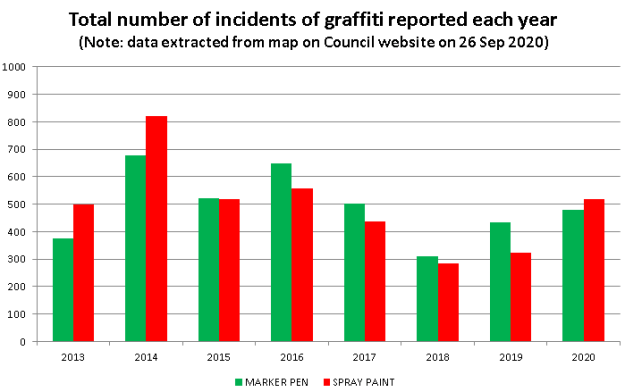
As far as graffiti is concerned, the Council map website helpfully provides a graffiti page showing historical data. Extracting the raw data gives the following graph.

There is no evidence that the CCTV operation has improved crime prevention or detection in any way, disappointing given the Police Tasmania website says that the preferred role of CCTV systems is “to prevent or reduce the opportunity for crime to occur.”

But that may not matter. If the prime objective is in fact to make people feel safer and it costs little to maintain and operate the cameras, then they should stay. Whether they in fact reduce crime would be neither here nor there. On the other hand, they may be a complete waste of money.

Towards 2040: A City of Arts – Arts and Culture Strategy Development Project

GCC today (July 28) announced a project to “develop an arts and culture strategy for the City of Glenorchy”. It is searching for a consultant capable of producing the strategy by November 20 this year within a budget of about $50,000. The closing date for quotations is August 7. Eleanor Downes, manager of the Moonah Arts Centre, is the council contact for any queries (which must be made by email).

This may well be the first step in the economic stimulus project named “Showcase” described in the council’s July 2020 quarterly report as “delivering an Arts and Culture Strategy and creative workforce hub”.

The strategy will “present outcomes that address the vision, roles and contributions of Council, arts and cultural stakeholders and other community members”.

To read the full documents, register on the Tenderlink website.

The deliverables are expected to include the following:

  • a staged plan for new and existing cultural infrastructure for the city
  • policy, plan and budget commitment for Council’s ongoing role in the delivery of events (including commercial)
  • opportunities that arts and culture offer to develop tourism in Glenorchy
  • vision, plan and ongoing budget commitment for the development, maintenance and protection of public art in the City.
  • ongoing plan for the Montrose Bay foreshore, GASP and Wilkinson’s Point areas including commitment to, plan and budget for the delivery of public art within the concept of an arts and sculpture park.

In particular, it acknowledges that selling the DEC may reduce venue for community performing arts that the DEC has offered to-date, such as eisteddfods, primary school bands, and dance groups performance. The consultant is expected to address this issue.

One of the top five priorities for the community as expressed in the GCC Community Plan 2015-2040 is to be “the hub for arts and culture in Tasmania and to forge a national and international reputation as a leading destination for arts tourism”.

Not a hub but the hub. Let’s hope that this ambitious objective was not triggered by optimism borne out of the fortuitous construction of MONA in our midst. It has done wonders for Tasmania and Hobart but we should not over-estimate what it has done for Glenorchy residents. We should leverage it’s popularity but not become dependent on it.

An Arts and Culture Strategy which does not rely on MONA is to be welcomed. All residents should take any opportunities to have their say.

Outdoor dining coming to Glenorchy

Among Council’s stimulus projects is one named “City Scape”, intended to “create a vibrant city centre for Glenorchy” – an aim I think most would support but believed would arise from the CBD Revitalisation project.

The Council’s latest Quarterly Report says that City Scape is “subject to further review by council” so it’s anybody’s guess what it will eventually look like. But Council clearly expects outdoor dining to be part of it because regulations are being prepared to allow it to happen.

On Monday (July 27, 2020) Council will decide to progress a new by-law about public spaces and infrastructure that will create “opportunities for mobile and footpath dining experiences, to enhance the cultural and social life of the municipality.”

You may wonder why a by-law is needed at all. The problem is the planning scheme. It does list uses and developments that are “exempt from requiring a permit”. But as you can see below [ref], the exemption for outdoor dining relies on Council having a by-law and a procedure for granting licences to operate outdoor dining.

“5.11.1 Use and development including outdoor dining facilities, signboards, roadside vendors and stalls which have been granted a licence under the Council’s relevant By-Law.”

Note that some other Tasmanian councils have made progress towards allowing outdoor dining. Here is a sample.

The proposed by-law will replace, simplify and update some by-laws that have already expired. Yes, they do expire. And no by-laws means no offences and no penalties, so Council is finding it difficult to regulate some aspects of public spaces. So the new by-law will also allow Council staff to more effectively manage public spaces and infrastructure.

Watch next Monday’s council meeting live on Facebook on the official council Facebook page. It is scheduled for 6pm on Monday July 27.

Read the meeting agenda and for the other documents for the meeting, such as the latest Quarterly Report which is definitely worth a look, go here.

Carried unanimously … not again!

Since the early days of the current Council, a remarkably high proportion of motions in open Council meetings have passed unanimously without questions or comment. A vote by any alderman against any motion whatsoever has become a noteworthy event. To hear an alderman speak against a motion is just as rare.

Only two issues spring to mind as triggering anything like a true debate. The first related to changing the meeting start time from 3pm to 6pm; I recall aldermen discussing this for over half an hour? The second resulted from significant public pressure for an unconditional opt-out option for FOGO.

After the dysfunction of past years, it may feel comfortable to have Council meetings with no heat, no anger, no disagreement. It may be reassuring to see efficiently run meetings. The aldermen themselves may be pleased to be on their way home early. Universal agreement (or at least consensus) on most issues might be seen by many as desirable given recent history.

On the other hand, before the pandemic people leaving Council meetings would regularly express the sentiment “Wasn’t that a waste of time?” A curious comment given they’d just witnessed an efficiently run and uneventful meeting. What else could they have wanted? And could the lack of any disagreement be a concern? What might it tell us about our council?

If the lack of discussion at Council did indeed reflect identical or similar personally-held views on every issue then Council lacks a diversity of views; that would not produce optimal or creative decision-making. That would be tragic and should discourage voters from voting for candidates as a team in future.

Realistically though, it would be truly remarkable if aldermen did not occasionally have different views. Why don’t we see those differences?

Agreement on all issues could perversely be as dysfunctional as continuous conflict if it is the result of groupthink – where individual desire for harmony or conformity overwhelms the individual desire to express their personal views. It may reflect pressures on aldermen to conform, to present an impression of unity or at least avoid any hint of disunity.

On the other hand, it may indicate that Council is simply rubberstamping results of discussion or workshops elsewhere. Aldermen have already arrived at a consensus, are all talked out, and have nothing left for the Council meeting.

Furthermore, a desire to get home early and keep the meeting short may discourage them from breaking the flow. That would be exacerbated by the scheduling of council meetings on the same day as some workshops. Aldermen may find it difficult to maintain enthusiasm at the end of a tiring day.

The Planning Authority has its own particular pressures.

First, there seems to be huge pressure to accept without question the evidence and recommendations of planning officers and other council staff. But we must keep in mind that much of the material provided by staff consists of professional opinions based on assessments of situations based on assumptions and computer models of unknown provenance and limited evidence of relevance. Aldermen should not feel uncomfortable questioning evidence and staff should not feel threatened by that questioning. Professionals in any field can arrive at different conclusions starting with the same evidence.

And the mere mention of RMPAT sends a chill through the room. Pressures to avoid the expense and resources required to deal with an appeal could easily cause self-censoring. Concerns about possible newspaper headlines describing council as “anti-development” could have the same effect.

None of these possible causes need result in misbehaviour, and this article makes no such accusations. But it’s time that aldermen showed that they have minds of their own. That is not disunity. That is not the antithesis of teamwork. The next time I hear “carried unanimously” announced with enthusiasm, I’ll scream.