When Council meets in open session next Monday (25/7/2022 agenda), it will dump two “economic recovery projects” – “Zinc Link” and “Greenshoots” – before they really started.
For residents who want to know how major council projects are going, the go-to item in Council meeting agenda is the “Capital Works Status Report”.
Normally this report simply reports. It provides informative progress reports on capital projects. But at this meeting the report recommends that two projects go no further.
In the section headed “Interest Free Loan Funded Economic Recovery Projects” you will read about projects entitled “Zinc Link” and “Greenshoots”. The penultimate paragraph says
“this report recommends that these two projects do not progress and are withdrawn from Council’s future capital works programs”
As far as Greenshoots is concerned, how quickly things changed since the last Council meeting (27/6/2022) where we were told that the project was continuing but without the proposed grant from the Tasmanian Community Fund.
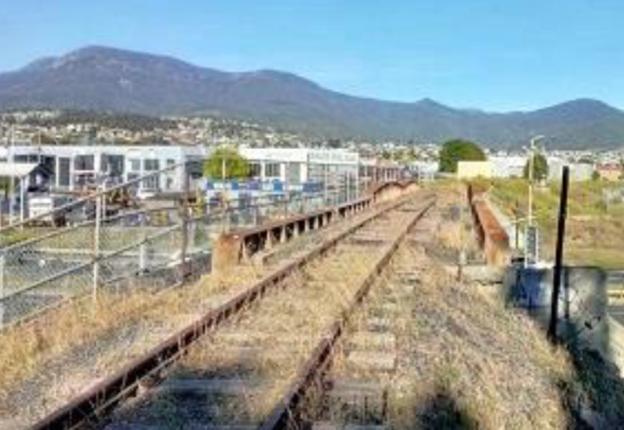
Many in Glenorchy may not be familiar with the term “Zinc Link”. It refers to a disused rail spur from Derwent Park across the Brooker Highway by bridge and on to near the Zinc Works.
If you search for “Zinc Link” in the entire Council website and all historical meeting agendas and attached reports, you will find very little.
“new gravel pathway along sections of the Zinc Link connecting the intercity cycleway to Lutana as part of stimulus measures” appears in the list of potential projects arising from the Paths, Tracks and Trails Project (open council 25 May 2020, agenda item 10).
If you drill down into the “Marine and innovation precinct” in the Economic Recovery Program page on the Council website you will see a reference to “Council investment in connecting infrastructure (the Zinc Link)”.
All versions of the “Prince of Wales Bay Marine and Innovation Master Plan” in the website mentions the Zinc Link as part of a medium term action.
Zinc Link does not appear in any list of economic recovery projects published by Council – except in the fine print of the website.
It is truly fortunate that Council borrowed only a small “interest free” five million dollar loan from the State Government, because its management of the project list (and the projects) has been opaque and uninformative.
Some modest/cheap projects on the list seem to have been successful but most will be lost in the mists of time.
Should we be nervous about the Jobs Hub – a project most would regard as relatively successful – when its continued operation depends on continued State Government grants? The subject of grant funding to 2025 is on the agenda of the closed session next Monday.
The development application (PLN-22-176) for the Claremont Hotel is creating intense argument in our city, particularly the potential extension of operating hours for Electronic Gaming Machines.
It has been interesting to see pokie-focused politicians, such as Andrew Wilkie and Kristie Johnston, weigh into the discussion.
For many years EGMs (pokies) have been rightly regarded as repugnant by the Glenorchy City Council for the harm they do to many members of the community. So it is not surprising to read Kristie’s contribution in today’s Mercury (Talking Point 9/7/2022).
Many of us recall the days when Johnston chaired many a meeting of the Glenorchy Planning Authority (GPA), and often reminded those present that the Authority must make decisions based solely on the provisions of the planning scheme. Wilkie will also be well aware of the legal situation. Johnston and Wilkie both understand that the Authority does not make political decisions; it applies the law. No amount of flag-waving or political posturing will make a jot of difference.
Some may not like the manner in which the applicant piggybacked an extension to hours onto an un-related extension to the building.
It is a classic political technique – combine a controversial change with a relatively routine change hoping that the decision-makers will feel compelled to pass the package as a whole because the procedure of excluding the controversial seems too difficult. Classic but not illegal. In this case however, the GPA could easily approve the application without approving the extension in hours.
We have also in the past seen members of the Authority worrying about the cost to Council of potential appeals against their decisions. The hotel industry would probably welcome an appeal on opening hours regarding it as a test case – so the Authority will have to be very confident in their reasons if they reject.
So it is a bit rich to have Johnston, now out of local government, overtly applying pressure on the Council to reject the application – without providing a single supporting argument that involves the planning scheme.
Johnston knows perfectly well that it is unlikely that the application breaches the planning scheme.
Sadly, for all the antipathy in the community to pokies, there appears to be no visible ongoing political campaign to change the rules. Those involved seem to wait for an event to trigger action. Such as this application.
References
Statement of Commitment on Gambling endorsed by Glenorchy City Council on 28 September 2020, Read here.
At last night’s planning authority meeting (21/3/2022), a rarely used word appeared in the agenda item (page 70) concerning the rezoning of property in Austins Ferry (PLS43A-21/03).
UV sterilizer
The word was “sterilise”. A word we associate with hand sanitizer. A word we use in relation to creatures unable to reproduce.
Let me give some context.
The application on the GPA agenda requested in part the rezoning of a land parcel from Rural Living (Zone A) to General Residential to allow a subdivision and residential development to take place. The major effect is to reduce the minimum lot size from one hectare (10,000 square metres) down to 450 square metres.
On the face of it, this seems an uncontroversial move until you learn that land on Whitestone Drive just over the hill is zoned Light Industrial.
General Residential and Light Industrial can make unhappy bedfellows – the peace and quiet preferred at home versus the noisier environment of industry. At times the relationship between residents and the nearby light industry was fraught to say the least.
Before this application, the method used to minimize potential conflict was to insert a ten metre wide strip of land zoned Open Space between the two zones. That Open Space has disappeared from the new SAP (Specific Area Plan) proposed to regulate development.
Council in the agenda argued that the previous application of the Open Space Zone would effectively “sterilise the use of the land”. And that, they say, would be a bad thing.
So what does that mean?
In general we would probably agree that the word “sterilise” means “to make sterile” but that begs the question “what does ‘sterile’ mean?”.
In our day to day conversation can mean a few things.
When referring to a person, to be sterile means “unable to have children”.
When referring to medical equipment, to be sterile means “free from living germs or microorganisms”.
When a farmer describes land as sterile, they mean “nothing will grow on that land”.
In land use management it has a more general definition. Land will be sterile with regard to various uses. There may be only one use impossible on that land or a variety of uses.
Here are some examples mentioning a broad-based sterility.
The Melbourne City Council in a planning document describes an inner-city precinct as “at risk of being sterilised by institutions. This growth needs to be balanced with a range of other uses that provide activity over a 24-hour period to create a lively and integrated knowledge precinct.”
In Western Australia, the explanatory memorandum for a piece of legislation states one of its purposes as – “Clarify the capacity of a responsible authority to acquire or purchase zoned land to avoid sterilisation of development potential.”
A report from a Queensland Floods Commission of Inquiry wrote: “The removal of buildings from the flood affected area, coupled with a moratorium on any new development, can amount to ‘sterilisation’ of the land.”
Here are a couple of references describing sterilization for a single use.
Here is an example showing sterility with regard to residential development. In New South Wales in 2021 after their major floods, the government gave “councils the power to refuse development occurring on land above the previously prescribed one-in-100 year floodline”. That was described at the time as “effectively sterilis[ing] land from residential use” (Sydney Morning Herald May 29, 2021).
Some sterilisation may result from a previous use of the land. Here is an example from the Department of Mines in Western Australia which is clearly concerned that subdivision and residential development may block any exploitation of mineral resources. They write in a planning document that it is important to avoid “unnecessary sterilisation of mineral and energy resources from incompatible land uses, such as subdivision and development proposals”.
Some forms of sterilisation are more permanent than others. Some may be reversed simply by rezoning the land.
The Essex County Council in the UK in their planning policy for minerals development helpfully defines “sterilisation” as “the term used when development or land-use changes take place which permanently prevent the extraction of mineral resources from the ground.”
In aplanning document from the Moray Council in the UK we read :- “the development must not sterilise significant workable reserves of minerals, prime quality agricultural land, or preferred areas for forestry planting.”
…
I hope you found that brief explanation interesting, for a word that most of us would think had no place in land use planning conversations.
The 2022 Tasmanian BMX championship is scheduled for a month earlier (October 21-23) with Southern City BMX as the venue – all being well. But the status of that venue is still up in the air after Glenorchy City Council discovered belatedly that the issues with the proposed new location raised the cost estimate to over triple the original estimate.
In the Mercury today (14/3/22) we read an article headed “Growth bid in BMX move”. The Tasmanian state manager for AusCycling – the national governing body for cycling in Australia – Craig Notman, appointed only last year, is quoted as saying AusCycling had “contingencies” if the Berriedale site was no longer available.
Craig may have a plan B but since the Tasmanian championship is now only six months away, I suspect he would prefer certainty concerning the Berriedale facility.
The pressure is definitely on the Glenorchy City Council to find a feasible new location for a replacement of the Berriedale track. Not only feasible from an engineering point of view but also from a funding point of view.
It may well be that any new track of a championship standard will require more funds than that set aside by Council. It would not surprise if Council were looking for other sources of funds to supplement its own resources. Given Commonwealth and State government elections this year, could Council extract a funding commitment from electioneering candidates or political parties? Will Council also work with the club to search for potential sponsors willing to provide funds in return for naming rights?
If Glenorchy cannot resolve the situation inside our city then we could see the club track, the only BMX racing track in the Hobart region, move outside the city. This potential outcome would embarrass Council, and upset members and supporters of a club who spent a great deal or time, effort and money building their Berriedale facility.
The question that Council, aldermen and staff, should answer now is: what lessons have been learnt from the BMX track saga?
Next Monday (28/2/22) Council will inevitably adopt a “Regional Sport, Recreation and Entertainment Hub Masterplan” (the “MP”). Public consultation ran through the Christmas holiday break concluding at the end of January.
“Establish Glenorchy as a regional hub for sport, recreation and entertainment Develop Glenorchy as a sport, recreation and entertainment hub for Tasmania’s southern region”.
which in June 2020, after the COVID pandemic had taken hold, was included in their list of ten economic stimulus projects.
The general public heard nothing more of this project until, like the proverbial rabbit out of a hat, ratepayers saw the draft MP in the agenda for the November 2021 Open Council meeting, a full eighteen months after the previous public mention of the project.
Those eighteen months clearly involved a great deal of activity from Council staff, aldermen, and many stakeholder groups (primarily organizations and companies operating in the geographic area covered by the MP).
Council engaged Urbis Pty Ltd as the principal consultant, while Pitt & Sherry provided traffic engineering expertise.
The draft MP described itself as “a bold and ambitious strategic tool that seeks to guide investment priorities to meet future demand and encourage a coordinated approach to Glenorchy Park in the future.”
As with most master plans, this MP has two primary purposes.
Firstly, it can function as a prospectus, the type of document that a company might use to support a fund-raising effort. That would explain the presence on every page of colour images designed to catch the eye without, in most cases, adding any useful information.
Secondly, the MP can function as a menu of funding opportunities for potential suppliers of funds, state and commonwealth governments in particular (containing a variety of supporting information such as consultant reports – always a good look – to give credence to the opportunities appearing in the menu).
But this MP has very specific third purpose, to create connections between venues in Glenorchy where none exist now or where existing connections have not been promoted or encouraged or maintained.
Damn the Brooker Highway
A primary reason for the current lack of connectivity is the presence of the Brooker Highway – constructed to provide rapid movement to and from Hobart with little thought apparently given to the way it would effectively build a wall splitting Glenorchy between the riverside and the hillside, a wall difficult or dangerous to cross on foot.
It has made pedestrian access to the riverside virtually impossible. Only the brave, foolhardy or desperate would use any pedestrian crossing near the ElwickRoad – BrookerHighway intersection.
Virtually no-one walks to the Montrose Bay Community Park. Everyone drives.
Virtually no-one walks to the MyState Arena. Everyone drives as close as possible before taking to their feet.
Virtually no-one walks to the Elwick Racecourse. Everyone drives.
Only locals walk to Giblins Reserve in Goodwood. No fancy regional playspace will change that.
It is consequently no surprise that this MP requires only two significant constructions, pedestrian overpasses crossing the Brooker Highway at the MyState Arena and the Hobart Showgrounds. Both are likely to have seven figure costs if they are to cater to all levels of personal mobility, costs that the State Government must bear since they are responsible for the Brooker Hwy. The need for those overpasses had already been noted in the Department of Infrastructure, Energy and Resources – Brooker Highway Transport Plan published in 2011 which says on page 10:
“Connectivity between suburbs separated by the Brooker will be improved, through improvements at key intersections, to improve both safe pedestrian movements and cross‐highway traffic movement. In addition, pedestrian overpasses will be Disability Discrimination Act compliant and appropriately located at key locations between intersections to maximise cross‐highway pedestrian connectivity.”
Even if the MP were to increase the connectivity between the various venues as designed, in order to achieve significant usage of that connectivity we must see people using the connections, walking to and fro.
But the predominant Glenorchy way to go somewhere is to to drive as close as possible to their destination and then walk from there. I do not mean to criticize; given the manner in which Glenorchy has expanded and poor public transport, choosing to drive is a completely logical decision to take most of the time.
Cultural change is required to make this MP work, change that is always difficult, but that is what Council hopes to achieve with this MP.
The agenda for next Monday (28/2/22) shows the Department of State Growth responding to the draft MP with the comment that “transport projects proposed within the plan do not form part of their current forward investment plans and because of their corridor or metropolitan wide impacts, would require an assessment of their relative benefits, feasibility and costs”. The State Government will take some convincing.
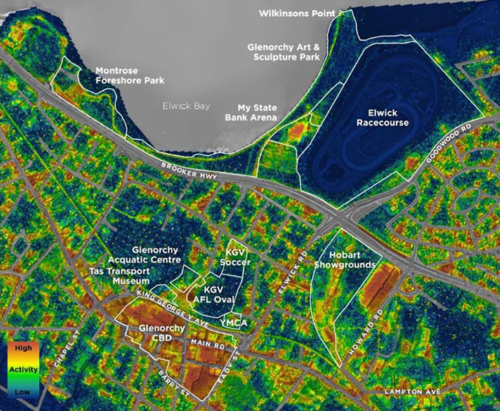
Despite a great deal of effort, funding of unknown amount, and a great deal of interesting statistical data about the movement of people and vehicles, this MP is distinctly underwhelming. Some lovely visitation heatmaps appear in the MP that essentially state the bleeding obvious (I’ve included one below). And it is not clear how all that statistical data contributed to the recommendations.
Visitation heatmap from the Masterplan (see key at bottom lefthand corner).
The residents and ratepayers of Glenorchy will take a great deal of convincing that this Masterplan will in reality change anything.
In early February 2022 I asked Council some questions about impending roadway upgrades near the top of Marys Hope Road in Rosetta.
Council has given me permission to publish here in full the questions and answers.
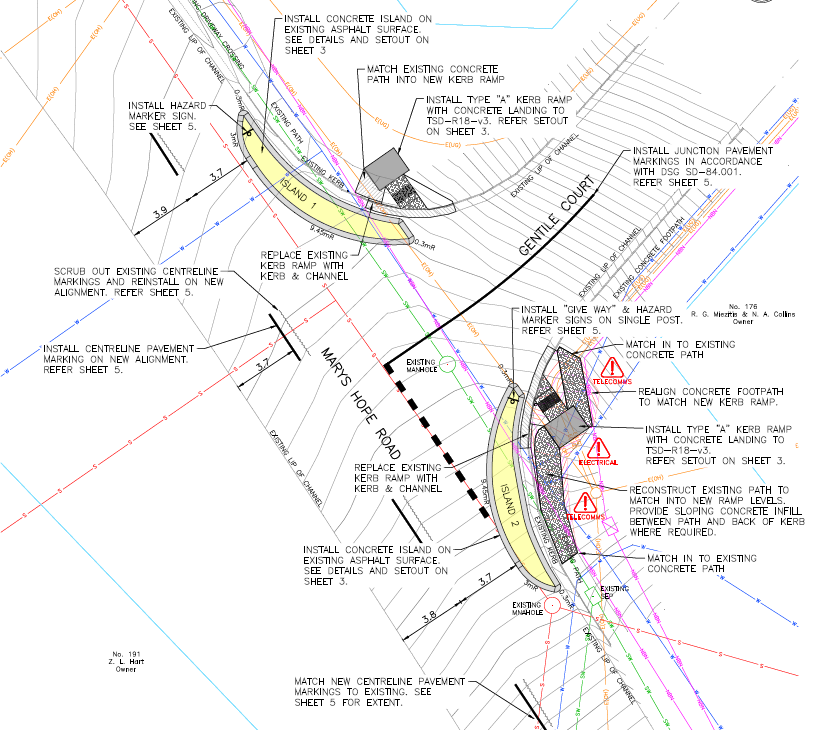
It seems that the approval of two large developments at 190 and 192 Marys Hope Road has increased the level of risk around Gentile Court so much that Council believes that a 60 km/h speed limit at that location is no longer safe. Council applied for a Black Spot Program grant for a project to prepare the nearby portion of Marys Hope Road for a reduction in speed limit. Council was successful and the tender for the roadworks at Gentile Court (and two other locations) closed at the beginning of February. You can view the drawings for the works at Gentile Court here.
Council has also helpfully provided a copy of its full submission to the Black Spot Program. Don’t worry; it’s only five pages. Council has permitted me to provide it on this website. Use this link to read the full document.
Get an insight into the Council thinking behind the project.
The questions and answers in full.
My question relates to a recent tender (contract #0869) for roadworks to be done at a number of locations in Glenorchy. One leapt off the page for me because it is not far from where I live. Titled “Marys Hope Road & Gentile Court Intersection Traffic Islands 2021/22 Blackspot Project”, it involved two small traffic islands at the intersection. Back in 2019 the advice from Council to the Planning Authority for the 190 Marys Hope Road DA was that the intersection was safe with adequate sight distances in both directions on Marys Hope Road.
Q1.Can Council please inform me why Council later submitted a request to the Black Spot Program for that location?
A. The developer of 190 Marys Hope Rod submitted a Traffic Impact Assessment which considered the safety of the intersection of Marys Hope Road and Gentile Court. It was concluded that the development would not have a detrimental effect on the safety of the intersection.
Marys Hope Road is very wide in the vicinity of this intersection and along this stretch of road which sets a road environment with a posted speed of 60km/h. Over time Council would like to reduce this speed limit due to developments in the area. However, before this can occur the road environment needs to be suitable for a 50 km/h speed limit.
To achieve this, the Black Spot project at the intersection involves the installation of kerb blisters at the intersection, as shown on the plan below. This will narrow the perception of Marys Hope Road to help reduce vehicle speeds. A similar treatment has been undertaken at the nearby intersection with Kilander Crescent. The project also has other benefits including increased sight lines at the intersection and improved pedestrian facilities. Upgraded kerb ramps will greatly improve the accessibility for pedestrians crossing Gentile Court.
Q2.Did Council have new advice? A. No
Q3.Can I please have a copy of Council’s submission? A. A copy of the report is attached.
Q4.What process does Council undertake to determine whether to submit requests to the Black Spot Program? Does it invite or accept public input?
Council reviews our road network and crash data annually to highlight any potential Black Spot projects. Black Spot projects can either be based on crash history or from a road safety audit perspective. Nominations for Black Spot locations are invited from state and territory governments, local councils, community groups, industry, and individuals.
Last night (8/11/21) the Glenorchy Planning Authority approved a massive development of social housing for North Chigwell.
Centacare Evolve Housing, the proponent of the development, have wasted an opportunity to come up with a design that would be a role model for future developments of this type.
Sad to say, it appears that the architectural firm Prime Design was given a brief to maximize the number of dwellings and minimize the construction cost.
The proposal to replace the current learning centre, contains 55 units, including ten two-storey units.
Some might say that anyone desperately needing housing should be grateful for whatever they are offered. “It’s better than living in a car or caravan.” But if built as designed, this development will be a rabbit warren of units with no facilities for the residents.
In summing up, the mayor gave the impression that the presence of the North Chigwell Soccer Ground outside the site could excuse the lack of amenity inside.
Another alderman stated that amenities were available in Claremont 2km to the north and the Chigwell Neighbourhood House 1km in the other direction in the other direction – as if that excused the lack of amenity inside. Not particularly convenient.
Some of the children living there will be able to see the soccer ground over their back fence but will have to walk half a kilometre to get there.
Adults living there will be provided with no amenities for social interaction, nothing to assist in making social connections, nothing to facilitate mutual support.
Nothing about the design will give the observer a sense of place, or give the resident a sense of belonging to a community. Might that be deliberate, an incentive for residents to explore ways to leave, to move on to affordable housing or even private housing elsewhere? That would be extremely disappointing.
Reference to the planning scheme
The development standard most relevant to my concern is 8.4.3 titled “Site coverage and private open space for all dwellings”.
The report concedes that the proposal does not satisfy the acceptable solution for this standard because ten units do not have the required minimum amount of private outdoor space.
Performance criterion P1 for that standard requires each dwelling to have enough private open space to accommodate outdoor recreation “consistent with the projected requirements of the occupants and, for multiple dwellings, take into account any common open space provided for this purpose within the development”.
I take this to mean that the more shared open space is provided for recreation, the less is required for each dwelling. And conversely, the more space is provided to each dwelling, the less is required in the form of shared recreational space.
As I understand it, there is an understanding of the total amount of recreational space required in a development, and that amount can be shared between public and private.
In this proposal we have a double whammy.
Ten units have insufficient private open space in absolute terms, and also certainly insufficient for recreation. But the residents of those units will have no shared recreational space to compensate. They lose on the private and on the public.
They would be entitled to believe they have been treated unfairly.
This is completely unacceptable and should provide sufficient cause for rejection.
In conclusion
This proposal is totally devoid of any social infrastructure, any facility for recreation or social interaction or networking. In fact it is antisocial.
Furthermore the proposal fails development standard 8.4.3. Residents of at least ten units will have insufficient private open space for recreation, and not have compensating access to public open space for recreation.
All developments of social housing in Glenorchy in recent times commit the same sin of no social amenity; examples include 190 Marys Hope Road, 79 Allunga Road (approved but not yet built), and 95 Abbotsfield Road.
An example of a seven year old development providing a dramatic contrast can be found in Hopkins Street, Moonah. Details can be found here and here.
It is time to put the “social” back into social housing.
The next Council election will take place within twelve months.
Due to the dismissal of the previous council, Glenorchy conducted its last poll almost a year before all other Tasmanian councils. The last Glenorchy City Council election was out of sync with the other councils, but the next one is to be conducted concurrently with all other Tasmanian councils in October 2022. The Local Government (Glenorchy City Council Election) Order 2018allowed for realignment to the elections schedule.
Councillors will be starting to contemplate their future. While Johnston, Stevenson, Dunsby and King came into Council fully aware of the size of the commitment (and with a public profile from the previous Council), the newbies may have been surprised by the amount of time and effort their election has generated. This was recently demonstrated by Alderman King self-nominating to replace Kristie on the Planning Authority after a deafening silence from all other aldermen.
How many will re-nominate for next year’s Council election?
Aspiring councillors will be considering their candidature and those deciding to stand will start their campaigns early.
The 2018 election saw the emergence of Team Kristie. That approach certainly succeeded with Johnston personally receiving almost 7 quotas in the alderman vote (enough to immediately bring seven other members of her team over the line, and sufficient to later bring Ryan into Council after the departure of Stevenson despite coming 23rd out of 24 candidates in the actual election).
The team strategy may not succeed again.
Despite Dunsby and King vigorously lobbying for unconditional FOGO exemptions, many in the community see the Council ensuring no signs of disunity.
Many in the community are also becoming impatient waiting for Council action on some major issues such as the decommissioning of the Tolosa Reservoir. Council does risk ending its term being perceived as a manufacturer of master plans, very expensive to implement and totally dependent on other levels of government for implementation.
Council has gained some kudos for most of its work helping Glenorchy businesses and ratepayers cope with the COVID-19 pandemic, although many of the economic recovery projects seem rather insubstantial (and Cityscape which will take half the $5m loan from the State Government will result in yet another master plan).
The overall public impression is of a Council with a focus on master plans but apparently without an ability to make incremental change. The big bang rather than smaller steps.
This Council’s term is five years. But it was not until Kristie’s departure that aldermen appear to have become more willing to share personal views and interests. Some aldermen have since displayed something of their personality, and their individual strengths, policies and interests.
Current councillors hoping for re-election would do well to find ways to differentiate themselves from each other and new contenders, to highlight their personal strengths and policies. They have twelve months to do so.
Today 8/9/2021 Council called for tenders to provide it with “an updated long-term waste strategy that will provide the basis for a decision in respect of the future of the Jackson Street Landfill site operation”. You can read the initial tender document here.
The timing seems odd since Council decided at its March 2021 Council meeting to award the contract for design and construction of the landfill extension to the company Downer EDI. Read about it on the Jackson Street landfill website. According to the Winter edition of Our Glenorchy (page 2) work should be starting about now. (By the way, naming the editions after seasons means I don’t know when the Winter edition was actually published. In any case, what stops the Council from informing the public immediately after the decision is made?)
According to today’s tender, the project is required to “assist Council in its long-term strategic decision-making framework for the most efficient and effective waste management service for the Glenorchy community and will set down a preferred direction to manage waste after the current landfill site reaches capacity.”
Council wants the project to deliver a strategy that addresses these questions.
1. What investment should be made in the existing site to extend its viable economic life as far as possible and enable its continued operation as a landfill?
2. Should Council invest in the existing site to redevelop it and provide a Waste Transfer Facility at the landfill site orconsider the establishment of a regional Waste Transfer Station at the Lutana site in Glenorchy?
3. Should Council join or partner with an existing (or potentially future) joint local authority to satisfy the municipality’s waste disposal needs?
4. Should Council divest itself of direct service delivery and rely on the waste management and disposal facilities of other councils (e.g. kerbside collection diverted directly to another council’s or joint authority waste transfer or disposal facility)?
Council expects the project to deliver a detailed comparative cost/benefit and feasibility analysis for three solutions in addition to the no change scenario (i.e. continued operation of the Jackson Street Landfill).
The questions to be considered have major and long-term consequences. Has Council stopped or suspended work on the landfill extension?
Council expects the entire project to take up to six months. Tenders close in four weeks i.e. Wednesday October 6.
It was reported at the February 2022 Open Council meeting that “Construction has commenced on the $2.9m Jackson Street Landfill extension project, to construct a new landfill cell which will extend the life of the facility by over a decade.
Next Monday (agenda p15+) Council will consider whether to dump the proposal for a regional playspace at Montrose Bay, and upgrade Giblin Reserve in Goodwood to a “regional” playspace.
Back in September last year (agenda p15) Council removed many components from both original playspace designs to reduce cost.
Montrose playspace
Village Green
Removed hard standing, power outlets and minor landscaping
Labyrinth
Removed
Dog Park
Removed
Future artwork
Removed
Forest Play
Ropes Removed
Giblins playspace
Cableway (Flying Fox)
Removed with the installation of a dual cable way (flying fox) at Montrose
Sensory Walkway
Removed
Intergenerational Future
Removed
Dog Park
Removed
But that was not enough. After Council saw the only complying tender response, they consulted a quantity surveyor for independent estimates of the work. Their report clearly indicated how optimistic Council had been with cost estimates. It makes one wonder what circumstances make Council decide to call in a quantity surveyor for a project?
Many organizations have used the pandemic as their default explanation for any problem since it started. But it’s hard to see how Council can explain away this schemozzle with COVID.
The recommendation for agenda item 10 is to try to divert all remaining funding to give the Giblin Reserve a super-upgrade to “regional” status.
While the first reaction of the very active Goodwood Community Centre might be great excitement about upgraded facilities, they should consider how the location might change as a result.
Car parking at Giblin, already less than Montrose, could become chaotic with playspace visitors competing with users of the boat ramp. Any overflow will go to Gepp Parade and Howard Road, roadways lined with residences. One virtue of Montrose is its separation from residential buildings by the Brooker Highway.
In arguing for the recommendation, Council for the first time treats traffic safety at the Montrose entrance as a serious issue. Curiously, despite the parking issues, it argues that Giblin traffic will be safer.
Finally, we are told that the draft Playspace Strategy currently open for public consultation has identified that two regionally significant playspaces so close together in Glenorchy “may constitute an oversupply”; let me know if you can find the reference. Curiously though, it does suggest the development of a regional playspace in the Tolosa Park Reserve.
The reader should recall that the original grant was a mere two million. Given that Council felt the need to immediately top that up with another 1.4 million, what did Council seriously expect to achieve with the original two million?
Council has three basic options on Monday – focus on Montrose Bay, focus on Giblins Reserve, dump the whole idea of a “regionally significant playspace” and use the $1.4 million for something else. It will be extremely interesting to see the discussion in Council.
Fingers crossed on Tolosa Park, another complex and large project coming soon!