In the COVID pandemic we saw an amazing variety of activities described as essential, why not the Mercury newspaper? It is after all regarded in Tasmania as a newspaper of record.
All levels of government need the Mercury to do their job. Tasmanian law often specifies the use of newspapers for public announcements – sometimes daily newspapers circulating in the area, region or municipality, sometimes local newspapers circulating in the region, locality or municipality, sometimes newspapers circulating in Tasmania, sometimes any newspaper.
And we the public need it. Even if we personally don’t subscribe, we all benefit from journalism of local and state government matters that Mercury journalists do – investigative or otherwise. We may use national and international sources for our news but they are unlikely to take any interest in “our” news.
Circulation of the printed Mercury had been steadily decreasing until 2018 when News Corp, its owner, stopped participating in the Audited Media Association of Australia. It’s probably fair to assume the decline has continued without losses fully covered by online subscriptions.
The Mercury is a regional newspaper and is not immune from the same commercial pressures as others interstate. The current pandemic dramatically increases those pressures. We have seen many regional newspapers in Australia shut up shop during the pandemic and many may not revive afterward.
So it is not at all fanciful to ask the question: how would southern Tasmania cope without the Mercury? With great difficulty, I suspect.
While the Tasmanian Government Gazette may suffice for public announcements and notices, no journalism takes place there. Journalism is not part of its purpose. There is no analysis, no explanation, no background.
Southern local free newspapers such as the Eastern Shore Sun, Glenorchy Gazette, Hobart Observer, Tasman Gazette, and Derwent Valley Gazette cannot step into the journalistic breech because they are monthly which is much too infrequent. Most importantly, they are all owned and published by public relations companies (Font PR and Cor Comms) who presumably see them as a potential tool for their business, and are unlikely to undertake investigations which may scare off those who supply the advertising they need. The Kingborough Chronicle and Huon News are privately owned but are also monthly.
I’ve found only two Tasmanian sites which appear to provide a broad range of news and also claim journalistic expertise – the Tasmanian Times and the Tasmanian Inquirer. Neither appears to have the resources for investigative journalism.
A democracy cannot function well without an informed public. Many of the public have already stopped receiving their news from newspapers. Despite that, every member of the public who wants to participate in our democracy should be able to be informed without payment. While printed newspapers can be read in libraries (while not closed during a pandemic), more and more news web sites can be read only by subscribers.
There must be no financial impediment to being informed.
This is no trivial matter. Does any level of government in Tasmania have a Plan B if it goes bust? Do we, the public, have a realistic alternative to the Mercury for current information about our community?
PS. dateline July 15, 2020. The company FontPR has added to its stable of regional newspapers by purchasing Tasmanian Country from News Corp. Read a detailed report here.
PPS. dateline September 2, 2025. In the USA many local governments have a list of publications they regard as their “newspapers of note” where they publish public notices. With the demise of many local newspapers there is increasing concern about how to keep the public informed. Read this article to learn more.
Others who have lived in Glenorchy much longer than I might recall swimming off a jetty at the Grove Reserve.
Recent plans to develop the DEC precinct and enhance the Montrose Bay Reserve could change the face of Elwick Bay dramatically – at least on land.
The government has for many years advised us not to eat any fish caught in the bay (pollution). It has also advised us not to swim in it – particularly after rain (stormwater).
The zinc smelter at Lutana and the paper mill at Boyer discharged heavy metal contamination into the Derwent estuary for many years. Even though both have dramatically reduced their emissions, and Council has installed many litter traps on stormwater outlets, it may never be safe to swim in Elwick Bay again.
But that should not mean that the river can play no part in any development plans apart from being a scenic backdrop and something to travel on.
Despite the presence of the Derwent, no water-based features appear in the Kestelman proposal for Wilkinsons Point. And a suggestion of something in or beside the river, or any water-based feature in the new “playspace” at Montrose Bay drew a very negative reaction at the public consultation morning at Montrose Bay.
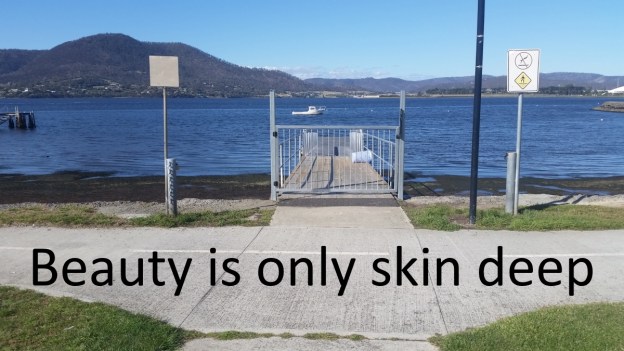
In fact, the jetty and pontoon at Montrose Bay actively discourage public access to the water – a “keep off” sign on the jetty and an equally ineffectual locked gate on the pontoon.
It’s no trivial matter using the river. As GASP CEO Frances Butler wrote on April 27:
“The bay is a very different matter and is not Council’s jurisdiction. Any installation in the water or encroachment into or over it (for instance the cantilever of the Wilkinsons Pt Pavilion) requires a Crown Lease. This means doing anything water-based is quite complex and requires very careful management – it’s a sensitive environment that we don’t wish to damage. We also need to take into account the effect of wash from the MONA ferry and future sea level changes and local area inundation due to climate change. That said, I am very keen for some water-based projects, funding and Crown permission permitting.”
It’s a tragedy that people going to Montrose Bay on a hot summer’s day cannot use water, either in the river or out, to cool down.
Tourists who travel along the river between MONA and Hobart will marvel at the landscape but would be aghast to learn that it is not healthy to go into it. Its beauty is only skin deep.
POSTSCRIPT: The first draft plan for the Montrose Bay Playspace (public comment closed June 2020) did include a tiny water feature called Water Play that features “interactive pumps, runnels and sluice gates in a creek-like setting.” It seems very small and designed for children to paddle, utterly useless for adults.
Off-street car parks are not the sole domain of vehicles but are shared with drivers, passengers and other pedestrians travelling across the car park. But the dangerous example in the featured image for this post shows that the Glenorchy Interim Planning Scheme 2015 (GIPS) fails to adequately cater for the safety of pedestrians in off-street car parks.
GIPS should be modified to explicitly and adequately provide for pedestrian safety. This document suggests how GIPS might be changed to avoid bad design in future. Council should then develop design guidelines for car parks to help architects to produce plans satisfying GIPS.
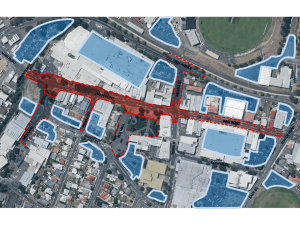
This is no trivial matter – the following map shows CBD off-street car parks in light blue. A great deal of effort has been applied to improving (revitalizing) a portion of the CBD but car parks (where most visitors first alight from their vehicles) are not addressed. Improving car park safety and amenity would complement the work being done on or near main road.
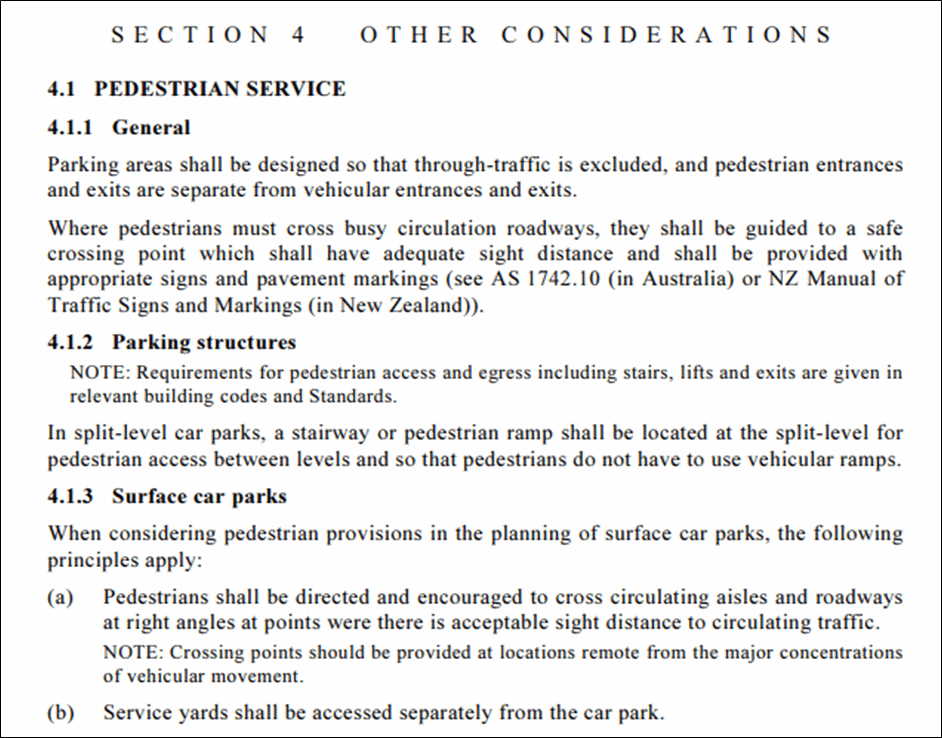
GIPS does not directly address the safety of pedestrians in car parks. It does so indirectly by referring to Australian Standards AS2890.1:2004 (part 1) regarding off-street car parking but in a cursory fashion, as you can see below.
It’s clear that it is virtually impossible for the GPA to reject a DA for inadequate pedestrian safety.
The standard “AS1428.1 – Design for Access and Mobility” is also referenced by GIPS. It provides very little content relating to safety of pedestrians which is rather surprising given its purpose.
I believe that the emphasis must shift towards the quality rather than the quantity of parking. And this should occur not only in the CBD but throughout the city.
Other jurisdictions have developed their own design guidelines that take pedestrian safety much more seriously. I’ve listed some at the end of this document.
The changes to GIPS should not have any retrospective effect on existing car parks. I would however certainly hope that council would encourage businesses in the CBD to consider improving their parks as an off-shoot of the CBD Revitalization Project. That project should not only consider Main Road; it should also consider the role the off-street parking plays in city life.
Although Glenorchy has no multi-level car parks, new provisions should be sufficiently general to apply to any car park – surface, underground or multi-level.
And they should also apply to dwellings as well as business; although the simplicity and small size of their parking generally allows direct access to the building and they almost always have a separate entrance and path from the street.
The planning scheme guides the assessment of development applications. The purpose of the Parking and Access Code says:
E6.1.1
The purpose of this provision is to: (a) ensure safe and efficient access to the road network for all users, including drivers, passengers, pedestrians and cyclists; (b) ensure enough parking is provided for a use or development to meet the reasonable requirements of users, including people with disabilities; (c) ensure sufficient parking is provided on site to minimise on-street parking and maximise the efficiency of the road network; (d) ensure parking areas are designed and located in conformity with recognised standards to enable safe, easy and efficient use and contribute to the creation of vibrant and liveable places; (e) ensure access and parking areas are designed and located to be safe for users by minimising the potential for conflicts involving pedestrians, cyclists and vehicles; and by reducing opportunities for crime or anti-social behaviour; (f) ensure that vehicle access and parking areas do not adversely impact on amenity, site characteristics or hazards; (g) recognise the complementary use and benefit of public transport and non-motorised modes of transport such as bicycles and walking; (h) provide for safe servicing of use or development by commercial vehicles.
As you can see, the word “safe” appears four times. Pedestrians are mentioned twice. Unfortunately, it becomes very clear as one reads the Use and Development Standards that pedestrian safety plays second fiddle to the safety and efficient operation of vehicles.
I believe the safety of pedestrians in car parks requires specific mention as a new Use Standard. Existing Use Standards should also ensure that their provisions do not adversely impact pedestrian safety.
Suggested changes to the Planning Scheme
B4.1 Planning Terms and Definitions
Define the term “pedestrian” to mean “a person not in a vehicle including being on foot or in a wheelchair”.
E6.1 Purpose (Parking and Access Code)
E6.1.1 already contains the purpose “(e) ensure access and parking areas are designed and located to be safe for users by minimising the potential for conflicts involving pedestrians, cyclists and vehicles; and by reducing opportunities for crime or anti-social behaviour;” which seems to be sufficient.
E6.6 Use Standards (Parking and Access Code)
E6.6.1 Number of car parking spaces
Add this exception to A1: “(iii) the number specified cannot be provided without adversely impacting the safety of pedestrians.“
Add the following performance criterion to P1: “(n) whether the provision of the parking spaces will adversely impact the safety of pedestrians.“
E6.6.2 Number of accessible car parking spaces
Add this requirement to A1: “(d) not seriously adversely impact the safety of pedestrians.“
E6.6.3 Number of motor cycle parking spaces
Add requirement to A1: “The number of spaces allocated must not seriously adversely impact the safety of pedestrians.“
Add performance criterion to P1: “(e) whether the provision of the parking spaces will adversely impact the safety of pedestrians.“
E6.6.4 Number of bicycle parking spaces
Additional requirement for A1: “The number of spaces allocated must not seriously adversely impact the safety of pedestrians.“
Additional performance criterion for P1: “(d) whether the provision of the parking spaces will adversely impact the safety of pedestrians.“
E6.6.5 Pedestrian safety – a new Use Standard
Objective
Acceptable Solutions A1 No acceptable solution.
Performance Criteria
To ensure that: (a) pedestrians can move safely between any parking space and any facility on site; (b) pedestrians can move safely from any street entrance to any facility on site.
P1 (a) Provide pedestrians with a separate entrance from the street into the car park. (b) Provide pedestrians with a clear and direct link, including a dedicated pedestrian path, from each street entrance into each car parking area. (c) Provide pedestrians a clear and direct link, including a dedicated pedestrian path, from each car parking area to each building entry. (d) Minimize visual obstructions in parking areas for both vehicles and pedestrians. (e) Provide passive surveillance of parking areas and pedestrian paths by ensuring they are not out of public view. (f) Provide adequate lighting throughout parking areas and to pedestrian paths for night safety within the car park and passive surveillance. (g) Minimize potential conflict with traffic by minimizing distance any pedestrian path travels across traffic aisles. (h) Where practicable, provide shade areas for vehicles and pedestrians. (i) All pedestrian paths and ramps shall:
Have a minimum width of 1000mm;
Have a non-slip finish;
Not be steep (ramp grades between 1:20 and 1:14 are preferred);
Comply with AS 1428.1 – Design for Access and Mobility; and
Comply with AS 1428.2 – Standards for blind people or people with vision impairment.
Conclusion
The planning scheme and other regulations used to assess development applications clearly provide a much greater emphasis on vehicle safety than on pedestrian safety. Dangerous car park design exists. It should not be allowed to happen again.
Improving the safety and amenity of off-street car parks would make a visit to the CBD more inviting and complement the work being done on and near main road in the Revitalization project.
I urge council to redress this imbalance by pursuing appropriate changes to the planning scheme (or through any other mechanism that might achieve the same purpose).
Now that light rail has made its way into the draft Hobart City Deal in early 2019, and council has committed ten million dollars as seed money, we must take a closer look at “light rail”.
There is clearly considerable support for the idea of light rail. Many can recall using passenger trains in their younger days and wonder why they cannot be revived. And many others have walked or ridden along the cycle path, seen a slowly rusting railway line, and thought “What a waste! Why not make it useful? How hard can it be?”
So when the Mercury Newspaper (November 16, 2016) in a public survey asks voters the leading question “Do you think that Hobart needs a light rail system?“, it is not at all surprising that 62 percent said yes. On the other hand, almost 40 percent said no or didn’t care.
Even 30 percent of respondents in Burnie and Launceston answered yes to the question! What do they know of the Hobart/Glenorchy transport situation? They clearly support the idea of light rail. The idea! It is the idea that is emotionally appealing.
Suppose now that the survey provided the information that the light rail is likely to cost at least 200 million dollars. That was the value of a light rail project the state government submitted in 2017 to Infrastructure Australia for inclusion in it’s Priority List. By the way, it didn’t make it.
This number of dollars should focus the mind. It raises thoughts of money, how the project might affect you. The amount to build it, to run it, to travel on it. It raises questions of whether the light rail is worth that amount of money, whether fares should cover the cost of operation, whether there will be sufficient demand to achieve financial objectives.
The Hobart Northern Suburbs Railway Rail Action Group has played a leading role advocating for light rail. Ben Johnston, president of that group since its inception, has just resigned from that position due to work commitments. In his resignation post on the group’s Facebook page he laments about “politicians apparently passionate about the rail project prior to election, only to find they’re less enthusiastic once in Government.” That may simply be a result of being confronted by the difficulty of justifying the expense of construction and operation when you are in a position to actually make a decision.
What makes current discussions about light rail more frustrating is the secrecy behind the Hobart City Deal. The public has not seen the deal. The public has not seen any detail on the transport link proposal included in the deal.
Since we have yet to see any detailed design for an actual project, let me try to imagine some basic requirements assuming the current rail track is used and railway stations from the past are used again. These are my thoughts. If you imagine differently, share your thoughts by commenting on this post.
1. It will take a service of at least four trains an hour each way to persuade people to use it and the service must run seven days a week and run well into the night to allow people to use it for sporting or social activities.
2. To make sure the rail service can stick to its timetable, automatic traffic lights and boom gates will be required at every railway crossing giving priority to the rail service. They will stop the traffic for a minute every eight minutes. Imagine that at high volume thoroughfares such as Albert Road, Hopkins Street, Derwent Park Road, Lampton Avenue, and, worst of all, Elwick Road.
3. There will be a “station” at each stop with a platform on each side of the line. Absolute minimum facilities might be seating, all-weather shelter, good lighting, and a panic button to use in an emergency.
4. Some new tracks will be laid in passing loops located to allow trains to pass and allow a two-way service.
5. A service to Hobart will require a terminus in the Hobart CBD so people don’t need to walk far.
Council must think strategically and plan for the long-term. But it must also bring city residents along. It must show residents how they will benefit from their plans.
It must explain to residents why light rail will not follow the same path as the Derwent Entertainment Centre, why it will not become a service never making a profit and requiring a permanent subsidy. All the studies I’ve read use modelling to try to predict how many passengers we can expect. That modelling is based on a large number of debatable assumptions.
A final note on funding. It may be easy for the Glenorchy City Council to lobby for light rail. The high capital cost of construction will almost certainly be borne by the Federal Government, The cost of operation and maintenance, assuming that Metro Tasmania becomes the operator, will be largely borne by the State Government. The Council hopes to reap the benefits of an increased rate base resulting from infill development in the rail corridor at minimal cost to itself.
The light rail proposal is a risky proposal involving a very large investment. We need to be shown why we should accept that risk.
References
Many reports have been produced over the years. The list below does not include every report. It is a collection of the most significant (in my opinion).
What does council do that affects ratepayers more than anything else? That affects them more often than any other issue?
Rubbish. Yes, rubbish. Or more precisely, making it possible for ratepayers to get rid of stuff – green stuff, glass stuff, plastic stuff, paper and cardboard stuff, stuff that is broken or unusable, stuff that is simply not needed or wanted any more – all sorts of stuff.
Most ratepayers interact with council every two weeks, when bins are emptied.
Stop a ratepayer in the street. Write a post in Facebook. If you want to get maximum response, don’t talk about rates, simply mention either the tip or the emptying of the bins. You will trigger an avalanche of complaints and suggestions.
Even if the original item wasn’t about rubbish, responses will rapidly wander from the original topic to any and all aspects of rubbish.
Why does collection cost so much? Why does using the tip cost so much, or more than other tips? Why can’t bins be emptied more often, say weekly? Why can’t we have an annual collection of big waste, such as furniture, like other councils? Why do I have to go all the way to the tip to recycle or dispose of stuff? Why can’t there be recycling stations across the city? Why can’t we have a “general & green waste free entry weekend” in January like Hobart? Why should I pay so much to go to the tip when I already pay so much in rates?
The lesson for council is that while some will obsess over rates, some will obsess over the sale (or not) of the DEC, everyone at least once a fortnight thinks about stuff and how council helps (or not) in disposing of or recycling it.
Absolutely everyone has rubbish, absolutely everyone needs a way to get rid of it. It is personal.
The Jackston Street Tip will fill up and our rubbish will start to end up somewhere outside Glenorchy (maybe Copping). Council and its ratepayers will need to adjust.
Council must work very hard to clearly explain how things will work after the Jackson Street Tip closes, all the various actions they will take to make it happen, and why. Statements like “We all need to be responsible waste managers – individuals, households, business, and Council” are not enough even if absolutely true – rubbish is personal and gets emotional reactions. Pure logic will not suffice.
We are accustomed to reading in our newspaper for calls to improve our roads whenever there is a particularly horrific accident involving death. The media always appears to scan the local population and locate a person who is quoted as saying that the location of the accident is a black spot that has needed repair or upgrade for years. Motoring organizations are often asked for an opinion and invariably make a statement that implies that the road design or driving surface were in some way substandard or inadequate.
Our roads and highways are becoming smoother and straighter. Our vehicles more often provide cruise control, and are becoming quieter (virtually silent in electric vehicles). The driver’s focus can easily move to what is inside the vehicle: their phone, iPod, or passengers. Reduced attention is almost inevitable.
This obsession with the quality of our roads and highways is misguided.
Better infrastructure encourages the public to take more risks since they perceive those risks to be lower. While risk-taking may in many other contexts help with personal development, it should not be encouraged in situations that may quickly become uncontrollable and life-threatening.
But better infrastructure also has the effect of making it more difficult for the driver to maintain a sufficient focus on what is happening outside the vehicle. This can result in complacency, but most often plain inattention. Not surprisingly, this is the most common cause of accidents on the road, bar none. The driver is distracted, and does not become aware of a potential problem while there is still time to avoid it. If the ultimate objective is to reduce accidents then the focus should be on assisting drivers to maintain their concentration and respect for the road conditions.
I advocate the deliberate introduction of defects and other devices to deliberately disrupt the driving experience. Defects might be very shallow potholes, and variations in the smoothness of the road surface. Disruptive devices might include coloured markers, possibly raised, to give tactile and visual feedback. They could also be speed limit signs placed at random locations, not only where the speed limit changes.
This disruption should be introduced into our driving infrastructure located at random intervals. A further refinement might be to move the defects or devices regularly so that drivers do not become accustomed to their location.
In our state Tasmania, a rough strip has been placed on the verges of many stretches of highway to alert drivers with a loud noise when they are in danger of leaving the road. This action reflects an acknowledgement by the road management authorities that drivers need help. My suggestion simply takes the rough verges to a more comprehensive solution.
Safe driving relies on the driver giving their driving the attention it deserves. The construction of more perfect roadways and vehicles inhibits this. The introduction of random disruption is one way to assist the driver (and the other occupants of the vehicle) to give the the driving process the attention it deserves, and survive their trip unscathed.




 Glenorchy City Observer