
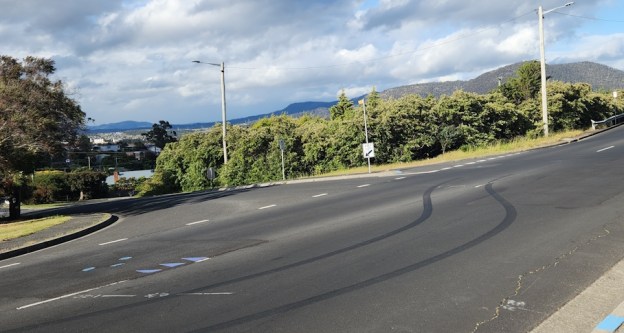
Marys Hope Road in Rosetta is very hospitable to drivers with a 1,000 metre sweeping bend coming from the crest down to Crosby Road. It is wide. It has generous sight lines to allow drivers to see far ahead. The road surface is mostly excellent. Very few vehicles park on the roadside because most adjacent properties have generous parking space. So it should not surprise the reader to learn that traffic statistics for May 2025 show that three out of every four vehicles travelling on Marys Hope Road break the current 50kph speed limit.
It is not however hospitable to pedestrians. There are stretches on both sides without footpaths. Anyone walking between Main Road and the crest of Marys Hope Road will cross the roadway at some point, taking great care to avoid traffic.
You will see few children walking to or from Rosetta Primary School because most parents do not regard Marys Hope Road as sufficiently safe for children to walk unaccompanied.
The location most regard as highest risk is the intersection of Marys Hope Road and Crosby Road and nearby streets. Most walkers needing to cross Marys Hope Road during their walk will probably do so at or near the intersection.
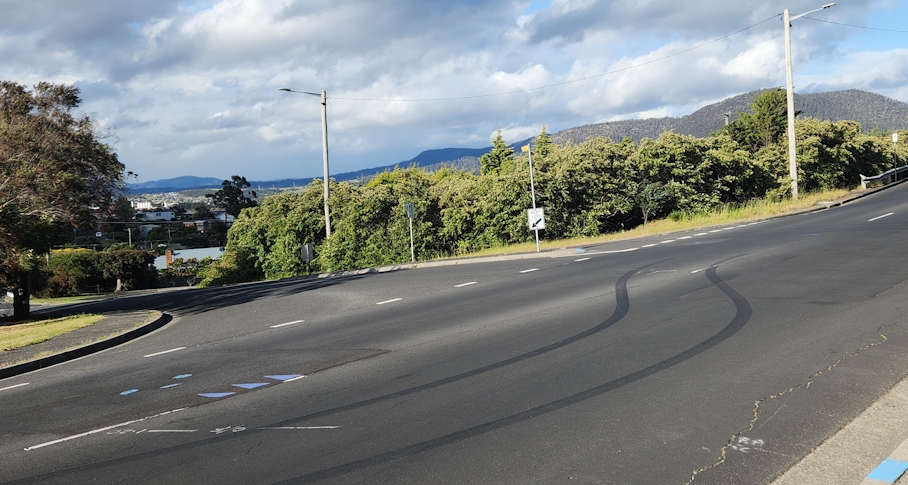
So that is where the rest of this article will focus.
Traffic speed
The reputation of Marys Hope Road as a roadway where drivers feel comfortable breaking the speed limit is well deserved, and they often do so inadvertently.
Council has generously provided traffic statistics for May 2025 (and for February 2020 before the speed limit was reduced from 60 to 50). Click here to view the data. Council’s decision to reduce the speed limit from 60 to 50 has, believe it or not, not reduced the average speed by 10kph. In fact, the percentage of vehicles breaking the speed limit has increased from 61% to 77%.
Lack of safety for pedestrians crossing Marys Hope Road
In March 2025 I raised with Council (using the SnapSendSolve app) my concern for pedestrians walking down or crossing Marys Hope Road. Here is their response.
“Thank you for raising the issue of pedestrians needing to cross Marys Hope Road due to the lack of a footpath on the southern side of the road.
We are aware of this and have on our program of works for our design area to look at a solution. However, instead of having pedestrians cross on Marys Hope Road twice, being either side of where there is no footpath, we are likely to investigate a crossing on Crosby Road. This would mean that pedestrians on the southern side of Marys Hope Road would divert to Crosby Road and then through Crosby Court. An image is below of the proposed route in blue.”
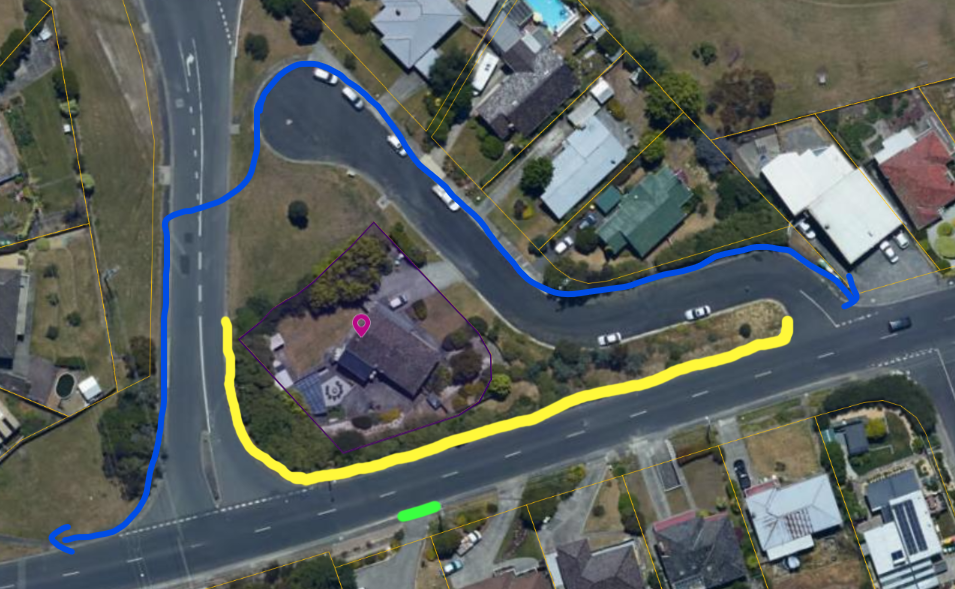
While their suggestion at first glance appears reasonable, the alternative route is unlikely to improve the situation.
- Not only does the detour add distance to the walk (increase from 160m to 230m) , it takes the pedestrian left into Crosby down a slope and back up a short steep slope to Marys Hope. A slope steep enough to discourage anyone with mobility issues.
- The detour could be used by walkers now but is not. Walkers are willing to accept the greater risk in crossing Marys Hope rather than the additional distance and effort in the alternative. If walkers found the alternative acceptable they would use it now. They don’t.
- People walking to the bus stop next to the shop will regularly walk on the road along the yellow line because it is the shortest route. The quality of bus services is such that they dare not risk a half-hour wait for the next bus.
Driveway with safety issues
One driveway entrance forces anyone with a mobility issue to walk on the roadway. The Australian standard AS2890.1 provides guidelines for off-street parking design. In particular, it specifies for “access driveways near property boundaries” a “maximum gradient across property lines is 1 in 20 (5%)”.
And if the single footpath is blocked, the pedestrian is forced onto the roadway. Once there they have traffic approaching from behind.
Here is an image of a recent situation. The driveway I’ve mentioned above is in the foreground of the photograph.

The Australian Government has for years run an annual grant program, the Black Spots Program (BSP), designed to improve road safety across Australia. Anyone (even me personally) can nominate a place as a Black Spot. But in the Tasmanian context, unless a nomination is made or directly supported by the local council, it has little chance of success.
According to the guidelines a Black Spot is “an area or stretch of road where serious crashes have occurred, or are at risk of occurring.”
While the eligibility criteria refer to “a proven history of casualty crashes”, they also
“recognise that there are road locations that could be considered as ‘accidents waiting to happen’. Therefore, some program funds may be used to treat sites where road traffic engineers have completed a Road Safety Audit or Safe Systems Assessment or equivalent report, and found that remedial work is necessary. This allows an opportunity for proactive safety works to be undertaken before casualties occur.”
Pedestrians are barely mentioned in the documentation relating to the Black Spot Program. The emphasis is clearly on the danger to those in vehicles, not those hit by the vehicles. But the situation I’ve described above contains the greatest risk to those walking along and across the roadway.
I believe there is sufficient evidence to make a good case for a formal safety assessment of that intersection as a first stop toward nomination for the Black Spot Program.
 Glenorchy City Observer