Tag Archives: housing

Mandatory off-street parking requirements more trouble than they’re worth

Tomorrow (10/11/2025) I will attend a meeting of the Glenorchy Planning Authority (GPA), a meeting with exactly one item on the agenda.

An item I find utterly exasperating.

An item necessary because the building in question, according to planning rules,  has too few parking spaces for its use.

An item necessary despite no response from any member of the public when the Development Application (DA) was advertised in the Mercury.

An item necessary because no Council staff member has the power to “determine applications with residential car parking discretions” (full list of delegations). Hence the Planning Authority must decide the matter.

But the situation arises originally because the Tasmanian Planning Scheme (TPS) contains an algorithm for calculating the minimum amount of off-street parking required for the use to which the site will be put. If the amount of parking in a DA is not at least as much as the algorithm says, the DA does not have an “acceptable” parking solution and must be assessed against the “performance criteria”. Take a look at the algorithm and the table C2.1 it refers to; they both fit on only eight A4 pages.

The Parking Plan

What is remarkably timely about this particular DA is its timing. It comes while council staff are preparing a Parking Plan for the city of Glenorchy, a plan which is intended to “override the number of car parking spaces specified in the planning scheme and reduce car parking numbers in specific areas.”

Council employed GHD, an international consultancy, to “determine and summarise potential adjustments to minimum car parking rates for development applications within key areas of the Glenorchy LGA that may be applied in a Parking Plan for the municipality” and provide a report to council on the results. You can read the 12 August 2025 version of the GHD report on Minimum Parking Rates.

The GHD report states “evidence does not support a minimum parking requirement” and consequently shows, in order from most effective to least effective) options as:

  1. Removal of car parking minimum rates
  2. Partial removal by-location of car parking minimum rates
  3. Partial removal by location and size of development
  4. Reduction in minimum-parking rates (by location and/or use class)
  5. Adopt widely accepted rates where appropriate

What is particularly disturbing about the first draft of the parking plan is that it adopts, without any explanation, the option GHD regards as the least effective, option 5, “Adopt widely accepted rates where appropriate”. The result was a decrease across the board of about twenty percent.

The first draft plan, if adopted essentially as is, would not improve the situation. The item on tomorrow’s planning authority agenda would still come to the GPA for decision.

We heard at the parking plan workshop that council were being encouraged to “be brave” in their decision-making. I hope that council will do so, change its mind, and accept the consultant’s number one recommendation to reduce minimum off-street parking requirements by 100% ….. all the way to zero.

Do we need another Whitestone Point?

Council owns the property at 261 Main Road, Austins Ferry, a property known in the past as “Nortonville”. While its total area is just over eight hectares, only 7.14 hectares is available for development.

It is one of the largest remaining parcels of undeveloped land inside the Urban Growth Boundary that is owned by Council and potentially suitable for residential development.

Council has designated a large part of the property an “Off-Lead Dog Exercise Area” and given it the name “Austins Ferry Park”. Regularly mowed but certainly not developed!

In March 2022, Council decided to begin an investigation to determine whether it is suitable for disposal.

In parallel with that process, it has worked to “clean up” the land to remove any impediments to disposal. According to the minutes of July 2024 Council,

“Council has undertaken a contamination report on the land. All contaminated soil has now been removed from site and awaiting written confirmation. An in-ground fuel tank has been removed and the site remediated.”

The same minutes state

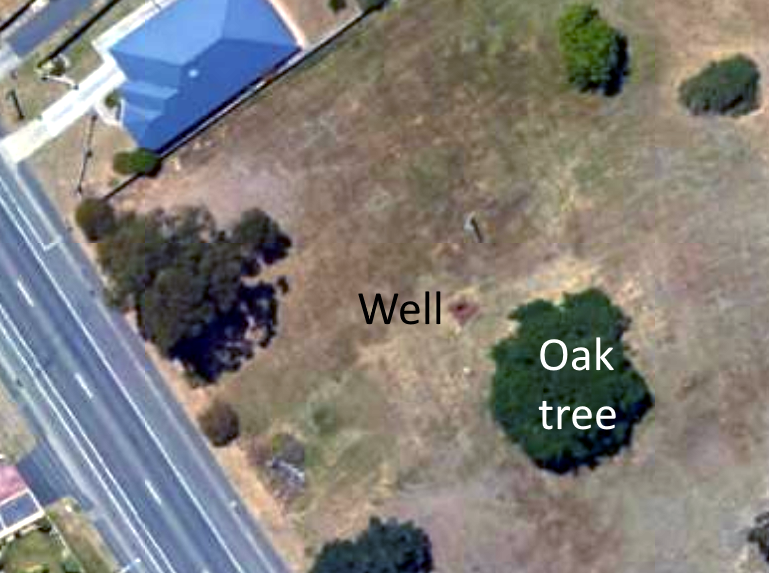
“potential heritage values at the 261 Main Road site (a well, an oak tree and possible structural remains) which means the site warrants further investigation for listing as a ‘Place of Archaeological Potential’.”

Aerial photo of western corner of 261 Main Road, Austins Ferry. 2024.

According to the Council’s 2009-2010 Annual Report, Council had asked its Heritage Officer to investigate a water well on the property as a “potential heritage site”. The well is currently covered for public safety (the image for this post shows the wire and plastic webbing used). Underneath is a circular well lined with dry stone, about a metre across and less than two metres deep. I couldn’t find the “possible structural remains”.

But even if the well and tree were found to require protection, their location in the far western corner would only slightly reduce the land area available for development.

So an investigation apparently did begin 15 years ago. According to a recent email from Council, the current investigation is being carried out by external experts and is expected to be finished in the first quarter of 2025.


But what is a ‘Place of Archaeological Potential’ and what are the consequences of a declaration?

The State Planning Provisions contains a Local Historic Heritage Code. Its purpose is to “recognise and protect the local historic heritage significance of local places, precincts, landscapes and areas of archaeological potential”.

It defines Place of Archaeological Potential as:

“a place that is a site, precinct or parcel of land that has been identified as having the potential to contain archaeological evidence that provides information about the past and is:
(a) shown on an overlay map in the relevant Local Provisions Schedule; and
(b) listed and identified in the places or precincts of archaeological potential list in the relevant Local Provisions Schedule.”

Note that the Code does not apply to Aboriginal heritage values.

Glenorchy’s Local Provisions Schedule contains a list entitled “GLE-Table C6.4 Places or Precincts of Archaeological Potential”. You can read that list through this link.

Top of the current list is the “Ashburton farm complex”. Much of the land it contains is in the old Claremont Primary School site where a permit for a major residential development was granted by Council in April 2021. So being declared a Place of Archaeological Potential does not preclude even major development on a site.


According to the March 2022 Open Council agenda 261 Main Road is a “very large, 7.14-hectare block which is zoned as a combination of Light Industrial 58%, Open Space 24%, General Residential 11%, Rural Living (Zone A) 7%.”

At that meeting Council decided to “authorise a community engagement process to be undertaken to identify any community concerns about the potential disposal” of the property. This in line with Council’s policy on Disposal of Council Land.

That decision was the result of a “strategic review of land suitable for disposal for housing” by Council officers.

The agenda described the property as “land with potential for significant multiple dwelling housing developments and are considered priority potential sites for increasing the supply of land for housing.”

The report goes to state that Council will soon start “preliminary public consultation process to identify any significant concerns about the potential sale” of that land.

Council’s own Statement of Commitment on Housing (adopted 30 January 2023) lists actions Council intends to take. The last says Council will “release surplus Council owned land to increase residential land supply for housing.” There is no evidence that Council has considered the property for residential development of any sort or in fact regards it as surplus.

Given the current housing crisis, it would be a tragedy if 261 Main Road were to become another Whitestone Point, another large residential subdivision to be sold as a commercial development. Half of the property slopes down to the river with fantastic views over the river. Too good for social or affordable housing? It would be tempting for Council to “land bank” the property to maximize its return on disposal.

It is hard to understand why Council has never shown visible signs of urgency in putting the property to a useful purpose. Perhaps we will see some movement after Council receives the report from the investigation into the heritage values of the property early this year.


Sources

May 2023 Council agenda (page 22).

How the Vinnies Project in Mill Lane slipped under the radar

On 23 September 2024 St Vincent de Paul Society Tasmania published a media release proudly announcing that construction is set to begin on its new, state-of-the-art southern base at Mill Lane in Glenorchy. Their new base will consolidate many existing functions into a single location, allowing greater efficiency in service delivery.

I have no quarrel with the sensible and worthwhile project. In fact, I wanted to know more about it. It was harder than I expected.

I first searched the agendas of all Planning Authority meetings that I could find online. Nothing there.

Some Council staff have delegations allowing them to deal with development applications in certain circumstances. Council publishes quarterly reports in its website that list approvals made under delegation. I searched them all. The closest match I could find was “PLN-23-264” described as “Alteration to Community Building” at “8 Mill Lane Glenorchy”, approved on 26 March 2024. The description was surprisingly uninformative for what has turned out to be a major construction project, not simply what most would regard as a renovation.

Now I had a Development Application and an application number “PLN-23-264”.

I searched the Mercury and found that the DA had been advertised on 6 March 2024. The description there – “Demolition, Addition and Alteration works to the existing building” – was different but no more informative, and certainly text which would not draw attention.

But wait, there’s more.

I googled the DA number in the entire Council website. It surfaced in the agenda of the 15 April 2024 Glenorchy Planning Authority Meeting in an item entitled “Planning Scheme Amendment Request – Mill Lane Rezoning” with number “PLAM-23/04”.

The effect of the planning scheme amendment was to label some land as the “Mill Lane Precinct”, rezone the land in it, and create a Mill Lane Specific Area Plan tweaking planning scheme controls over development on that land.

Buried in the 15 page report accompanying that item was this paragraph:

“A planning application PLN-23-264 was approved recently for sites at 8 and 12 Mill Lane, Glenorchy for a mixed-use development. The approval is related to existing uses and development to allow additions and alterations to the existing buildings to allow St Vincent De Paul Society (Vinnies) distribution centre with associated storage space (Storage use class), reconfiguration of existing Tas Textiles light manufacturing facility for textile knitting, sewing, and embroidery (Manufacturing and Processing use class), St Vincent Industries for cutting and production of rags (Manufacturing and Processing use class), subservient retail outlet shops for Vinnies and TasTextiles that would be open to the public, and a small scale catering/takeaway service for Loui’s Van Kitchen (Food Services use class). The planning permit has not yet been acted upon. The proposed planning scheme amendment will support the existing approved uses and development under PLN-23-264.”

Read the last sentence. The true purpose of the planning scheme amendment started to emerge.

More searching revealed a reference to Mill Lane in the Greater Glenorchy Plan (GGP) adopted by Council back in February 2021. The Council car park at 9–11 Mill Lane was said to be suited to infill residential development, but not number 8 over the road. So the planning scheme amendment had nothing to do with the GGP.

That planning authority meeting approved the next step in the process which was public consultation of the proposal. The documents provided to the public are still available on the council website.

Public consultation included a “Community Information Sesson” at a King George V meeting room on 3 October 2023 ostensibly to get feedback from the public on the proposal. Most attendees had difficulty discerning the actual purpose of the proposal. They regarded the Mill Lane situation as stable – long-term occupants with no plans for significant change. Major change seemed unlikely. The proposal seemed of little value. Much was made of its “strategic” nature. Much was made of the potential for apartment living. But the significance of Vinnies in the proposal was not mentioned.

Throughout the entire process, Council appeared reluctant to reveal to the public the underlying purpose of the proposal which was clearly not strategic.

All the information about the development application and related planning scheme amendment give a strong impression of an effort to expedite a Vinnies proposal with no fuss and minimal visibility.

The lack of transparency in this situation worries me. While the objectives of Vinnies are laudable and would be supported by most of the public, a lack of transparency in other circumstances might not be so benign. And while Council may not have deliberately obscured the underlying purpose of the planning scheme amendment, perception matters.