Others who have lived in Glenorchy much longer than I might recall swimming off a jetty at the Grove Reserve.
Recent plans to develop the DEC precinct and enhance the Montrose Bay Reserve could change the face of Elwick Bay dramatically – at least on land.
The government has for many years advised us not to eat any fish caught in the bay (pollution). It has also advised us not to swim in it – particularly after rain (stormwater).
The zinc smelter at Lutana and the paper mill at Boyer discharged heavy metal contamination into the Derwent estuary for many years. Even though both have dramatically reduced their emissions, and Council has installed many litter traps on stormwater outlets, it may never be safe to swim in Elwick Bay again.
But that should not mean that the river can play no part in any development plans apart from being a scenic backdrop and something to travel on.
Despite the presence of the Derwent, no water-based features appear in the Kestelman proposal for Wilkinsons Point. And a suggestion of something in or beside the river, or any water-based feature in the new “playspace” at Montrose Bay drew a very negative reaction at the public consultation morning at Montrose Bay.
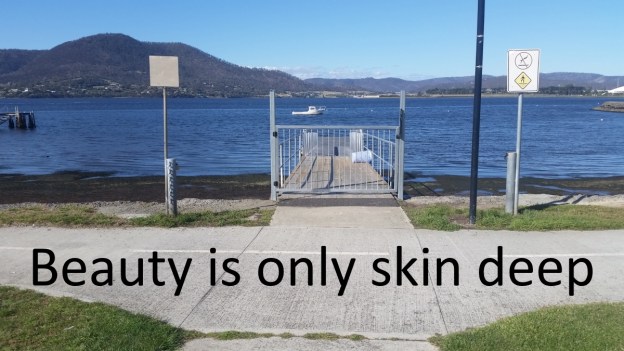
In fact, the jetty and pontoon at Montrose Bay actively discourage public access to the water – a “keep off” sign on the jetty and an equally ineffectual locked gate on the pontoon.
It’s no trivial matter using the river. As GASP CEO Frances Butler wrote on April 27:
“The bay is a very different matter and is not Council’s jurisdiction. Any installation in the water or encroachment into or over it (for instance the cantilever of the Wilkinsons Pt Pavilion) requires a Crown Lease. This means doing anything water-based is quite complex and requires very careful management – it’s a sensitive environment that we don’t wish to damage. We also need to take into account the effect of wash from the MONA ferry and future sea level changes and local area inundation due to climate change. That said, I am very keen for some water-based projects, funding and Crown permission permitting.”
It’s a tragedy that people going to Montrose Bay on a hot summer’s day cannot use water, either in the river or out, to cool down.
Tourists who travel along the river between MONA and Hobart will marvel at the landscape but would be aghast to learn that it is not healthy to go into it. Its beauty is only skin deep.
POSTSCRIPT: The first draft plan for the Montrose Bay Playspace (public comment closed June 2020) did include a tiny water feature called Water Play that features “interactive pumps, runnels and sluice gates in a creek-like setting.” It seems very small and designed for children to paddle, utterly useless for adults.
Off-street car parks are not the sole domain of vehicles but are shared with drivers, passengers and other pedestrians travelling across the car park. But the dangerous example in the featured image for this post shows that the Glenorchy Interim Planning Scheme 2015 (GIPS) fails to adequately cater for the safety of pedestrians in off-street car parks.
GIPS should be modified to explicitly and adequately provide for pedestrian safety. This document suggests how GIPS might be changed to avoid bad design in future. Council should then develop design guidelines for car parks to help architects to produce plans satisfying GIPS.
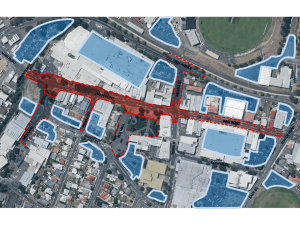
This is no trivial matter – the following map shows CBD off-street car parks in light blue. A great deal of effort has been applied to improving (revitalizing) a portion of the CBD but car parks (where most visitors first alight from their vehicles) are not addressed. Improving car park safety and amenity would complement the work being done on or near main road.
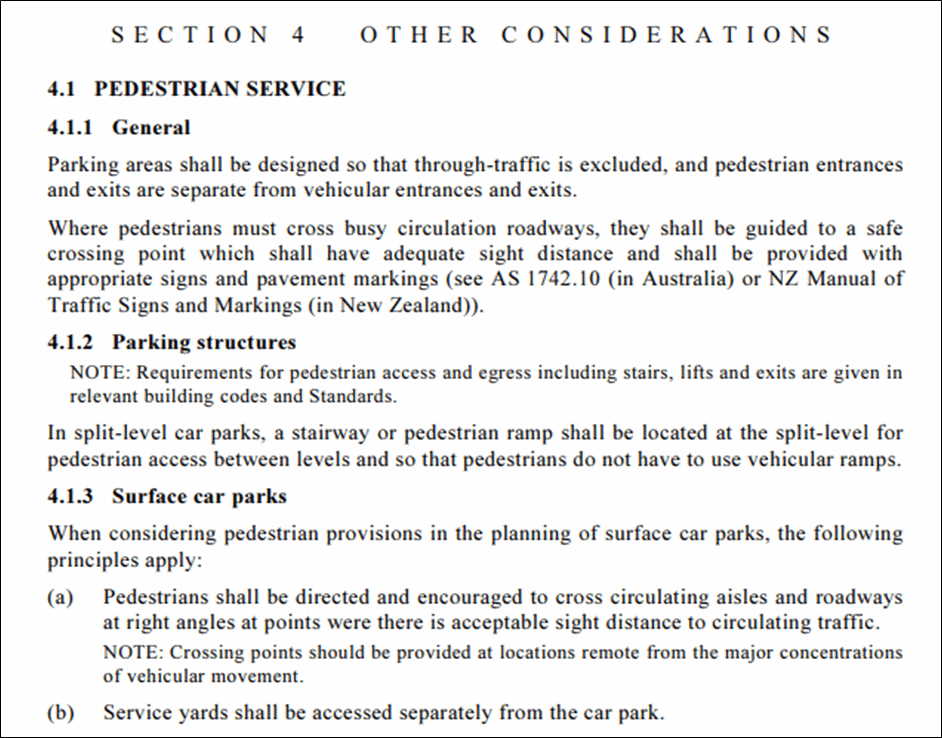
GIPS does not directly address the safety of pedestrians in car parks. It does so indirectly by referring to Australian Standards AS2890.1:2004 (part 1) regarding off-street car parking but in a cursory fashion, as you can see below.
It’s clear that it is virtually impossible for the GPA to reject a DA for inadequate pedestrian safety.
The standard “AS1428.1 – Design for Access and Mobility” is also referenced by GIPS. It provides very little content relating to safety of pedestrians which is rather surprising given its purpose.
I believe that the emphasis must shift towards the quality rather than the quantity of parking. And this should occur not only in the CBD but throughout the city.
Other jurisdictions have developed their own design guidelines that take pedestrian safety much more seriously. I’ve listed some at the end of this document.
The changes to GIPS should not have any retrospective effect on existing car parks. I would however certainly hope that council would encourage businesses in the CBD to consider improving their parks as an off-shoot of the CBD Revitalization Project. That project should not only consider Main Road; it should also consider the role the off-street parking plays in city life.
Although Glenorchy has no multi-level car parks, new provisions should be sufficiently general to apply to any car park – surface, underground or multi-level.
And they should also apply to dwellings as well as business; although the simplicity and small size of their parking generally allows direct access to the building and they almost always have a separate entrance and path from the street.
The planning scheme guides the assessment of development applications. The purpose of the Parking and Access Code says:
E6.1.1
The purpose of this provision is to: (a) ensure safe and efficient access to the road network for all users, including drivers, passengers, pedestrians and cyclists; (b) ensure enough parking is provided for a use or development to meet the reasonable requirements of users, including people with disabilities; (c) ensure sufficient parking is provided on site to minimise on-street parking and maximise the efficiency of the road network; (d) ensure parking areas are designed and located in conformity with recognised standards to enable safe, easy and efficient use and contribute to the creation of vibrant and liveable places; (e) ensure access and parking areas are designed and located to be safe for users by minimising the potential for conflicts involving pedestrians, cyclists and vehicles; and by reducing opportunities for crime or anti-social behaviour; (f) ensure that vehicle access and parking areas do not adversely impact on amenity, site characteristics or hazards; (g) recognise the complementary use and benefit of public transport and non-motorised modes of transport such as bicycles and walking; (h) provide for safe servicing of use or development by commercial vehicles.
As you can see, the word “safe” appears four times. Pedestrians are mentioned twice. Unfortunately, it becomes very clear as one reads the Use and Development Standards that pedestrian safety plays second fiddle to the safety and efficient operation of vehicles.
I believe the safety of pedestrians in car parks requires specific mention as a new Use Standard. Existing Use Standards should also ensure that their provisions do not adversely impact pedestrian safety.
Suggested changes to the Planning Scheme
B4.1 Planning Terms and Definitions
Define the term “pedestrian” to mean “a person not in a vehicle including being on foot or in a wheelchair”.
E6.1 Purpose (Parking and Access Code)
E6.1.1 already contains the purpose “(e) ensure access and parking areas are designed and located to be safe for users by minimising the potential for conflicts involving pedestrians, cyclists and vehicles; and by reducing opportunities for crime or anti-social behaviour;” which seems to be sufficient.
E6.6 Use Standards (Parking and Access Code)
E6.6.1 Number of car parking spaces
Add this exception to A1: “(iii) the number specified cannot be provided without adversely impacting the safety of pedestrians.“
Add the following performance criterion to P1: “(n) whether the provision of the parking spaces will adversely impact the safety of pedestrians.“
E6.6.2 Number of accessible car parking spaces
Add this requirement to A1: “(d) not seriously adversely impact the safety of pedestrians.“
E6.6.3 Number of motor cycle parking spaces
Add requirement to A1: “The number of spaces allocated must not seriously adversely impact the safety of pedestrians.“
Add performance criterion to P1: “(e) whether the provision of the parking spaces will adversely impact the safety of pedestrians.“
E6.6.4 Number of bicycle parking spaces
Additional requirement for A1: “The number of spaces allocated must not seriously adversely impact the safety of pedestrians.“
Additional performance criterion for P1: “(d) whether the provision of the parking spaces will adversely impact the safety of pedestrians.“
E6.6.5 Pedestrian safety – a new Use Standard
Objective
Acceptable Solutions A1 No acceptable solution.
Performance Criteria
To ensure that: (a) pedestrians can move safely between any parking space and any facility on site; (b) pedestrians can move safely from any street entrance to any facility on site.
P1 (a) Provide pedestrians with a separate entrance from the street into the car park. (b) Provide pedestrians with a clear and direct link, including a dedicated pedestrian path, from each street entrance into each car parking area. (c) Provide pedestrians a clear and direct link, including a dedicated pedestrian path, from each car parking area to each building entry. (d) Minimize visual obstructions in parking areas for both vehicles and pedestrians. (e) Provide passive surveillance of parking areas and pedestrian paths by ensuring they are not out of public view. (f) Provide adequate lighting throughout parking areas and to pedestrian paths for night safety within the car park and passive surveillance. (g) Minimize potential conflict with traffic by minimizing distance any pedestrian path travels across traffic aisles. (h) Where practicable, provide shade areas for vehicles and pedestrians. (i) All pedestrian paths and ramps shall:
Have a minimum width of 1000mm;
Have a non-slip finish;
Not be steep (ramp grades between 1:20 and 1:14 are preferred);
Comply with AS 1428.1 – Design for Access and Mobility; and
Comply with AS 1428.2 – Standards for blind people or people with vision impairment.
Conclusion
The planning scheme and other regulations used to assess development applications clearly provide a much greater emphasis on vehicle safety than on pedestrian safety. Dangerous car park design exists. It should not be allowed to happen again.
Improving the safety and amenity of off-street car parks would make a visit to the CBD more inviting and complement the work being done on and near main road in the Revitalization project.
I urge council to redress this imbalance by pursuing appropriate changes to the planning scheme (or through any other mechanism that might achieve the same purpose).


 Glenorchy City Observer