
Next Monday (28/2/22) Council will inevitably adopt a “Regional Sport, Recreation and Entertainment Hub Masterplan” (the “MP”). Public consultation ran through the Christmas holiday break concluding at the end of January.
The genesis of this most recent of Council master plans was as the following line item in the Glenorchy Economic Development Strategy 2020 – 2025 (approved by Council in February 2020)
“Establish Glenorchy as a regional hub for sport, recreation and entertainment
Develop Glenorchy as a sport, recreation and entertainment hub for Tasmania’s southern region”.
which in June 2020, after the COVID pandemic had taken hold, was included in their list of ten economic stimulus projects.
The general public heard nothing more of this project until, like the proverbial rabbit out of a hat, ratepayers saw the draft MP in the agenda for the November 2021 Open Council meeting, a full eighteen months after the previous public mention of the project.
Those eighteen months clearly involved a great deal of activity from Council staff, aldermen, and many stakeholder groups (primarily organizations and companies operating in the geographic area covered by the MP).
Council engaged Urbis Pty Ltd as the principal consultant, while Pitt & Sherry provided traffic engineering expertise.

The draft MP described itself as “a bold and ambitious strategic tool that seeks to guide investment priorities to meet future demand and encourage a coordinated approach to Glenorchy Park in the future.”
As with most master plans, this MP has two primary purposes.
Firstly, it can function as a prospectus, the type of document that a company might use to support a fund-raising effort. That would explain the presence on every page of colour images designed to catch the eye without, in most cases, adding any useful information.
Secondly, the MP can function as a menu of funding opportunities for potential suppliers of funds, state and commonwealth governments in particular (containing a variety of supporting information such as consultant reports – always a good look – to give credence to the opportunities appearing in the menu).
But this MP has very specific third purpose, to create connections between venues in Glenorchy where none exist now or where existing connections have not been promoted or encouraged or maintained.
Damn the Brooker Highway
A primary reason for the current lack of connectivity is the presence of the Brooker Highway – constructed to provide rapid movement to and from Hobart with little thought apparently given to the way it would effectively build a wall splitting Glenorchy between the riverside and the hillside, a wall difficult or dangerous to cross on foot.
It has made pedestrian access to the riverside virtually impossible. Only the brave, foolhardy or desperate would use any pedestrian crossing near the ElwickRoad – BrookerHighway intersection.
Virtually no-one walks to the Montrose Bay Community Park. Everyone drives.
Virtually no-one walks to the MyState Arena. Everyone drives as close as possible before taking to their feet.
Virtually no-one walks to the Elwick Racecourse. Everyone drives.
Only locals walk to Giblins Reserve in Goodwood. No fancy regional playspace will change that.
It is consequently no surprise that this MP requires only two significant constructions, pedestrian overpasses crossing the Brooker Highway at the MyState Arena and the Hobart Showgrounds. Both are likely to have seven figure costs if they are to cater to all levels of personal mobility, costs that the State Government must bear since they are responsible for the Brooker Hwy. The need for those overpasses had already been noted in the Department of Infrastructure, Energy and Resources – Brooker Highway Transport Plan published in 2011 which says on page 10:
“Connectivity between suburbs separated by the Brooker will be improved, through improvements at key intersections, to improve both safe pedestrian movements and cross‐highway traffic movement. In addition, pedestrian overpasses will be Disability Discrimination Act compliant and appropriately located at key locations between intersections to maximise cross‐highway pedestrian connectivity.”
Even if the MP were to increase the connectivity between the various venues as designed, in order to achieve significant usage of that connectivity we must see people using the connections, walking to and fro.
But the predominant Glenorchy way to go somewhere is to to drive as close as possible to their destination and then walk from there. I do not mean to criticize; given the manner in which Glenorchy has expanded and poor public transport, choosing to drive is a completely logical decision to take most of the time.
Cultural change is required to make this MP work, change that is always difficult, but that is what Council hopes to achieve with this MP.
The agenda for next Monday (28/2/22) shows the Department of State Growth responding to the draft MP with the comment that “transport projects proposed within the plan do not form part of their current forward investment plans and because of their corridor or metropolitan wide impacts, would require an assessment of their relative benefits, feasibility and costs”. The State Government will take some convincing.
Despite a great deal of effort, funding of unknown amount, and a great deal of interesting statistical data about the movement of people and vehicles, this MP is distinctly underwhelming. Some lovely visitation heatmaps appear in the MP that essentially state the bleeding obvious (I’ve included one below). And it is not clear how all that statistical data contributed to the recommendations.
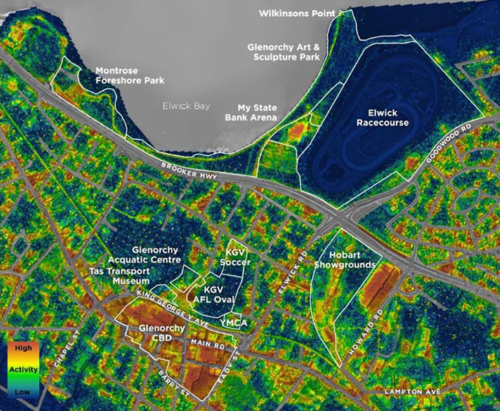
The residents and ratepayers of Glenorchy will take a great deal of convincing that this Masterplan will in reality change anything.
 Glenorchy City Observer
There’s a simple answer to this ‘pie in the sky’ – it won’t change a bleeding thing! To try and connect any part of the waterfront to Glenorchy proper is throwing money away. We used to walk to Montrose Bay but not any more – I still consider I’m too young to die yet.