
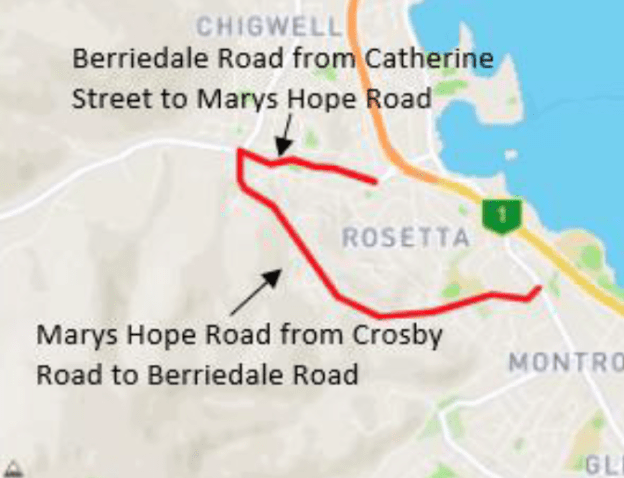
At about 11pm on 25 July 2023, a crash involving two cars and a telegraph pole took place in Marys Hope Road 25 metres from my home. Both cars were seriously damaged. The power pole was pulled out of the ground and left suspended in the air between the poles on either side. Police, ambulance, and a fire engine attended. Tasnetworks worked through the night to finally restore power by sunrise.
This crash reminded me of the many other occasions when we have heard or seen vehicles speeding up or down the road, and how every time it happened we wondered what could be done to stop it happening (or at least make it less frequent).
I’d noticed speed humps in Katoomba Crescent in Rosetta. Another flat top road hump in Nathan St, Berriedale. I’d noticed broader flat speed humps at Cornelian Bay near the waterfront.
Request to Council
So I emailed council asking that they consider modifying Marys Hope Road with some sort of traffic calming like speed humps (narrow or broad and flat) to make it very difficult or uncomfortable for drivers to speed.
The response very politely explained why that was never going to happen, primarily because Marys Hope Road is a collector road, and secondly because Council relies absolutely on external funding to construct traffic calming.
It also mentioned that Council was within the month going to put out proposals for speed limit reductions for public consultation – including one for Marys Hope Road. But its effect would be to reduce the speed limit and change some speed limit signs. No mention of road calming.
Which brings me to Council’s current Traffic Calming Devices policy. The emails from Council hadn’t mentioned this policy, and when I read it, I could see why.
The first version of this policy was adopted in 2016. We are now on version three. There was no public consultation for any version of this policy. According to the agenda item for its first review in 2019 the reason is that the “policy itself provides for a four-week period of community consultation wherever it is proposed to install traffic calming devices in a street.”
Yes – public consultation for a speed hump.
Council undertakes most roadworks with no public consultation. Council determines which locations it will propose for Black Spot grants. The public has no say. Council spent more than a quarter of a million dollars on a 300 metre footpath from the cycleway to the Granada opposite MONA (almost a thousand dollars per metre) without public consultation.
Why is traffic calming treated differently? So differently that the policy dictates that the decision to construct traffic calming must be decided by the councillors around the table (if it gets over all the other hurdles placed in its way by the policy). Yes, a proposal for a speed hump must come to an Open Council meeting.
Council makes difficult decisions, financial and otherwise. It can apparently disband an entire economic development team but cannot decide to build a speed hump without asking the public.
It is disappointing in this case to see Council apparently granting more importance to the occasional complaint from the public experiencing some minor inconvenience through being unable to travel at their desired speed – than to public safety.
In fact, the primary purpose of Council’s Traffic Calming Devices policy appears to be to make it more difficult to implement traffic calming. The policy in a section “Background” is completely negative about traffic calming. The entire document seems to obsess over “hooning”.
It claims to provide “a policy position and to develop a consistent and practical approach in the management of road humps and other traffic calming devices”. What it actually does is discourage residents from bothering Council with requests for traffic calming (and encourage them to take their hooning complaints elsewhere).
Council needs to decide whether the proposed changes to speed limits are simply to remove an anomaly on the speed limit map OR to actually reduce traffic speed and improve safety.
If council is serious about safety on the roads, it must scrap the current Traffic Calming policy and begin to produce a new policy that focuses on public safety and involves public consultation.
A policy that makes clear the actual likelihood of action.
A policy which does not give the reader false hope.
Sources
Version 3 of Council’s policy on “Traffic Calming Devices” (downloaded on 22/3/24 from https://www.gcc.tas.gov.au/traffic-calming-devices-policy-2021-final/ ).
Open council meeting agenda item for 2019 review of policy (downloaded on 22/3/24 from http://glenorchy.infocouncil.biz/Open/2019/04/OC_29042019_AGN.PDF – pages 49-50) and report for agenda item (downloaded on 22/3/24 from http://glenorchy.infocouncil.biz/Open/2019/04/OC_29042019_ATT.PDF – pages 69-72 )
 Glenorchy City Observer