Category Archives: News

Glenorchy is a city. Who cares?

When Molly Kendall and Harry Quick attended their first council meeting after being elected at the 2022 election, they both declared their desire to be referred to as “Councillor” rather than “Alderman”.

According to the 1993 Local Government Act: “A person elected to a city council is a councillor but may be known as an alderman.”

Although Kendall and Quick were within their rights to ask to be called “Councillor”, it did trigger considerable discussion among those we now quaintly refer to as “elected members”.

Some were quite passionate about wanting to be called “Alderman”. Some didn’t seem to care. I still don’t understand why some took the subject so seriously, probably because I’m a newcomer to Glenorchy having lived here for only 40 years. I was curious.

A little background.

City status was granted to Glenorchy on October 24, 1964, exactly one hundred years after it was first proclaimed a municipality (the third city proclaimed in Tasmania).

The definitive list of Tasmanian councils appears in Schedule 3B of the Local Government Act and currently contains

  • Burnie City
  • Clarence City
  • Devonport City
  • Glenorchy City
  • Hobart City
  • Launceston City

Clarence is an outlier because you will not find “Clarence” on any map I’ve seen.

And you’ll find that Hobart Council has special status in various situations.

Here are the criteria that must be satisfied by a “city” in Tasmania. The Board referred to is the Local Government Board.

38.   Criteria for city status
For the purposes of section 214D(3) of the Act, the Board may make a recommendation relating to the declaration of a municipal area or part of a municipal area as a city if all of the following circumstances exist:
(a) for 5 years immediately preceding the Board’s review, the municipal area had a population of at least 20 000 persons;
(b) at least 60% of the population of the municipal area lives in an urban area;
(c) an elector poll conducted on behalf of the council has indicated that the majority of electors favour the recommendation.

[ Section 38 of the Local Government (General) Regulations 2015 ]

Back to the original question: why do some care so much?

Is it a feel-good thing? Do the residents of Glenorchy have greater pride in where they live because it is a city?

Does it add to the Glenorchy brand (whatever that is)? Is it about having Glenorchy perceived as an urban centre rather than simply a collection of dormitory suburbs? The G brand needs all the help it can get because G is geographically simply an extension of the City of Hobart.

Does it give Glenorchy extra privileges, advantages, opportunities or powers? Commonwealth legislation?

I suppose that being a city means that Glenorchy can be a sister city to another city (Australian or overseas). Glenorchy can’t have a sister city if it isn’t a city.

I still don’t get it … so I shall ask Council. I’ll keep you posted.


Here are my questions to Council sent on 7 February 2023 and the answers I received.

My questions relate to Glenorchy’s city status. It was apparently a matter of civic pride when Glenorchy received that status in October 1964. I’m interested in whether our city or its residents have received any benefits as a result. As far as I can tell, it allows (a) Glenorchy to have a sister city if it wishes, and (b) councillors to call themselves “Alderman” if they wish. I’d like to know more.

Q1.      Is Council aware of any circumstances in which it is treated differently by any state or commonwealth government body as a direct result of Glenorchy’s city status?

A:        No. Under Commonwealth grants, the entire state of Tasmania is classified as ‘regional’ and there is no differentiation between cities and other municipalities.

Q1a:   If so, please provide some examples?

A:        For example Commonwealth assistance grants are allocated according to a complex model that takes no account of City status.

Q2.      Is Council aware of any powers, authority, entitlements or privileges that it would not have if Glenorchy did not have city status?

A:        Under the Local Government Act, cities, with exception of Burnie, have a larger body of councillors (10-12) and may use the title of Alderman.

Q2a.   If so, please provide some examples?

Q3.      Is council aware of any income from any source that it would not receive if it did not have city status?

A:        Glenorchy is part of the Hobart City Deal that carries Commonwealth government funding. However, if Glenorchy was not a city, but had the same commercial/industrial/residential composition and proximity to the Hobart CBD it would still likely have been part of the Deal.

Q3a.   If so, please provide some examples?

A:        As above.


Now make it safe for pedestrians at Montrose Bay

Now that the efforts of Council and others appear to have finally persuaded the State Government to make the Montrose Bay Park entrance safer for drivers, maybe it can do the same for those who do not drive.

The State Government allocated funds for a project to improve safety at the intersection. The Department of State Growth (DSG) have had a draft design for the intersection to make it controlled by traffic lights. They’ve had that design on their books for years. Enquiries to DSG have always elicited the same response – “we’re waiting for the funds”.

The State Government (and many others) will claim that the proposed traffic lights will make the intersection safe for those on foot, on bike, on scooter, or on skateboard – in other words, for what is now called “active transport”.

Most who have attempted to cross the Brooker Highway on foot will tell a story of being extremely cautious, extremely nervous, extremely tentative. And they will say that using traffic lights does little to reduce the tension. 

Any reasonable person could easily come to the conclusion that the Brooker Highway has one prime purpose – to allow traffic to enter and leave Greater Hobart as quickly as possible. It is a facility for traffic. It is utterly ludicrous to suggest that the Highway was in any way designed for the safety of people moving around in any other way, certainly not on foot.

So the proposed traffic lights may help drivers feel safer at Montrose Bay but will do little for pedestrians.

Which brings me to the pedestrian overpass at Montrose Bay High School. The only place in a two kilometre stretch of highway where you can cross without walking on the road surface.

A passing glance at the overpass might fool a casual observer that the overpass is the solution. And it is in roughly the right place, not too far from the school and Montrose Bay Park.

View of pedestrian overpass at Montrose Bay High School facing north. 2025.

But on a second glance, the sets of stairs on each side of the highway will become evident. Those stairs are an impassable barrier for anyone with any significant mobility issues.

That problem has been recognized officially. That overpass is not DDA-compliant, in other words, not compliant with the Commonwealth Disability Discrimination Act 1992. This is after all what the State Govt’s own Brooker Highway Transport Plan said back in February 2011.

You might look at its title and think that the DDA is just for the disabled. Not so. It is all about access. It is about everyone having the right to “have access to places used by the public”.

To learn more about the DDA, take a look at the website of the Australian Human Rights Commission.

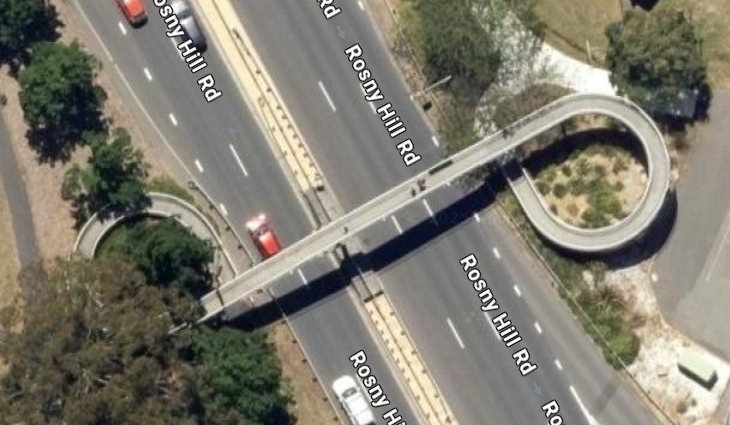
To see an aerial view of a compliant overpass you need go no further than Bellerive.

Pedestrian overpass on Rosny Hill Road 2025.

It has become clear over many years that no state government of any political persuasion has had any interest in the safety of pedestrians on or around the Brooker Highway. Their strategy has been to stonewall any request for change and rely on lobbyists giving up in frustration.

Council must now add the provision of a DDA compliant overpass to its priority list for funding.

It must not put up the white flag on the safety of its residents – and everyone else from the region – who go to the high school or park.

How much of Glenorchy’s plastic is recycled? (part 3)

I asked at the January 25 open council meeting if Council would provide me with information about the nature of the statistical report they receive now and then from Cleanaway.

Here is the complete response.

“you asked, which was “what is the nature of the report Council receives from the recycling facility Cleanaway” we committed to seek permission to provide you with the headings of the report, so you have an insight into the nature of the report.  Cleanaway agreed to providing this information to you.

This report has commercial in confidence information which we do not have permission to publicly release.  Council sought permission to provide the topics that are reported on, so you have an insight to the nature of the report.

The report content is:

Council Monthly Tonnes In
Commercial Tonnes In
Total Tonnes In
Council Monthly Tonnes In – Percentages
Commercial Monthly Tonnes In – Percentages
Glass Out
Waste Out
Cardboard In/Out
Commodities Out
Standard Reporting
Incident Report”

Email received 6 Feb 2025 3:16pm

The brevity of this response begs more questions than it answers. In the faint hope of further clarification I asked these questions as “questions on notice” in February 2025 and received answers (shown in red) in the agenda of the March 2025 Open Council.

  • When the word “in” appears, where is the measured material going from and where is it going to?
    Answer: The material comes from the 12 southern Tasmanian Councils. Council is not informed of where it is going to.
  • When the word “out” appears, where is the measured material going from and where is it going to?
    Answer: The material is going from the Material Recovery Facility in Derwent Park Road. Council is not informed of where it is going to.
  • What is the definition of “commodities” in the context of the report?
    Answer: Commodities is made up of cardboard, paper, metals and plastics.
  • Does Council have any data relating specifically to reuse of plastics recovered by Cleanaway at its MRF? If so, can you describe it’s nature?
    Answer: Council does not have this data.
  • Does Council have any data relating to reuse of any materials whatsoever recovered by Cleanaway at its MRF? If so, can you describe it’s nature?
    Answer: Council does not have this data.

How much of Glenorchy’s plastic is recycled? (part 2)

I’ve written before about wanting to know whether I should bother to put plastic into my yellow bin. I finally learnt on October 24 (use this link) that

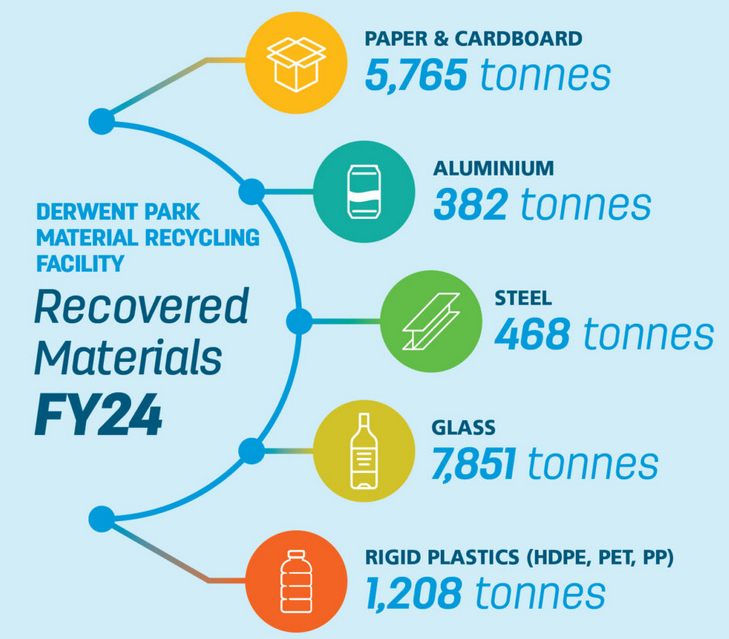
“Cleanaway recovered during the 2024 financial year 1,208 tonnes of rigid plastics (HDPE, PET, PP).”

This response was intensely disappointing because (a) it provided no statistics relating to Glenorchy. and (b) it only referred to plastic that had been “recovered”.

In plain English, “Recover means to separate the wanted stuff from the unwanted stuff”. So I still have no idea how much of that “recovered” plastic has been put to a new use.

So I’ve tried a different approach. I asked, during public question time, at the January 25 open council meeting if Council would provide me with information about the nature of the statistical report they receive now and then from Cleanaway. In other words, what were the statistics that Council received?

I was told that Council would ask Cleanaway for permission to do that. It certainly appears that Cleanaway is under no obligation to provide the public any data whatsoever about how successful they are in having their “recovered” plastics reused.

I look forward to Council’s (i.e. Cleanaway’s) response.

Govt calls for tenders for new Park and Ride in Claremont

On Saturday the State Govt called for tenders to construct the new Park and Ride along Link Road in Claremont. Here is a portion of the overall key plan for the build from the tender documents.

It seems like a bad time to publish a tender with companies in the construction business winding down for the Christmas break.

But I guess the govt wants to get the Park and Ride built and run in before they finalize the design for the new Sports Centre over the road near Claremont College and start building that.

Only time will tell if people actually use the Park and Ride. And let’s hope that bus services are improved on Link Road to encourage people to use it. Very few Metro services travel the full length of Link Road.

Do we need another Whitestone Point?

Council owns the property at 261 Main Road, Austins Ferry, a property known in the past as “Nortonville”. While its total area is just over eight hectares, only 7.14 hectares is available for development.

It is one of the largest remaining parcels of undeveloped land inside the Urban Growth Boundary that is owned by Council and potentially suitable for residential development.

Council has designated a large part of the property an “Off-Lead Dog Exercise Area” and given it the name “Austins Ferry Park”. Regularly mowed but certainly not developed!

In March 2022, Council decided to begin an investigation to determine whether it is suitable for disposal.

In parallel with that process, it has worked to “clean up” the land to remove any impediments to disposal. According to the minutes of July 2024 Council,

“Council has undertaken a contamination report on the land. All contaminated soil has now been removed from site and awaiting written confirmation. An in-ground fuel tank has been removed and the site remediated.”

The same minutes state

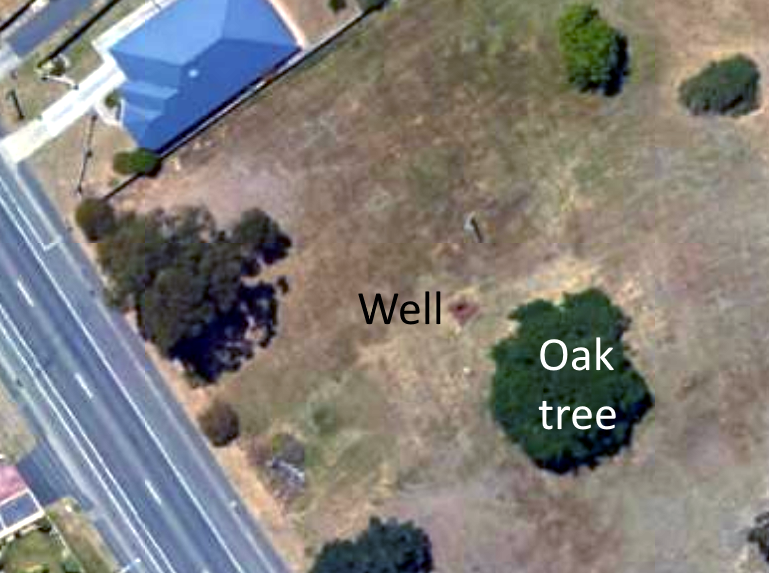
“potential heritage values at the 261 Main Road site (a well, an oak tree and possible structural remains) which means the site warrants further investigation for listing as a ‘Place of Archaeological Potential’.”

Aerial photo of western corner of 261 Main Road, Austins Ferry. 2024.

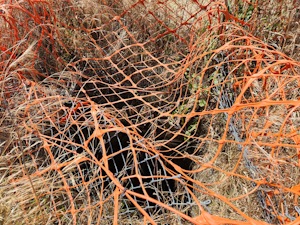
According to the Council’s 2009-2010 Annual Report, Council had asked its Heritage Officer to investigate a water well on the property as a “potential heritage site”. The well is currently covered for public safety (the image for this post shows the wire and plastic webbing used). Underneath is a circular well lined with dry stone, about a metre across and less than two metres deep. I couldn’t find the “possible structural remains”.

But even if the well and tree were found to require protection, their location in the far western corner would only slightly reduce the land area available for development.

So an investigation apparently did begin 15 years ago. According to a recent email from Council, the current investigation is being carried out by external experts and is expected to be finished in the first quarter of 2025.


But what is a ‘Place of Archaeological Potential’ and what are the consequences of a declaration?

The State Planning Provisions contains a Local Historic Heritage Code. Its purpose is to “recognise and protect the local historic heritage significance of local places, precincts, landscapes and areas of archaeological potential”.

It defines Place of Archaeological Potential as:

“a place that is a site, precinct or parcel of land that has been identified as having the potential to contain archaeological evidence that provides information about the past and is:
(a) shown on an overlay map in the relevant Local Provisions Schedule; and
(b) listed and identified in the places or precincts of archaeological potential list in the relevant Local Provisions Schedule.”

Note that the Code does not apply to Aboriginal heritage values.

Glenorchy’s Local Provisions Schedule contains a list entitled “GLE-Table C6.4 Places or Precincts of Archaeological Potential”. You can read that list through this link.

Top of the current list is the “Ashburton farm complex”. Much of the land it contains is in the old Claremont Primary School site where a permit for a major residential development was granted by Council in April 2021. So being declared a Place of Archaeological Potential does not preclude even major development on a site.


According to the March 2022 Open Council agenda 261 Main Road is a “very large, 7.14-hectare block which is zoned as a combination of Light Industrial 58%, Open Space 24%, General Residential 11%, Rural Living (Zone A) 7%.”

At that meeting Council decided to “authorise a community engagement process to be undertaken to identify any community concerns about the potential disposal” of the property. This in line with Council’s policy on Disposal of Council Land.

That decision was the result of a “strategic review of land suitable for disposal for housing” by Council officers.

The agenda described the property as “land with potential for significant multiple dwelling housing developments and are considered priority potential sites for increasing the supply of land for housing.”

The report goes to state that Council will soon start “preliminary public consultation process to identify any significant concerns about the potential sale” of that land.

Council’s own Statement of Commitment on Housing (adopted 30 January 2023) lists actions Council intends to take. The last says Council will “release surplus Council owned land to increase residential land supply for housing.” There is no evidence that Council has considered the property for residential development of any sort or in fact regards it as surplus.

Given the current housing crisis, it would be a tragedy if 261 Main Road were to become another Whitestone Point, another large residential subdivision to be sold as a commercial development. Half of the property slopes down to the river with fantastic views over the river. Too good for social or affordable housing? It would be tempting for Council to “land bank” the property to maximize its return on disposal.

It is hard to understand why Council has never shown visible signs of urgency in putting the property to a useful purpose. Perhaps we will see some movement after Council receives the report from the investigation into the heritage values of the property early this year.


Sources

May 2023 Council agenda (page 22).

How the Vinnies Project in Mill Lane slipped under the radar

On 23 September 2024 St Vincent de Paul Society Tasmania published a media release proudly announcing that construction is set to begin on its new, state-of-the-art southern base at Mill Lane in Glenorchy. Their new base will consolidate many existing functions into a single location, allowing greater efficiency in service delivery.

I have no quarrel with the sensible and worthwhile project. In fact, I wanted to know more about it. It was harder than I expected.

I first searched the agendas of all Planning Authority meetings that I could find online. Nothing there.

Some Council staff have delegations allowing them to deal with development applications in certain circumstances. Council publishes quarterly reports in its website that list approvals made under delegation. I searched them all. The closest match I could find was “PLN-23-264” described as “Alteration to Community Building” at “8 Mill Lane Glenorchy”, approved on 26 March 2024. The description was surprisingly uninformative for what has turned out to be a major construction project, not simply what most would regard as a renovation.

Now I had a Development Application and an application number “PLN-23-264”.

I searched the Mercury and found that the DA had been advertised on 6 March 2024. The description there – “Demolition, Addition and Alteration works to the existing building” – was different but no more informative, and certainly text which would not draw attention.

But wait, there’s more.

I googled the DA number in the entire Council website. It surfaced in the agenda of the 15 April 2024 Glenorchy Planning Authority Meeting in an item entitled “Planning Scheme Amendment Request – Mill Lane Rezoning” with number “PLAM-23/04”.

The effect of the planning scheme amendment was to label some land as the “Mill Lane Precinct”, rezone the land in it, and create a Mill Lane Specific Area Plan tweaking planning scheme controls over development on that land.

Buried in the 15 page report accompanying that item was this paragraph:

“A planning application PLN-23-264 was approved recently for sites at 8 and 12 Mill Lane, Glenorchy for a mixed-use development. The approval is related to existing uses and development to allow additions and alterations to the existing buildings to allow St Vincent De Paul Society (Vinnies) distribution centre with associated storage space (Storage use class), reconfiguration of existing Tas Textiles light manufacturing facility for textile knitting, sewing, and embroidery (Manufacturing and Processing use class), St Vincent Industries for cutting and production of rags (Manufacturing and Processing use class), subservient retail outlet shops for Vinnies and TasTextiles that would be open to the public, and a small scale catering/takeaway service for Loui’s Van Kitchen (Food Services use class). The planning permit has not yet been acted upon. The proposed planning scheme amendment will support the existing approved uses and development under PLN-23-264.”

Read the last sentence. The true purpose of the planning scheme amendment started to emerge.

More searching revealed a reference to Mill Lane in the Greater Glenorchy Plan (GGP) adopted by Council back in February 2021. The Council car park at 9–11 Mill Lane was said to be suited to infill residential development, but not number 8 over the road. So the planning scheme amendment had nothing to do with the GGP.

That planning authority meeting approved the next step in the process which was public consultation of the proposal. The documents provided to the public are still available on the council website.

Public consultation included a “Community Information Sesson” at a King George V meeting room on 3 October 2023 ostensibly to get feedback from the public on the proposal. Most attendees had difficulty discerning the actual purpose of the proposal. They regarded the Mill Lane situation as stable – long-term occupants with no plans for significant change. Major change seemed unlikely. The proposal seemed of little value. Much was made of its “strategic” nature. Much was made of the potential for apartment living. But the significance of Vinnies in the proposal was not mentioned.

Throughout the entire process, Council appeared reluctant to reveal to the public the underlying purpose of the proposal which was clearly not strategic.

All the information about the development application and related planning scheme amendment give a strong impression of an effort to expedite a Vinnies proposal with no fuss and minimal visibility.

The lack of transparency in this situation worries me. While the objectives of Vinnies are laudable and would be supported by most of the public, a lack of transparency in other circumstances might not be so benign. And while Council may not have deliberately obscured the underlying purpose of the planning scheme amendment, perception matters.

Make the KGV car park safe for walkers

Most of the conversation to date about the proposed replacement for the Glenorchy War Memorial Pool has focused on the internal design of the facility – the various architectural components – with little concerning its surroundings.

The observant reader will have noticed that the Intercity Cycleway comes within a few metres of the entrance of the proposed replacement for the current Glenorchy War Memorial Pool.

A major active transport route coming within a stone’s throw of a proposed major recreation centre with no safe connection defies logic.

There is currently no way to walk from the cycleway to either the entrance of the Tasmanian Transport Museum or the entrance of the Glenorchy Pool without crossing a roadway and potentially dealing with traffic. Some painted walkways across the nearby car park seem to exist only to help those who park there and then cross the railway lines to go to shop or work in the Glenorchy CBD. The car park is unfriendly to pedestrians. Council’s own Glenorchy Parking Strategy 2017-2027 makes it very clear that “Well-designed parking improves … pedestrian safety”. Council must make it safe.

Many council policies mention Council’s enthusiasm for active transport – walking, riding, scooting, running, etc. One of the more recent is the Active Glenorchy 2040 Framework for Sport and Recreation Infrastructure published in 2021.

The new facility provides an ideal opportunity to take advantage of the cycleway to promote active transport; in fact, to make the cycleway the preferred method for people to get to the pool.

To encourage this approach, patrons need a secure facility where they can lock up their bikes etc. CCTV would reassure those worried about theft.

Even if patrons don’t use the cycleway to go all the way from home to pool, some might be willing and able to park nearby and walk the last few hundred metres. Not so much a park and ride, more a park and walk. To allow this in all weathers, shelter needs to be provided along the cycleway – shelter against the heat and the cold. There is virtually none now.

There is or was apparently a Master Plan for a King George V Sports and Community Precinct Master Plan. It focussed entirely on places for people to go, the facilities, but nothing about how they can safely move around.

The close proximity of the cycleway to the Transport Museum and proposed pool gives council an opportunity to add a vital link to the pedestrian network in the city. Council need not wait for the construction of the new pool. It must plan the link immediately.

Plastics in the yellow bin. Any point?

For many years my family has taken the use of our yellow bin seriously, giving careful consideration to deciding what can and can’t be placed in that bin. I have also wondered at times what happened to the contents of our yellow bin. For some reason, I’ve generally felt that most glass, aluminium cans, paper and cardboard, was probably recycled – without any real evidence of that. I’ve never had the same confidence that any of our plastic has in fact been put to any useful purpose.

To get a brief overview of Council’s kerbsite recycling operation, read this 2021 post in council’s own special website about its Waste Services. It says that “Council pays Veolia Environmental Services to empty our recycling bins and take the recyclables to the Materials Recovery Facility (MRF) in Derwent Park. Cleanaway Waste Management Ltd runs the MRF and is the contractor for all southern Councils.” Taswaste South, a Joint Authority established by the 12 Councils of Southern Tasmania, handles the contact with Cleanaway.

I started my search for information back in April 2024. To summarize what I’ve learnt so far:

  1. Council receives a report, originally written by Cleanaway and marked “Confidential”, containing some statistics.
  2. Council files those reports and appears to do nothing with them.
  3. It appears that Cleanaway decides what statistics it will provide and who will see them. Council has no say. It is not clear whether Taswaste South has any say.
  4. By the end of July, “Council had requested that volumes of recyclables received, and volumes of recyclables being recycled or reused be made available to the public and this has been agreed to be provided. The timeline for release has not been advised but we have been advised it will be soon.”

At the March 2019 Open Council meeting, Bob Pettit asked in public question time

“What is the position of Glenorchy City Council on the ban on petroleum based single use plastic products (which the City of Hobart recently moved to ban)?”

The question was taken on notice. Later in the same meeting, newly elected aldermen Bec Thomas and Peter Bull moved a motion without notice which after some discussion became

“That Council receives a report on the options for and impacts of reducing the use of single-use plastics in our community including a staged approach.”

Council finally received a report on “the potential options for regulating single-use plastics in Glenorchy City” at its November 2019 council meeting. The delay gives us some idea of council’s lack of interest. The report recommended that council “continue in accordance with our Waste Management Strategy including action to work with our business community to assist in the reduction, reuse, and recycling of waste.” It states “Officers do not recommend that Council moves to introduce any process or measures to reduce the use of single-use plastic in our municipality now.”

Ironically, it seems that Rosetta Primary School has done more than Council to reduce the use of plastics. They received a Glenorchy Community Award in 2022 in part because of their organization of Plastic Free Days in their school.


At the April 2024 Open Council I asked in Public Question Time: “Can Council provide me with any evidence or statistics to reassure me that any of the plastic I put into my yellow bin is in fact being recycled or reused?”

In response, I was first given a brief synopsis of the recycling situation including Cleanaway and the Southern Tasmania Regional Waste Authority (STRWA). The second part of the response informed me that Council does indeed receive detailed statistics relating the amount of various types of material that are processed by Cleanaway. I was informed that the statistics were for “internal use”. When I asked if Council would publish those statistics, the answer was non-committal.

Not feeling particularly reassured, I followed up with some Questions on Notice so I could get answers in writing. In my experience Council has generally provided comprehensive answers to Questions on Notice (even if I wasn’t always happy with those answers).


Here is my first set of questions on notice with the answers as they appear in the May 2024 Open Council agenda.

Q1: What “internal use” are the statistics put to?

A1: They are provided to Councils for information on volumes of recyclables and comparisons across the various municipal areas.

Q2: Will council publish the most recent statistics and each new set of statistics as they are received by Council, and if not, why not?

A2: The reports include information on all of the Southern Councils, not just Glenorchy, as well as commercial information relating to the commodities and processors. The reports are received with a “confidential” marking. Council is happy to request if the reports, of a version of the reports, can be publicly released by the regional body each month.

I immediately sent back some clarification questions. They were included with the original questions and answers.

Q2a: I didn’t quite understand what Council actually did with the reports. Can you clarify that please?

A2a: They are simply provided as “for information” reports to Council. They provide GCC with information on volumes of recyclables and comparisons across the different Council areas.

Q2b: Is the confidentiality a provision of STRWA’s contract with Cleanaway? If not, who marks the reports as “confidential” – Cleanaway or STRWA or someone else?

A2b: Cleanaway.

Q2c: I would definitely like Council to follow up to find out if the entire reports (or portions) might be made publicly available. Can you make that followup happen?

A2c: Yes, these discussions have already been had with STRWA, and are currently underway between STRWA and Cleanaway.


In the absence of any further contact from Council on my questions, I sent another batch of questions on notice. They appear in the agenda of the July 2024 Open Council meeting. Here they are.

Most of the following questions relate to STRWA (now TasWaste South). That organization appears to be doing its best to be operationally invisible to the general public, dealing only with member councils. So, I ask these questions of my council.

Q1. What does Council know about the status of discussions between TasWaste South and Cleanaway regarding provision of statistics?

A1: The TasWaste South CEO has advised that a draft of the report for public viewing has been produced by Cleanaway and reviewed by the CEO, this is being progressed by Cleanaway for release in the near future (date unknown at this stage).

Q2. What has Council done to encourage or expedite those discussions?

A2: A publicly available report was requested by the previous Mayor when she was on the STRWA forum, and the Director of Infrastructure and Development has also requested its release.

Q3. Has Council received permission from either TasWaste South or Cleanaway to release any data? If so, which data and why haven’t we seen it?

A3: No

Q4. Has Council been informed by TasWaste South that public access to data is denied?

A4: The report in its current format includes commercially confidential information and Cleanaway’s intellectual property and cannot be released by any third party.

Q5. Will Council demand from TasWaste South details of any confidentiality provisions in their contract with Cleanaway? That should include provisions relating to publication of data for volumes of recyclables received, and volumes of recyclables being recycled or reused?

A5: Council has requested that volumes of recyclables received, and volumes of recyclables being recycled or reused be made available to the public and this has been agreed to be provided. The timeline for release has not been advised but we have been advised it will be soon.


I have now contacted Taswaste South using the “Contact” page in their website, saying this:


“My family and I are very interested in recycling in general, and in particular the recycling of whatever we place in our Glenorchy City Council recycling bin. Our specific interest at the moment is plastics. Earlier this year we asked our council if they had any statistics on how much of our plastics are in fact recycled or reused. We learnt that their data came from Cleanaway and they did not have the right to share the data. We then asked council to request through your organization some statistics. The last report from council (July 2024 open council agenda) said this:

“Council has requested that volumes of recyclables received, and volumes of recyclables being recycled or reused be made available to the public and this has been agreed to be provided. The timeline for release has not been advised but we have been advised it will be soon.”

What can you tell us about the “timeline for release” and when they may be provided?”


I followed up by sending the same text in an email directly to Taswaste South at their general address admin@taswastesouth.tas.gov.au on September 5.


After an apology for “the delay in responding”, the email went on to say

“I am pleased to let you know that we have published some data regarding the operation of the material recovery facility at Derwent Park that we have obtained from Cleanaway via the Rethink Waste website.  

https://rethinkwaste.com.au/cleanaway-derwent-park-material-recovery-facility-mrf/

This information is being made available to the public broadly to answer similar questions to the one that you’ve asked below.  We intend to keep this information update and hopefully we can include further information as it becomes available to demonstrate the positive impact from this facility.”

The information content appeared in the following image:

The alert reader will notice that the source was not the Cleanaway website. It was “Brought to you by Tasmania’s regional waste management groups in partnership with the Tasmanian Waste & Resource Recovery Board using the state waste levy.”

To be clear, the information relating to plastics can be summarized in a single sentence:

Cleanaway recovered during the 2024 financial year 1,208 tonnes of rigid plastics (HDPE, PET, PP).

I have since replied (19 December) to the email asking: What exactly does “recovered” mean in that context?


The Leaking

What feels like years ago but is actually less than 12 months (4 July 2023), the General Manager of Glenorchy City Council abruptly closed the Glenorchy War Memorial Pool to the public until further notice. He has that authority as “person controlling the business or undertaking” under the Work Health and Safety Act 2012. His decision was based on an Inspection and Audit Report from consultants (Lacus Consulting) listing unacceptable risks to the health and safety of pool users, staff and contractors. The public learnt of his decision via a media release.

We’re told that an excessive loss of water was one of the triggers for commissioning the specialist assessment of the pool condition in the first place. While the report from Lacus did confirm “severe water loss in all pools”, it did not quantify or fully explain it.

Despite that, the agenda item (July 2023 Open Council Agenda item 10) gave a specific figure of 35,000 litres per day leaking from the pool, a figure that did not appear in the media release.

The agenda did not explain where that figure came from. And that gave the already angry and upset members of the public an easy target for their invective. Most of us can intuitively understand a leak and how leaks are fixed. Plug a hole, replace the pipe, fix the grout, replace some tiles, replace a washer, etc etc. Simple. No big deal.

It allowed them to virtually ignore all the other genuinely unsafe or dangerous issues at the pool, and focus on the “leaking” despite the fact that it played little or no part in the GM’s decision to close. It has been remarkable how few of the public questions to Council directly related to specific safety or health issues.

The “leaking” is primarily a financial issue, not a safety issue. It is extremely unlikely that the pool would have been closed indefinitely if “leaking” had been the only significant problem.

But it is still not clear whether there is one leak or many, where the water is leaking from and where it is going, and how the leaking can best be stopped or reduced. Council has since explained how it arrived at the 35,000 figure but made a bad mistake in gilding the lily by including it. There are already enough clear and indisputable public health and safety issues to justify closure.