Category Archives: News

Walking paths of desire

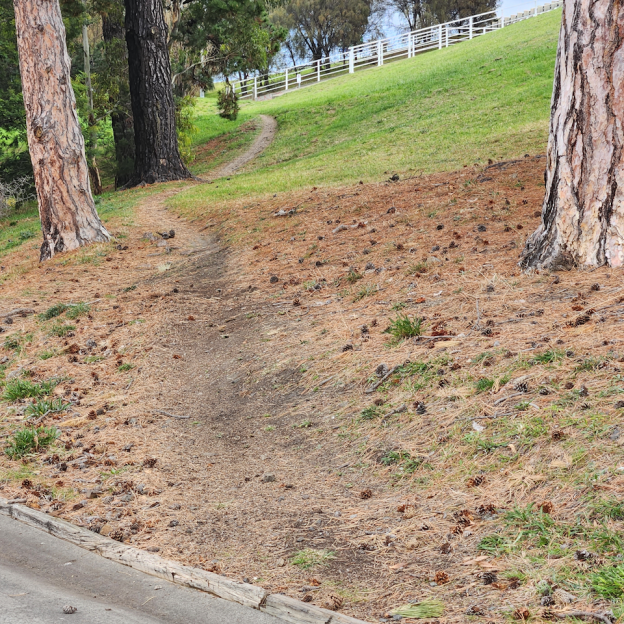
When pedestrians find existing pathways or roadways inconvenient or dangerous, they will naturally look for alternatives. When there is no marked path, people will work it out for themselves – and make their own path. We might call it a shortcut. But a path made that way is, in the jargon of urban design, called a desire line or desire path. The image for this post shows an example running down from McVilly Drive down to the Intercity Cycleway.

Maybe the architect or designer gave more thought to the aesthetics (or the cost) than to whether people would actually use them.

In some situations, designers build no path, wait to see where people walk, then build the path there.

I’ve written about desire lines here because the term appears in the agenda for the July 2023 GPA meeting (page 15). The agenda item concerns a proposed development at 72-74 Main Road, Claremont, and contains a few paragraphs arguing for no change to the service road for the new development. It is part of an attempt (perfunctory as usual) to consider the needs of pedestrians. It is as weak as dishwater.

It was really a token gesture because, as you can see below, the current service road provides no safety for pedestrians. And there is too little space on its verges to provide any.

Service road to 72-74 Main Road, Claremont.

In any case, it would be truly miraculous for the needs of pedestrians to be a serious part of any GPA discussion.

A desire line will usually be the shortest or quickest route from A to B. But not always. People can take account of details in the landscape. And there may be more than one desire line from A to B, with one going up and the other going down, depending on the terrain.

Next time you go walking, notice where you walk, and you will occasionally find yourself on a desire line (possibly even starting a new one).


  1. Desire paths: the illicit trails that defy the urban planners from the Guardian.
  2. Desire lines: to pave or not to pave? from the University of New South Wales.
  3. Desire lines: signs of bad design? from Daniel Bowen.
  4. What desire paths can tell us about how to design safer, better public spaces from the ABC (Australia).

The image for this post is the desire path running down from McVilly Drive
to Intercity Cycleway in Hobart near the Regatta Ground. Photo taken 27 July 2023.

Bus Stop Infrastructure: No-one’s responsibility!

This post shows a number of questions I put to Glenorchy City Council on 1 July 2023, and their responses to each question exactly as received.

Take note: the only reason there has been any official communication regarding bus stops is the deadline for making bus stops compliant with the Disability Discrimination Act passed in Canberra in 1992. That Act gave the states 30 years to take the appropriate action. The Tasmanian government missed the 2022 deadline. They clearly hope that applying minimum resources to the minimum number of bus stops will allow it to later plausibly claim compliance. See the answer to question 4 to learn more.


Q1. Did Council make any allowance in its 2023-24 budget specifically for the maintenance or upgrade of bus stop infrastructure? If so, how much?

A: Bus stop infrastructure is not the responsibility of local government, and Glenorchy City Council does not own any bus stop infrastructure, except for the Tolosa Street Bus Interchange. council has no specific allowance in the 23/24 budget for the upgrading of bus stop infrastructure.


Q2. Council has on many occasions mentioned the difficulty they have arriving at an acceptable agreement with Metro Tasmania for maintenance of bus stop infrastructure. What does council see as the sticking points in their negotiations with Metro Tas?

A: Metro Tasmania is a Public Transport operator contracted by the Department of State Growth. Metro Tasmania advises that they are not contracted for, or funded to, upgrade or maintain bus stop infrastructure. The Department of State Growth claims bus stops on local roads are the responsibility of the relevant local government. However, bus stop ownership is not legally defined or legislated. The council has not accepted ownership of bus stops as it has never installed or owned bus stop infrastructure and does not have it listed as an asset on Council’s assets register. This position is consistent with that of other councils and LGAT is undertaking advocacy to the state government in relation to ownership of bus stop infrastructure, on behalf of the sector.


Q3. Council has repeatedly given the impression that it believes it should not have any responsibility for maintaining bus stops. It occurs to me that council taking control of bus stops could create opportunities. For example,

(a) bus shelters might be used as a communications channel to the public, and

(b) it might be possible to sell advertising space on the shelter to defray maintenance costs.

A: Council has not explored the potential for this as we do not own the bus stop infrastructure. However, any revenues are unlikely to defray the costs to the community of owning, maintaining, renewing and replacing bus stop infrastructure.


Q3a. Has Council ever requested from staff a comprehensive cost benefit analysis for taking over maintenance of bus stop infrastructure? If so, can I have a copy?

A: No, council’s priority is managing the over $1 billion of community assets it already owns. There are significant costs to ratepayers with taking on any new infrastructure. Even without a cost/benefit analysis, we know bus stop infrastructure would come with significant costs, including upgrades to meet Disability Discrimination Act (DDA) standards, in addition to the ongoing maintenance and depreciation.


Q3b. Has Council ever requested any type of report on such a proposal? If so, can I have a copy?

A: No, council has not requested this type of report. However, a desktop analysis in 2022 suggests there are 404 bus stops in the City, and upgrades to meet DDA standards would cost at least $2 million plus project management costs.


Q4. In 2022 the Department of State Growth announced a Bus Stop Upgrade Program triggered by a requirement for bus stop compliance with the Disability Discrimination Act 1992. The program allows Councils to access grant funds to assist in the upgrade of bus stop infrastructure to satisfy the Act.

Will Glenorchy City Council participate in the program? If not, why not?

If yes, how will Council select the bus stops to propose for upgrade, and how many would be included? Will it for example only consider the 40 or so bus shelters in the city?

A: Glenorchy City Council made a submission for funding through the grant program, but later the Department announced that should Council’s accept the grant funding, they would be accepting ownership and ongoing maintenance responsibilities for bus stop infrastructure. Once this was announced, the Council clarified its submission, stating that Council would undertake the required works to assist in making bus stops DDA compliant but would not accept the transfer of ownership by accepting the grant funding. The Department of State Growth withdrew their grant offer on this basis.

The council is willing and has offered to undertake the necessary works on a fee for service basis. This has not been accepted by State Growth. As mentioned earlier, this is consistent with the position of other councils and an issue LGAT is undertaking advocacy to the Government in relation to, on behalf of the sector.

The Department of State Growth has recently written to council stating they are reconsidering their approach to this matter and will advise councils of their new proposal in due course.

Some clarification of the position of local government appears in the submission by LGAT in December 2023 to the State Government Road Management Legislation Review Discussion Paper. A full copy of the submission can be found through this link – https://www.lgat.tas.gov.au/news-and-events/latest-news/lgat-submission-road-management-legislation-review-discussion-paper

Here is a direct quote of the relevant section in that submission.


Ambiguity

Ambiguity of road management responsibility needs to be addressed, with councils providing many examples of when road management responsibility for a particular asset or road component has been ambiguous. The asset transfer process proposed above should help with council case studies used to test legislative proposals.

Bus stops

An example of this ambiguity is bus stops on local roads. Bus stops are rarely constructed by councils and typically established by either developers or the public transport authority (Department of State Growth). Tasmanian councils also do not operate the service so have very little influence on their operational costs and no ability to impose a user charge to recover costs. Bus stops are also part of a larger transport function, beyond the scope of any council. In their role in public transport services, bus stops more closely resemble utility infrastructure, like transformers for electricity supply or pump stations for water and wastewater services, both of which are the responsibility of the service provider, not the land owner or road reserve manager.

Despite this, there is ambiguity around who owns and is responsible for maintaining bus stops. The Tasmanian Government claims that bus stops, both on local roads and even on state roads in urban areas, belong to and are the responsibility of councils. This claim implies that ratepayers should pay for bus stop maintenance and councils should increase rates to provide this service. Councils reject this as they have no natural or active role in public transport provision – they are incidental to the service.

To compound this, these assets are never responsibly transferred to councils with any formal process. It is merely claimed that councils are the owners and must suddenly start to maintain, upgrade, and fully account for these assets, raising rates to do so.

The review should use the natural asset ownership and transfer process proposed above to start resolving the ambiguity around bus stops.

For the reasons explained above, it clear to local government that we are not the natural owner of bus stops, nor are councils responsible for the transport function they deliver. If the Tasmanian Government believes that ratepayers should subsidise the ownership, maintenance, upgrade, and full accounting of bus stop infrastructure, it should make that case honestly and explicitly with ratepayers to justify this subsidisation. There may be a case there, but it is irresponsible to leave this implication unspoken and force councils to have to negotiate this cost increase with communities alone.

Why did I change the banner?

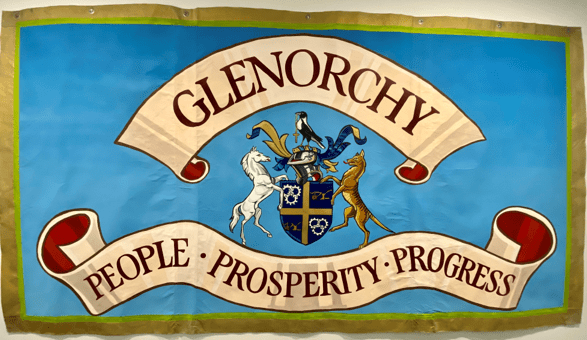
The banner for my website has till now been a nice photo of the GASP boardwalk near Montrose Bay. When I started, GASP was a thing, there was a group called GASP and they did stuff. No longer. Council pulled the financial plug. The boardwalk is now in ‘care and maintenance’. That decision was just one more step as tourism became a word barely mentioned or written.

My banner now reflects the reality of Glenorchy as a city which is not focused on tourism. The term “northern suburbs” may rankle but there is significant truth to it. While we have great businesses and industrial enterprises, our city is largely suburbia. This may have made council’s decision last year to quickly disband the economic development team as the first major cost-cutting exercise very easy.

Hence my new banner with text in Glenorchy magpie colours on a suburban background.

Let’s take a closer look at tourism.

At the June 2023 council meeting we heard that council had entered the 2023 Tasmanian Tourist Towns competition. The meeting heard the script of the voice-over to the video submitted by council with their entry. Oddly though, the only tourism mentioned in recent years is art or cultural tourism which did not rate a mention in the video.

While it is admirable that council wants our city regarded as a significant tourist destination, most residents of Glenorchy think we’re not there yet.

Let me first clarify what I mean by a tourist destination. A place that tourists will visit and spend time at. Not simply performance venues or places where we go to experience a performance. MONA for example is a tourist destination because people can simply spend time there. On the other hand, MyState Arena is not currently a tourist destination. People do not go there to simply spend time; they go there for events such as sporting or dancing competition, or concerts. If MyState was interesting architecture, it could be promoted as such and become a place where people with that interest would spend time looking around. It would become a tourist destination.

While many will rightly point to MONA as an internationally renowned museum and gallery, the reality is that the majority of MONA patrons travel to MONA from Hobart by car or ferry or bike, undertake the full range of MONA activities, and then immediately return to Hobart the same way. MONA is a destination; Glenorchy isn’t. Despite this, and despite David Walsh’s own admission that the presence of MONA has not economically boosted the surrounding area or gentrified it, council persists in bending over backwards to support it.

Here are some locations in Glenorchy that I’d regard as genuine tourist destinations.

• Goulds Lagoon
• Mountain bike tracks at Tolosa
• Moonah Arts Centre
• Tasmanian Transport Museum
• Austins Ferry cottage

but they do not make our city a tourist destination.

Council has in the past made major efforts to encourage tourism. Council had a tourism plan in the past last mentioned in its 2005-2025 Community Plan and there have been Visitor Taskforces. But when I recently asked council for a copy of that tourism plan, they couldn’t find it.

Glenorchy may well be a leader in creative industry. It may well have many strong sporting clubs and organizations. It may well be innovative. But we have a long way to go to become a tourist destination. And council has to lead.


Sources

Appendices to the Glenorchy Community Plan 2005 – 2025

Appendix 1 provides a status report of the actions that were listed in the original Glenorchy Community Plan. The 2004/5 review of the Community Plan included considerable public consultation during which the community was asked to provide comments about Glenorchy. These comments are included as Appendices 2 and 3. The document does refer to a “Glenorchy Tourism Plan”.

Economic Development Strategy 2020-2025

Page 2 quote “… when I first opened Mona, I expected to see some services (coffee shops, restaurants etc.) cropping up in the area. I don’t know why that hasn’t happened, except that there may be some zoning issues, but Local Pizza recently opened in Claremont, and it is exactly the sort of business I was hoping for. I hope it is the vanguard of more quality, consumer-oriented businesses to come. So, start selling stuff in the Glenorchy region. I’m buying. David Walsh, MONA”

Page 9 medium-term action “Create an urban village at Moonah Investigate the establishment of a business improvement district to attract retail, hospitality and tourism businesses to Moonah and enhance public spaces to create an urban village”.

Page 17 short-term action “Spread the MONA effect Work with MONA, other tourism operators and local businesses to encourage visitors to come to Glenorchy when visiting nearby attractions”

Glenorchy City of Arts Strategy 2040

Page 26 “2.2.3 Collaborate with MONA, the major arts festivals, commercial event presenters and tourism businesses to support and increase arts and cultural tourism in Glenorchy.”

Page 29 refers to “our ambition to be one of Tasmania’s cultural tourism draw cards”.

Video submitted to the 2023 Top Tourism Town competition


5a Taree

In the paper (Mercury 17/7/23) appeared a small article entitled ‘Chigwell residents in limbo’. The article alleged that residents living in a Housing Tasmania property had been advised by letter that their home was to be demolished by the end of the year. The article did not state the actual location but research revealed it as the large internal block at 5a Taree Street.

Council sold that block to Housing Tasmania (now Homes Tasmania) back in November 2022 (Mercury 26/11/22). Council had identified the property during its ongoing program to dispose of surplus properties. A sale was not guaranteed since the block was a battleaxe property inside a block with a single narrow driveway access.

It was indeed fortuitous that Housing Tasmania owned adjoining blocks which might be incorporated into a major development across the centre of the block. Housing Tasmania identified the opportunity and bought the block. Council in its own media release about the sale showed great satisfaction in the result. A casual reader might think that Council had offered the land directly to Housing Tasmania, and Housing Tasmania had said ‘thank you very much’ and handed over $1.25 million. But no, the land was sold in a public process (advertised by Harcourts Signature Mercury 1/9/22). Housing Tasmania (we assume) was the highest offer.

Remember that media release. It said: ‘Homes Tasmania will consult with neighbours and key stakeholders when preparing the development application for the site in the New Year.’

That does not appear to have happened. But then the word ‘consult’ means different things to different people.

And it says a great deal about Homes Tasmania culture that their staff apparently felt no need to convey such serious and life-changing news in person. No respect for their tenants. And as for their relocation, let us hope they are not moved to the fringes of our city (or out of our city).

The image for this post: It shows the only visible indication of change on the block, a forbidding sign at the only entrance. It seems that Council’s only interest after putting up the sign and installing a gate at the entrance was to keep the grass down.

Council’s historical collection starts to see daylight

If you walk into the council chambers through the front door, you will see directly ahead two small display cabinets containing interesting historical artefacts from council’s historical collection. Those coming in the back door won’t see them.

Manual press ‘seal’ machine for the Glenorchy City Council (late 19th early 20th century). Council collection.

The collection has accumulated since the 1800s. Over the years, members of the public have asked questions about council’s historical collection but received little information – not the size of the collection, not a spreadsheet listing the contents, and certainly not photographs of the contents on a website.

A question asked of council last year revealed that an inventory does exist but that council was reluctant to publish because of fears that the heritage officer would be swamped by questions from the public.

Very few objects have been revealed to the public. Some are in poor condition or very fragile. The collection is currently stored in one location off-site with various bits and pieces scattered around council chambers.

Council has not been able to find a suitable space where the collection can be displayed ‒ safe, secure, climate-controlled, and easily accessible to the public – a museum.

But even if it found a location, the three-days-a-week heritage officer, the only council staff member with duties relating specifically to the collection, simply does not have the time to manage a museum (in addition to their statutory duties).

But even if they had the time, museum management requires a skill set quite different to that of a heritage officer.

But even if they had the skills, a museum would generate little income and simply be a financial overhead. Most of the public would see it as a drain on council funds.

Every now and then, council’s one and only heritage officer (part-time) will stock the cabinets with a new set of objects. That is probably the best display method we can hope for.

Council can do more. It should find a way to place the collection catalogue online, and attach photos of each item to the catalogue. They will not be swamped with requests for help or information. Even if they are, there may well be volunteers in the community who could assist in dealing with the requests (and possibly implementing the online catalog and gallery). Volunteers who could help with its design.

Next time you go to council, go in the front door and learn a little history.


NOTE: the image for this post shows the photo of a banner was created by artist Chantale Delrue for ‘The Gathering’ Centenary of Federation event, Launceston, Sunday 2 December 2001. Currently located in Council Chambers.


Claremont Primary School site update July 2023

Recent reports of construction and demolition work on the Claremont Primary School site prompted me to find out more. Below are direct quotes from replies from someone intimately involved in the development project.

My first question related to the work going on now.

“[I’m] happy to say that the demolition of the newer extensions to the school are as per our DA permit. We are also adding temporary protective works to the roof and making the walls of the main building more secure to try and stop unauthorised ingress and protect more from weather. These were requirements of the permit and the owner felt it was best to do them now while we still work on finalising the project so as to not risk any further damage. 

This will hopefully make the site less of an attraction to vandals and make it harder for them to get in to the lovely main building that of course remains and will have its facade restored to its previous state. The grounds will also be easier to upkeep as it will remove a number of hazards on the ground. 

We are still the architects and still working hard to get the best results for everyone including the local community.”

Email received July 2, 2023 with minor edits for readability.

My next question related to possible changes to the original design.

“There is not much I can say due to commercial confidentiality but also simply things not being finalised in terms of decision as to what if anything to change.

As you are aware covid and other recent events have affected the construction industry heavily in terms of material costs and other site costs which affected many projects across the state in terms of their feasibility studies, Claremont included. We have therefore been working hard with builders and others to understand better the various cost implications of materials etc so we can make sure we document a project that maintains its viability under the new conditions. This has meant exploring options of reducing scale and other elements which may be what you are referring to but I stress that we have not made any decision as to the final outcome of these explorations and that is why we do not wish to be premature in stating that things have or haven’t changed as that just causes confusion, frustration and disappointment.

Our eye is always on making the project as good as it can be for all concerned, and is not priced out of reach for those who wish to live there. We think the market is settling down now with logistics problems and material shortage problems being reduced so we can start to feel more confident in what we have to deal with. The project will be built in stages in over a number of years and so need to get these things right.

I am sorry we cannot be more forthcoming at present, the whole industry is frustrated at the moment, believe me, but we believe some firmness is returning to the relevant areas. Architect is both an art and a business and it is difficult to get these balances right, so we are not going to rush it.”

Email received July 5, 2023

The comments above come directly from someone in the project team. They are the facts.

PS. Received this supplementary information today (July 14) from the same source on the project team:

“The demolition and tidy up for the site should finish next week. We will be leaving some of the slabs as we wish to crush and recycle that material to help with raising the ground level in some locations to help with the local flood issues that was part of our DA requirement. They are also useful for.the builders during construction to place their site huts etc.”

Email received July 14, 2023

McGill Rise update November 2023

The McGill Rise saga continues. It’s disappearance from the media does not mean it is done and dusted.

Back in October last year I mentioned the disciplinary panel run by CBOS focusing on those involved in the development. Back in October CBOS said “action is underway to close this process out”. On March 14 I learnt that the panel continues. But readers might be pleased to learn that there have been consequences. CBOS said: “practitioners that are no longer licensed include both of the builders, the building surveyor and the building designer”.

The other strand to the story is Glenorchy City Council’s obligation to ensure public health and safety.

The legal list of the Tasmanian Supreme Court in the Mercury (March 15) contained the item “For notice to review: Aviation Consolidated Holdings Pty Ltd v Glenorchy City Council”. Council helpfully provided the following response to my query.

“The Council infringed Aviation Holdings (the developer company for McGill Rise) in relation to non-compliance with a building order which required the removal of unapproved fill from a pad at McGill Rise. That infringement notice was contested in the Magistrates Court, but the developer was convicted of that offence. The developer has recently appealed their conviction to the Supreme Court.”

In plain English:

  1. Council made a building order requiring the removal of unapproved fill from a pad.
  2. The developers did not do it in time.
  3. Council issued the developer an infringement notice.
  4. The developers disputed the notice in the Magistrates Court.
  5. The Court came down on the side of Council, and upheld the notice.
  6. The developer is now appealing the Magistrates Court decision all the way to the Supreme Court.

The agenda for the coming March 27 Council meeting includes a closed session item “22. Approval of legal expenditure”. That item could include McGill Rise. Decisions on whether or not to continue legal action are not easy. Council does not have inexhaustible funds – and can get no external funding to help.

Are the developers, Aviation Consolidated Holdings, trying to wear Council down, to make them give up? My feeling is that most of us would want Council to hold the developers accountable for their actions. But how much do we want them to spend?

We’ll try to keep you up to date.

At tonight’s open council meeting (27/11/2023) we “accidentally” learnt of action being taken right now to improve safety at the McGill Rise site.

Agenda item 20 relates to a fairly obscure report – the Procurement And Contracts Exemptions Report – explaining where council has in unusual or extreme circumstances taken a shortcut through the Council’s Code for Tenders and Contracts.

To quote the agenda, the exemption was for “the supply and installation of water filled barriers to be used at the base of batter slopes on the McGill Rise development at Claremont. The product installed is to provide a safety barrier for any potential rocks that become dislodged from the face of the building platform batters.” The action was urgent.

Ratepayers will be pleased to learn that they should not expect to have to contribute to the cost of $65,165 because council has issued abatement notices on the affected properties.

Please do not feed the ducks! Any ducks!

There has been talk on some Facebook groups about the apparent disappearance of ducks from Windermere Bay. There was speculation that Glenorchy City Council had conducted a cull, possibly with poison.

Councillor Dunsby appeared in the Facebook group and undertook to look into the matter. But we’ve not seen a response yet.

In the meantime, I contacted the experts in ducks in Tasmania – Birdlife Tasmania – to see if they could shed any light on the situation.

Here is a very detailed response received from Jason Graham, a registered native duck carer, who currently helps to coordinate a joint-council education project in southern Tasmania about the impacts of duck feeding and about raising awareness of the existence of our different native duck species. The “Eric” he refers to is Eric Woehler, convenor of Birdlife Tasmania.


Response from Jason Graham

Thank you for your concern and making the effort to reach out to an organization! I’m passionate about the conservation and welfare of native ducks in Tasmania, particularly the Pacific black duck. I specialize in the identification of mallard x Pacific black duck hybrids, as I saw many of these crosses come into care when I worked at Bonorong Wildlife Sanctuary. While working there I started to learn about how widespread the issue of domestic ducks breeding with native Pacific black ducks (PBD) is in Tasmania, as the majority of ducks we were having called through the rescue service in some years were domestic mallards and mallard x PBD hybrids. These hybrids are fertile, so over time and ongoing cross breeding, hybrids can replace PBDs.

Eric and I believe that the majority of ducks present in Windermere Bay, and therefore the ducks that are now missing, are domestic mallards and mallard x PBD hybrids.

There is a serious risk to the genetic identity of Pacific black ducks in Tasmania. A pure/actual Pacific black duck can be hard to find in parts of the Derwent such as Windermere Bay. On several visits over the last few years, I have counted large numbers of domestic mallards and mallard x PBD hybrids, and rarely encounter any native species or non-hybrid PBDs. For example, on this survey I counted 61 domestic mallards and mallard x PBD hybrids, and no native duck species: . Here are some of the photos from the area.

I’ve had a look through surveys for Windermere Bay and there are some records of low numbers of Australian wood ducks and Chestnut teals, but it’s likely these were not in the main duck area near the car park and gazebos. It’s also important to mention that native species are never culled by councils. Apart from duck hunting, the only native ducks that are culled in Tasmania as far as I’m aware are by farmers and golf courses. Wood ducks are unfortunately the main victims in both cases as their favourite food is grass. These permits are organised by the state government and have nothing to do with local councils. As far as duck conservation and welfare is concerned, Southern Tasmanian councils are doing far more good than the state government!

It’s also important to remember that when councils do remove domestic ducks, they only need to do so due to the cruel actions of people dumping unwanted pet ducks in the first place. It’s the same as with people who dump chickens on the side of the road. The big difference is that many of these chickens don’t survive long due to starvation, exposure and predators. Domestic mallard ducks don’t face these same problems and can thrive, especially when they’re fed by people.

Councils are in a tough spot, and don’t actually want to cull ducks, but are forced to by the actions of irresponsible and cruel duck owners. Down the track I want to push for a registration system for ownership, like with cats and dogs, to try and reduce dumping and the resulting culling.

There could be a bit of migration happening. Domestic mallards don’t usually stray far from feeding areas, but they may have moved to other problem areas in the Derwent, such as Old Beach, Newtown Rivulet, Wrest Point etc. Mallard x PBD hybrids are more capable of migration (due to PBD ancestry) and may have flown elsewhere, which can be a problem for pure PBD populations.

I also like to think that some ducks may have moved on due to there being less feeding, as was the council’s intention by placing new signage in the area. But this may be wishful thinking and may take years! The more that people feed and put water out for domestic ducks, the more they are supported and breed succesfully, meaning more ducks need to be removed by council. It’s unfortate that many of the people who have complained about the council’s actions in the past are partly responsible for the need for action!

Duck feeding only supports domestic ducks in Australia. Most natives are too timid to approach humans, and most have completely different diets to domestic ducks (musk ducks for example are mostly carnivorous!). Some like Chestnut Teals, PBDs and Wood Ducks will hang around for leftovers, and this increases mallard x PBD crossbreeding by encouraging the two species to hang around together. These species can simply fly and swim elsewhere for more nutritious, natural food anyway.

If interested, I moderate a facebook group on the issue. We share information about current action, hybrid x pure PBD identification tips, ways for people to help etc.

I helped Glenorchy Council create a page in their website last year about the impacts of duck feeding, and about what native species we have in Tasmania. This is especially relevant to Windermere Bay.

And lastly, if you are interested in learning how to identify them, I wrote an article on identifying mallard x PBD hybrids vs pure PBDs birds.

End of response.


In summary, next time you are carrying your bag of old bread to feed the ducks, think again! Put that bag in the bin. While the feeding may give you a warm fuzzy feeling, you may be doing more harm than good.

Just watch them. See the cute way in which they behave. And leave it at that.

Responsibility for bus stops in Glenorchy

There are many bus stops in Glenorchy where infrastructure can be described as truly awful in terms of safety.

But Council comments have always suggested that it was unclear where responsibility for those bus stops lay – Council or the state Department of State Growth (DSG).

A recent email from the DSG concerning the Bus Stop Upgrade Program said “it is expected that bus stop infrastructure on local roads or local footpaths will continue to be owned by local government”. Clearly, the department believes that Council “owns” the bus stops. However, the same email says “final arrangements for maintenance continue to be discussed between the department and councils”. That program will provide funds to Council for upgrades to “high priority” bus stops. Council will be responsible for the upgrades. It seems the program demands clarity on responsibilities when the program work is complete.

It will be interesting to see whether Council takes on responsibilities for bus stops unaffected by the program.

I certainly hope that Council informs us of the resulting situation because there are certainly bus stops in the city that require work. Here are a couple of the worst I’ve come across in my travels.

Stop 39 on Berriedale Road

A narrow path is the only access. Surrounded by trees and no street lighting, so unlit on a dark night. No assistance crossing the road from the bus stop. Anyone waiting would be invisible to bus drivers. No shelter whatsoever (but that is not unusual). No timetable attached to the pole. It is clearly designed to be a good-weather day-light drop-off stop only. Awful!

Stop on exit to Glenorchy from Bowen Bridge

Well here is another that is almost as bad, on the left hand side as you go toward Glenorchy from the Bowen Bridge. It is clearly intended (I hope) only for people to get off a bus – but it is unsafe even for that limited purpose. It takes more than a small bus stop sign stuck to a light pole to make a safe bus stop. Cheap and dangerous.


Further information from the Pedestrian & Public Transport Users Group
(on Facebook 04/04/2021 09:37)

Source: Christian Bell.

Met with State Growth, they stated that was their position. Policy no longer resides with Metro, it’s the departments position. The stated they might provide new seats and shelters on new routes (at their discretion) but on existing routes it was up to local government. Whenever the public ring up wanting a new seat. If they ring up the response they will get from the state government is “try local government”, if they ring up local they get the response “try state government”. Local government just views the State Governments position as cost shifting.

Pedestrian & Public Transport Users Group (on Facebook 04/04/2021 09:37)

Short-term cost cutting without clear strategy will not work

In four months we’ve moved from an innocuous agenda item entitled “Organizational Direction-setting” to the removal of positions and staff, and some Council activities placed on the endangered list.

The public has been surprised by the speed of the review and how quickly actions have been taken as a result. Some aldermen may also be surprised at the consequences of the review.

It seems that the agenda item arose from the development of the 22/23 budget. Aldermen seem to have experienced an epiphany after learning about “Council’s structural deficit position”, apparently for the first time. We learnt later that “Council’s structural deficit position” was an obscure way to describe a “trend of being in deficit in ten of the last twelve financial years”.

The first mystery is why the tenth deficit triggered alarm that was absent for the previous nine, and why that alarm generated a need for action on this occasion.

The agreed action was to investigate an increased focus on “core” services and to better understand the cost of “non-core” service delivery ‒ in other words, the services to investigate further. This has been simplistically described as the “back to basics” approach.

When the agenda item came up at Council, aldermen seemed to spend endless time on what “core” means, which somewhat bemused those watching. It was clear that legislation labels some council activities as “discretionary” and some not. But it is the needs and views of the public that determine whether a service is “core”, not legislation.

We learnt that the review was still on when Council in June approved its Annual Plan 2022/23‑2025/26 that contained the one-liner “Complete a targeted review of Council services”.

The second mystery is the use of the word “targeted”. That implies there are targets but we don’t know how they will be chosen.

Having been given the green light to go ahead, the review commenced. Council released a media release on July 8 .

The first decision I learnt of was the elimination of the Executive Officer position. Soon after, virtually the entire economic development team was gone.

The next visible target was childcare centres. Happily for their clients, they have been given a lifeline of half a million dollars. It wasn’t clear from the media release why. Aldermen were probably very relieved to learn of the “profits the service has made in recent years” mentioned in the media release – yes really! That made it easier to avoid a politically unpalatable decision to further reduce services or increase charges or shut them down so close to an election.

The most recent target was “Events and Awards Programs”. The survival of some events will  depend on Council finding partners which can reduce the funding required from Council.

In summary, we have seen an opaque process.

We do not know how Council activities are being chosen as targets.

We do not know why it is necessary for the process to take place at a breakneck pace.

We do not know how much influence aldermen have had over the decisions that are being made.

We do not know how Council will know when costs have been sufficiently reduced. How will Council know, how will the public know, when to stop, because stop we must? Slashing costs is a very blunt instrument; long-term we have to rethink Council strategies.