
What follows is a copy of a Facebook post written last year as a rant about the way cyclists on the Cycleway treat those on foot.
As a regular walker on what is officially called a Cycleway but in reality is a shared space, I regularly feel uncomfortable when overtaken from behind by a cyclist or scooterist. No bell, no warning, just a quiet whoooshh as they pass!
It might not be so disconcerting if they slowed as they pass but that is extremely rare. And speeds seem to be increasing so much so that a direct collision would be damaging, sometimes speeds that might not be legal on a public road.
It seems that we pedestrians are viewed as interfering with their riding or scootering pleasure, obstacles to be navigated.
There is some irony in seeing cyclists treating pedestrians in ways they would not accept from drivers.
There was such a variety of responses to the Facebook post that I decided to find out exactly what rules do apply to those of us who use the Cycleway, whether walking, cycling or scooting. Legally I mean. For example, does the Cycleway have any road rules about how we behave and how we deal with each other.
Since most of the Cycleway is in Glenorchy I supposed that Council would have the knowledge through an interest in the safety of their residents. So I asked them. Their response simply referred me to the legislated Road Rules.
It turns out that the Tasmanian Road Rules do apply to the cycleway for people walking, riding, or scootering. You can read the road rules online. The current version is 2019.
To start with, the Cycleway is not a road (because roads are mainly for “driving or riding of motor vehicles”), But it is what the legislation calls a “road-related area“ because it is “open to the public and designated for use by cyclists”. No mention of drivers or pedestrians so I don’t know what this designation means for the Cycleway.
And because the Cycleway “is an area open to the public (except a separated footpath) that is designated for, or has as one of its main uses, use by both the riders of bicycles and pedestrians” and has these signs beside it, it is also a “shared path” (Rule 242). That means that pedestrians are allowed to use the Cycleway and have just as much right to be on it as any cyclist.
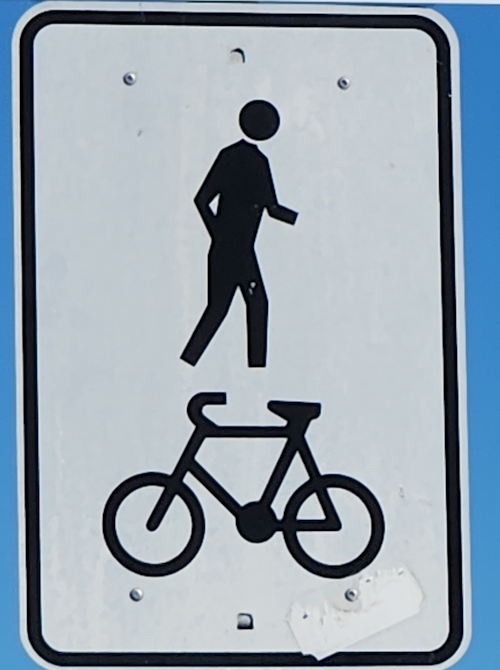
Part 15 of the Road Rules, entitled “Additional Rules for Bicycle Riders” :
- Rule 250 says that the “rider of a bicycle riding on a … shared path must (a) keep to the left of the footpath or shared path unless it is impracticable to do so; and (b) give way to any pedestrian on the … shared path.”
- Rule 251 says “The rider of a bicycle riding on a … shared path must keep to the left of an oncoming bicycle rider … on the path.”
So, despite what many think, some rules do apply.
My thoughts then turned to the issue of speed. Are there any speed limits for any type of user of the Cycleway?
Rule 244O says that someone “must not travel in or on a personal mobility device … on a shared path … at a speed exceeding 25 kilometres per hour.” But the dictionary for the rules says personal mobility devices do “not include a bicycle, motorised scooter, motorised wheelchair or wheeled recreational device”. I couldn’t find any other reference that might be relevant for the Cycleway.
And finally, there is the question of whether cyclists should attempt to warn pedestrians using a bell (or something else), a question that can surprisingly arouse strong emotions. In my experience, hearing a bell is a rare event – but a welcome one from a cyclist approaching from behind particularly if done early and not seconds before the overtake. The bell does not however absolve the cyclist of prioritizing safety over speed, slowing for the overtake.
In conclusion, not only is there no acknowledgement that bicycle speed could increase the danger to pedestrians, there is no signage whatsoever on the Cycleway reminding cyclists that they are sharing the path with walkers, and that their riding speed and behaviour matters.
 Glenorchy City Observer