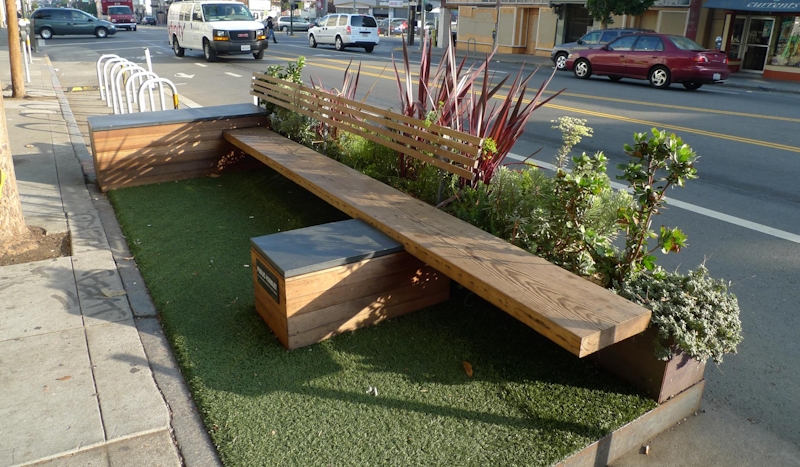
Parklet in San Francisco (Wikimedia Commons under Creative Commons licence.
Back in 2022 when council developed guidelines for Footpath Trading, the resulting document stated that a business could apply to council for permission to trade on the roadway. It went on to say that “this would [generally] be for the installation of a deck where parking exists to become an outside dining area.”
The idea has been raised earlier in the 2021 Greater Glenorchy Plan (page 77). That document stated in relation to the Moonah CBD that “it also has under-utilised parking areas that could be transformed into parklets which will provide green open spaces for the community to use for passive recreation and events”.
Council last year (without public announcement or consultation) started to look into the potential for parklets in the Moonah CBD. The Mayor let slip the parklet project in her announcements at the November 2025 Open Council. We have heard nothing since.
So at last night’s (January 2026) council meeting in public question time the following question was asked.
“Was Council intending to consult with the public as well as ‘affected businesses’? And what more can you tell us about progress on that project?”
“CEO: We have made some progress with some design work. There has been some consultation with businesses. We did have a session out of hours and invited businesses to make contributions and we are progressing. We expect to see more movement this financial year.
Director Patrick Marshall: The first thing we had to do was speak with Metro Tasmania about the possibility of relocating some bus stops so that the parklets would have the most benefit. We had to do some trials of different types of location – that was successful. The next stage is targeted consultation with businesses that would be directly affected by where they’ll be – parking and things like that. Once we’ve done that targeted consultation we’ll go out to wider consultation with the public.”
The Moonah strip is very commercial and functional and many might find some vegetation, trees or plants, pleasant and relaxing. A roadway with parking on both sides leaves little room for a median strip of trees as in the Glenorchy CBD so parklets seem the only viable alternative. We look forward to seeing a design or plan to give us a clearer idea of what is proposed and where.
In December 2025 I read in the Mercury website a story about the debate in Burnie Council regarding the Marinus Link project. The Mercury article says that “Mayor Teeny Brumby excused herself from the vote due to a conflict of interest stemming from her public support for the project”. To learn more about conflict of interest I sent questions on notice to council. Here are the questions with answers in red.
Q1: If a mayor expresses a public position (for or against) a proposed project, is that by itself enough to constitute a conflict of interest? Response: No, see comments below.
Q2: If any councillor expresses a public position, does the same apply? Response: No, see comments below.
Q3: If any councillor publicly lobbies for or against a proposed project, is that byitself enough to constitute a conflict of interest? Response: No, not by itself.
Part 2 of the Local Government (Code of Conduct) Order 2024, does impose important limitations, including that there cannot be a personal or private interest involved as well. An elected representative is expected to “openly and honestly in the public interest” debate various matters, with the Mayor acting as the spokesperson for the Council. In all their duties, Elected Members are to “give genuine and impartial consideration to all relevant information known”.
However, in some circumstances an Elected Member will be making administrative decisions, such as when they attend the Glenorchy Planning Authority meetings. There they will have a duty to uphold the legislated planning scheme, and are expected to approach the issue with an “open and unprejudiced” mind.
I found a more detailed explanation in the March 2025 Open Council agenda in the response to a question from Michelle Austen. I’ve quoted it here in full.
“An elected member would be required to declare and manage a conflict of interest in any matter coming before them. There is not an automatic conflict of interest in every matter because a person was, for example, a real estate agent.
It is a matter of considering the circumstances surrounding each individual matter that comes forward to an elected member for decision.
The Local Government Act 1993 sets out in detail the requirements for elected members when it comes to conflict of interest.
In summary, the Act requires elected members to bring an open and unprejudiced mind to all matters being decided upon in the course of their duties, including when making planning decisions as part of the Council’s role as a Planning Authority. They must make decisions free from personal bias or prejudgement.
There are two kinds of conflict detailed in the Act – pecuniary (or “money-related”) interests and non-pecuniary interests.
Pecuniary interest An elected member has a pecuniary interest in a matter if the elected member or a close associate would, if the matter were decided in a particular manner, receive, have an expectation of receiving or be likely to receive a pecuniary benefit or pecuniary detriment.
Close associate is defined in detail under the Act to include a range of business and family relationships.
If an elected member has a pecuniary interest in a particular matter, they are required to declare their interest, leave the room and not participate in the decision-making. There are penalties under the Act for not doing so.
Non-pecuniary interest Non-pecuniary interests are non-money-related personal or private interests (whether actual, potential or perceived) that might unduly influence, or be seen to unduly influence, an elected member in their decision-making. These are addressed in the Elected Member Code of Conduct and the Act.
An elected member must act in good faith and exercise reasonable judgement to determine whether they have an actual, potential or perceived conflict of interest.
An elected member must avoid, and remove themselves from, positions of conflict of interest as far as reasonably possible.
An elected member who has a non-pecuniary interest, must: (a) declare the conflict of interest and the nature of the interest before discussion of the matter begins; and (b) act in good faith and exercise reasonable judgement to determine whether a reasonable person would consider that the conflict of interest requires the elected member to remove themselves physically from any Council discussion and remain out of the room until the matter is decided by the Council.
There are penalties under the Act for not complying with the Code of Conduct.”
Many cities in many countries across the world have a place in the centre where people can go … not necessarily for any special purpose, but often just to be, to sit, to eat, to read, to watch, to relax and feel safe. In Italy it is a piazza, in Spain a plaza, in Germany a platz, and so on.
Not necessarily a place full of vegetation, plants or trees … but usually with shade to protect from the sun, usually with a central water feature help you relax or cool down, definitely with areas where people can sit sheltered from the weather.
A city square would serve a special purpose … it is a place where people can go that costs nothing to enter and where you are not expected to spend while you are there. Glenorchy has some places like that ( e.g. Tolosa Park, Montrose Bay) but none are in the centre of town easy for people to walk to.
You might imagine that Glenorchy’s council forecourt (view a short video of it) might serve that purpose. It is in the centre of the CBD. But if you watch what goes on in that lawn you will notice that few people stop … most use the paths in the lawn to go from somewhere to somewhere else. To the library. To their car. To a shopping centre.
Sociologists call places like that “third places” … places that are not home, not work, not education i.e places where you do not have to do anything if you don’t want to. You can read a good explanation at this link.
It seems that the council lawn is not a third place.
Maybe it should be.
Maybe council should have a plan to make it a third place.
That would require a plan but council seems to lack any vision for what the council lawn could be.
Indeed a casual glance at the lawn gives the impression that changes to the lawn area are ad hoc without any particular destination in mind. That should now change.
Council staff are now finalising a draft Parking Plan (GPP) for our city. If you want to learn more about Parking Plans there is precious little to go on. In this post I will attempt to describe the weirdness of the Parking Plan concept.
The concept of a Parking Plan is based on a single paragraph (read the original) which says:
“the site is subject to a parking plan for the area adopted by council, in which case parking provision (spaces or cash-in-lieu) must be in accordance with that plan;“
In essence, it says that if a proposed development is in a place covered by a Parking Plan then some or all of the usual State rules for off-street parking might be over-ridden by the Parking Plan.
The first weird thing … there is no other explanation or definition of what a Parking Plan looks like or the information it contains. Council’s approach has been to base its structure on the look of the Parking Code in the State rules.
The second weird thing … is that it is “adopted by council”. Councils have taken this to mean that the entire process of designing, writing, and putting a Parking Plan in place is controlled by council.
The third weird thing … is that our council has, despite the Parking Plan affecting the application of an integral part of the city’s planning scheme, used a variation of its usual policy development process so far … staff draft, consultation with public and stakeholders, etc.
The next weird thing … is that council has, as is usual for its policies, set a review period (four years). Reviews of many council policies are staff reviews only, done with no public visibility and presented to an open council meeting as a fait accompli. This will not do for the Parking Plan which must incorporate the same level of public consultation used for the first version.
The Parking Plan concept seems to be a fudge to the state planning scheme to allow councils to tweak off-street parking rules in their city without any external oversight by the Tasmanian Planning Commission (or anyone else for that matter).
Given the lack of information about Parking Plans, some questions arise.
The text I quoted above referred to “a Parking Plan”, not “the Parking Plan”. Does that mean that Glenorchy can have more than one Parking Plan, each relating to specific portions of the city?
If so, it could create a new Parking Plan quite quickly without waiting for the scheduled review date of the first plan. That might be useful. For example, it would allow council to create a Parking Plan for the site of any proposed development if it regarded the development as being of sufficiently great significance to the city?
And finally, there is the interaction between council and the planning authority. If council adoption of a Parking Plan takes immediate effect, it could create a new Parking Plan to suit a Development Application that council has received while assessment is still under way.
In conclusion, many readers might find a discussion on off-street parking a little weird. It may be … but it is also an internationally controversial and contested subject.
Many cities, large and small, across the world have removed all mandatory off-street parking requirements in part or all of the city. Many others have reduced the requirements. Many others have ongoing argument and debate.
A couple of the most common arguments for removing/reducing mandatory off-street parking requirements are:
a) Reducing the amount of space for parking provides more space for living space. What is not used for parking can be used for accommodation.
b) The developer knows best what amount and type of parking is most appropriate for the proposed development. So why not let them decide the quantity? Council’s interest should be in the size, design, and safety of any parking spaces.
It is of course not as simple as this in reality. For example, if there is little parking provided for a residential development then the availability of travel options such as public transport becomes an important topic for those without their own vehicle.
This is no trivial matter and should be treated seriously.
On 11 November 2025 a full page article appeared on page 7 of the Mercury newspaper telling the story of the closure of the Hidden Garden Estate, a major wedding venue in Berriedale Tasmania. The article was surprisingly balanced, and did not directly blame the Glenorchy City Council for the closure. Local government is often an easy target for those wishing to redirect the blame for a business failure.
The post in the business’s Facebook page announcing the closure, and quoted in full by the Mercury, did however spend many words attempting to describe Council as unwilling to make any concession or give the owners time to sort it out, and create an image of a pedantic legalistic inflexible unfeeling organisation.
The owners had not gained a permit for either the major renovations or for occupancy after the work was done. Did the rules not apply to them?
The owners should feel relieved that those who had little choice but to cancel were satisfied with refunds and have not taken legal action. They clearly suffered from actions (or more accurately lack of action) of the owners. Imagine cancelling or relocating a wedding at a month’s notice!
PS. This content of this post is based on the Mercury article mentioned.
An item necessary because the building in question, according to planning rules, has too few parking spaces for its use.
An item necessary despite no response from any member of the public when the Development Application (DA) was advertised in the Mercury.
An item necessary because no Council staff member has the power to “determine applications with residential car parking discretions” (full list of delegations). Hence the Planning Authority must decide the matter.
But the situation arises originally because the Tasmanian Planning Scheme (TPS) contains an algorithm for calculating the minimum amount of off-street parking required for the use to which the site will be put. If the amount of parking in a DA is not at least as much as the algorithm says, the DA does not have an “acceptable” parking solution and must be assessed against the “performance criteria”. Take a look at the algorithm and the table C2.1 it refers to; they both fit on only eight A4 pages.
The Parking Plan
What is remarkably timely about this particular DA is its timing. It comes while council staff are preparing a Parking Plan for the city of Glenorchy, a plan which is intended to “override the number of car parking spaces specified in the planning scheme and reduce car parking numbers in specific areas.”
Council employed GHD, an international consultancy, to “determine and summarise potential adjustments to minimum car parking rates for development applications within key areas of the Glenorchy LGA that may be applied in a Parking Plan for the municipality” and provide a report to council on the results. You can read the 12 August 2025 version of the GHD report on Minimum Parking Rates.
The GHD report states “evidence does not support a minimum parking requirement” and consequently shows, in order from most effective to least effective) options as:
Removal of car parking minimum rates
Partial removal by-location of car parking minimum rates
Partial removal by location and size of development
Reduction in minimum-parking rates (by location and/or use class)
Adopt widely accepted rates where appropriate
What is particularly disturbing about the first draft of the parking plan is that it adopts, without any explanation, the option GHD regards as the least effective, option 5, “Adopt widely accepted rates where appropriate”. The result was a decrease across the board of about twenty percent.
The first draft plan, if adopted essentially as is, would not improve the situation. The item on tomorrow’s planning authority agenda would still come to the GPA for decision.
We heard at the parking plan workshop that council were being encouraged to “be brave” in their decision-making. I hope that council will do so, change its mind, and accept the consultant’s number one recommendation to reduce minimum off-street parking requirements by 100% ….. all the way to zero.
Katoomba Crescent laneway (entrance on Katoomba Crescent). 15/7/2025.
At its June 2025 open meeting council “endorsed” (whatever that means) the final draft of a Glenorchy Cycling Infrastructure Plan (GCIP) which contained no timeline, no description of what type of infrastructure might be where, and consequently no budget. It is in effect a vision for where cycling infrastructure might sit geographically long-term, but without any of the data needed to make a Priority Project. Still better than nothing and sufficient to satisfy, for now, the well organized lobby groups (such as Cycling South and Tasmanian Bicycle Council) in southern Tasmania.
By carefully reading the GCIP you will find the word “walking” mentioned 38 times, usually in the phrase “walking and cycling”. It seems the authors believed that the GCIP might serve as an infrastructure plan for all active transport, not just cycling.
It takes a few moments of thought to realize that those who walk have vastly different needs and considerations from those who ride. But it is not at all clear how those who often or mostly walk have their differing needs recognized by any level of government. There is a Facebook page “Pedestrian & Public Transport Users Group” that appears to focus exclusively on public transport. A recent addition is an organization known as Hobart Streets which shows some promise. So no organized lobby groups for those who walk.
Let me clear. I am not talking about tracks or trails designed purely for sport or recreation. Council already takes management of walking trails seriously, so seriously that you could say that Council has 4 R’s – Roads, Rates, Rubbish, and Recreation – instead of the usual three. I am talking primarily about people using “walking” as a way of getting about in their day-to-day life. To the shops. To the bus stop. To visit. To work. To school. To play sport. To the doctor. To study. etc. etc.
Infrastructure
It is easy to forget that there is a great deal of infrastructure in our city whose prime purpose is to cater for pedestrians. We drive past it. We walk over it. We can easily take it for granted.
Footpaths are the most ubiquitous. They are everywhere, well almost everywhere, and council does have policy documents related to them. The basic Footpaths Policy provides “guidance on the standards required for the provision and construction of footpaths and kerb ramps”. That policy refers to a footpath hierarchy defined exactly as follows:
Category 1 – CBD: footpaths in the main street in the CBD where there is significant business and pedestrian activity.
Category 2 – Primary: high pedestrian activity within the CBD areas and includes direct pedestrian links between the key CBD zones, such as the Intercity Cycleway.
Category 3 – Secondary: footpaths that provide the best link between key destinations and facilities (e.g. bus stops, local shops, schools, playgrounds, etc.)
Category 4 – Local: footpaths generally in the residential streets and any footpaths which are not included in the other categories above.
Notice the reference to the Intercity Cycleway as a “footpath”. Any regular user of the cycleway would regard it as “contested” in terms of whether pedestrians or cyclists have priority.
The Footpaths Policy also states that a “digital map of footpath hierarchy will be … maintained by Council”. It would be similar to the map underlying the Cycling Infrastructure Plan but not developed with any public consultation. The only map in Council’s map website is the Infrastructure Map which shows roads and kerbs but no footpaths.
The Footpath Trading Policy and Guidelines concern how businesses can operate on footpaths.
But there is much more infrastructure which exists to serve pedestrians.
Pedestrian priority streets (access by vehicles limited and low speed)
Pedestrian refuge islands
Pedestrian safety and comfort (e.g. lighting, shelter)
Pedestrianized streets (vehicles excluded)
Rules regarding pedestrian priority (or not)
Spaces shared with cyclists (separate?)
Wayfinding (signage etc)
All this pedestrian-oriented infrastructure demands a pedestrian-oriented Infrastructure Plan.
Taking the bigger view
Before people walk, they think about how they will get from the starting point to the destination – everything in between – the route.
It is time for council to think the same way, in terms of routes, not simply individual pieces of infrastructure mitigating local issues.
It is time for walking infrastructure to be planned using routes as the primary focus, not apparently piecemeal addition here and there according to demands or complaints from residents.
Planning could in fact move to the next level via networks where integration and interconnection of major walking routes comes into play. This approach has been used elsewhere (such as Victoria (Australia), Queensland, and Dundee (Scotland)) so it has been tried and tested elsewhere.
A focus on the elderly
It is generally accepted that pedestrians are the most vulnerable road users. And older pedestrians are the most likely to be injured or killed in a crash. Furthermore, most demographic projections predict an increase in the proportion of older people in Glenorchy’s population. The State government’s Population Policy website says that for Glenorchy the “population of people aged 65 and above is projected to increase from 8,862 (17.4% of the LGA population) in 2023 to 12,074 (22.2%) in 2053.”
Clearly when considering pedestrian safety on roads, there must be a focus on the particular vulnerabilities of the older members of our community.
In conclusion
An interesting possible result of this type of planning is that it might trigger applications to the Black Spot Program for “walking” black spots in addition to the current almost exclusively “driving” black spots?
The State Government in their Active Transport Strategy tends to universally use the phrase “walking, wheeling and riding” as if they have identical requirements in all contexts. While many cycling and walking routes will overlap, the needs of pedestrians and cyclists differ dramatically and may even conflict.
Those differences demand a Walking Infrastructure Plan specifically designed for those for whom walking is important. Yes – a Glenorchy Walking Infrastructure Plan. The absence of an active lobby group should not delay council. Work must begin immediately.
When Molly Kendall and Harry Quick attended their first council meeting after being elected at the 2022 election, they both declared their desire to be referred to as “Councillor” rather than “Alderman”.
According to the 1993 Local Government Act: “A person elected to a city council is a councillor but may be known as an alderman.”
Although Kendall and Quick were within their rights to ask to be called “Councillor”, it did trigger considerable discussion among those we now quaintly refer to as “elected members”.
Some were quite passionate about wanting to be called “Alderman”. Some didn’t seem to care. I still don’t understand why some took the subject so seriously, probably because I’m a newcomer to Glenorchy having lived here for only 40 years. I was curious.
A little background.
City status was granted to Glenorchy on October 24, 1964, exactly one hundred years after it was first proclaimed a municipality (the third city proclaimed in Tasmania).
The definitive list of Tasmanian councils appears in Schedule 3B of the Local Government Act and currently contains
Burnie City
Clarence City
Devonport City
Glenorchy City
Hobart City
Launceston City
Clarence is an outlier because you will not find “Clarence” on any map I’ve seen.
And you’ll find that Hobart Council has special status in various situations.
Here are the criteria that must be satisfied by a “city” in Tasmania. The Board referred to is the Local Government Board.
38.Criteria for city status For the purposes of section 214D(3) of the Act, the Board may make a recommendation relating to the declaration of a municipal area or part of a municipal area as a city if all of the following circumstances exist: (a) for 5 years immediately preceding the Board’s review, the municipal area had a population of at least 20 000 persons; (b) at least 60% of the population of the municipal area lives in an urban area; (c) an elector poll conducted on behalf of the council has indicated that the majority of electors favour the recommendation.
Back to the original question: why do some care so much?
Is it a feel-good thing? Do the residents of Glenorchy have greater pride in where they live because it is a city?
Does it add to the Glenorchy brand (whatever that is)? Is it about having Glenorchy perceived as an urban centre rather than simply a collection of dormitory suburbs? The G brand needs all the help it can get because G is geographically simply an extension of the City of Hobart.
Does it give Glenorchy extra privileges, advantages, opportunities or powers? Commonwealth legislation?
I suppose that being a city means that Glenorchy can be a sister city to another city (Australian or overseas). Glenorchy can’t have a sister city if it isn’t a city.
I still don’t get it … so I shall ask Council. I’ll keep you posted.
Here are my questions to Council sent on 7 February 2023 and the answers I received.
My questions relate to Glenorchy’s city status. It was apparently a matter of civic pride when Glenorchy received that status in October 1964. I’m interested in whether our city or its residents have received any benefits as a result. As far as I can tell, it allows (a) Glenorchy to have a sister city if it wishes, and (b) councillors to call themselves “Alderman” if they wish. I’d like to know more.
Q1. Is Council aware of any circumstances in which it is treated differently by any state or commonwealth government body as a direct result of Glenorchy’s city status?
A: No. Under Commonwealth grants, the entire state of Tasmania is classified as ‘regional’ and there is no differentiation between cities and other municipalities.
Q1a: If so, please provide some examples?
A: For example Commonwealth assistance grants are allocated according to a complex model that takes no account of City status.
Q2. Is Council aware of any powers, authority, entitlements or privileges that it would not have if Glenorchy did not have city status?
A: Under the Local Government Act, cities, with exception of Burnie, have a larger body of councillors (10-12) and may use the title of Alderman.
Q2a. If so, please provide some examples?
Q3. Is council aware of any income from any source that it would not receive if it did not have city status?
A: Glenorchy is part of the Hobart City Deal that carries Commonwealth government funding. However, if Glenorchy was not a city, but had the same commercial/industrial/residential composition and proximity to the Hobart CBD it would still likely have been part of the Deal.
Now that the efforts of Council and others appear to have finally persuaded the State Government to make the Montrose Bay Park entrance safer for drivers, maybe it can do the same for those who do not drive.
The State Government allocated funds for a project to improve safety at the intersection. The Department of State Growth (DSG) have had a draft design for the intersection to make it controlled by traffic lights. They’ve had that design on their books for years. Enquiries to DSG have always elicited the same response – “we’re waiting for the funds”.
The State Government (and many others) will claim that the proposed traffic lights will make the intersection safe for those on foot, on bike, on scooter, or on skateboard – in other words, for what is now called “active transport”.
Most who have attempted to cross the Brooker Highway on foot will tell a story of being extremely cautious, extremely nervous, extremely tentative. And they will say that using traffic lights does little to reduce the tension.
Any reasonable person could easily come to the conclusion that the Brooker Highway has one prime purpose – to allow traffic to enter and leave Greater Hobart as quickly as possible. It is a facility for traffic. It is utterly ludicrous to suggest that the Highway was in any way designed for the safety of people moving around in any other way, certainly not on foot.
So the proposed traffic lights may help drivers feel safer at Montrose Bay but will do little for pedestrians.
Which brings me to the pedestrian overpass at Montrose Bay High School. The only place in a two kilometre stretch of highway where you can cross without walking on the road surface.
A passing glance at the overpass might fool a casual observer that the overpass is the solution. And it is in roughly the right place, not too far from the school and Montrose Bay Park.
View of pedestrian overpass at Montrose Bay High School facing north. 2025.
But on a second glance, the sets of stairs on each side of the highway will become evident. Those stairs are an impassable barrier for anyone with any significant mobility issues.
That problem has been recognized officially. That overpass is not DDA-compliant, in other words, not compliant with the Commonwealth Disability Discrimination Act 1992. This is after all what the State Govt’s own Brooker Highway Transport Plan said back in February 2011.
You might look at its title and think that the DDA is just for the disabled. Not so. It is all about access. It is about everyone having the right to “have access to places used by the public”.
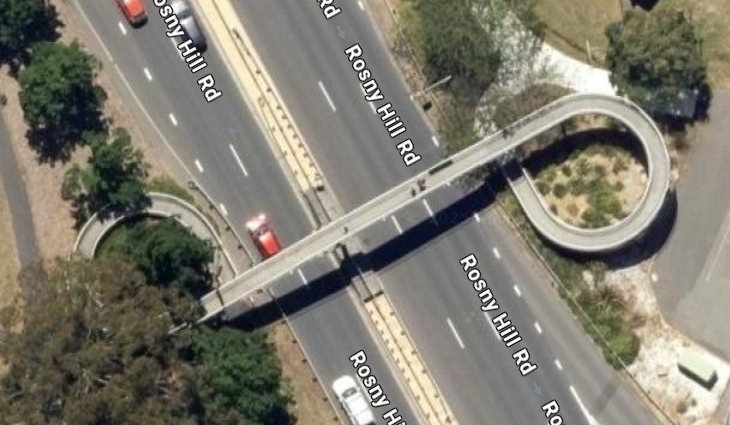
To see an aerial view of a compliant overpass you need go no further than Bellerive.
Pedestrian overpass on Rosny Hill Road 2025.
It has become clear over many years that no state government of any political persuasion has had any interest in the safety of pedestrians on or around the Brooker Highway. Their strategy has been to stonewall any request for change and rely on lobbyists giving up in frustration.
Council must now add the provision of a DDA compliant overpass to its priority list for funding.
It must not put up the white flag on the safety of its residents – and everyone else from the region – who go to the high school or park.
Council owns the property at 261 Main Road, Austins Ferry, a property known in the past as “Nortonville”. While its total area is just over eight hectares, only 7.14 hectares is available for development.
It is one of the largest remaining parcels of undeveloped land inside the Urban Growth Boundary that is owned by Council and potentially suitable for residential development.
Council has designated a large part of the property an “Off-Lead Dog Exercise Area” and given it the name “Austins Ferry Park”. Regularly mowed but certainly not developed!
In March 2022, Council decided to begin an investigation to determine whether it is suitable for disposal.
In parallel with that process, it has worked to “clean up” the land to remove any impediments to disposal. According to the minutes of July 2024 Council,
“Council has undertaken a contamination report on the land. All contaminated soil has now been removed from site and awaiting written confirmation. An in-ground fuel tank has been removed and the site remediated.”
The same minutes state
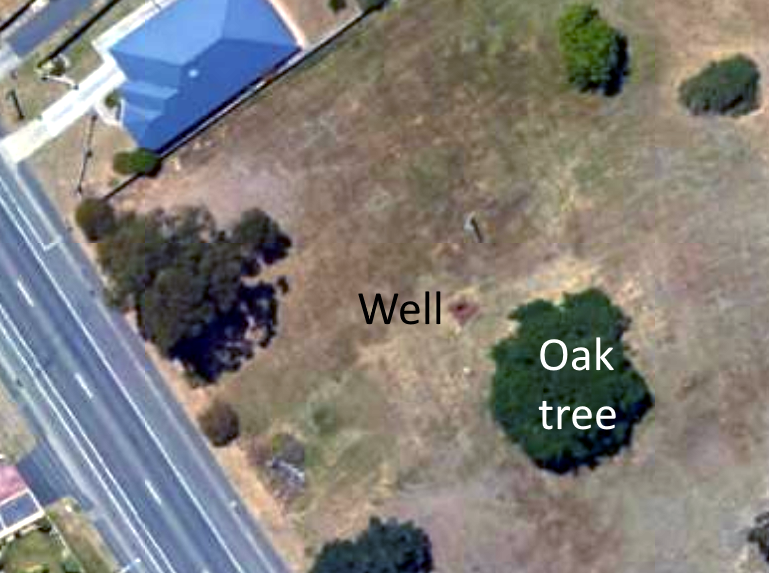
“potential heritage values at the 261 Main Road site (a well, an oak tree and possible structural remains) which means the site warrants further investigation for listing as a ‘Place of Archaeological Potential’.”
Aerial photo of western corner of 261 Main Road, Austins Ferry. 2024.
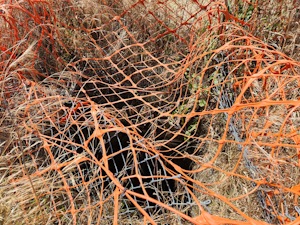
According to the Council’s 2009-2010 Annual Report, Council had asked its Heritage Officer to investigate a water well on the property as a “potential heritage site”. The well is currently covered for public safety (the image for this post shows the wire and plastic webbing used). Underneath is a circular well lined with dry stone, about a metre across and less than two metres deep. I couldn’t find the “possible structural remains”.
But even if the well and tree were found to require protection, their location in the far western corner would only slightly reduce the land area available for development.
So an investigation apparently did begin 15 years ago. According to a recent email from Council, the current investigation is being carried out by external experts and is expected to be finished in the first quarter of 2025.
But what is a ‘Place of Archaeological Potential’ and what are the consequences of a declaration?
The State Planning Provisions contains a Local Historic Heritage Code. Its purpose is to “recognise and protect the local historic heritage significance of local places, precincts, landscapes and areas of archaeological potential”.
It defines Place of Archaeological Potential as:
“a place that is a site, precinct or parcel of land that has been identified ashaving the potential to contain archaeological evidence that provides informationabout the past and is: (a) shown on an overlay map in the relevant Local Provisions Schedule; and (b) listed and identified in the places or precincts of archaeological potential list in the relevant Local Provisions Schedule.”
Note that the Code does not apply to Aboriginal heritage values.
Glenorchy’s Local Provisions Schedule contains a list entitled “GLE-Table C6.4 Places or Precincts of Archaeological Potential”. You can read that list through this link.
Top of the current list is the “Ashburton farm complex”. Much of the land it contains is in the old Claremont Primary School site where a permit for a major residential development was granted by Council in April 2021. So being declared a Place of Archaeological Potential does not preclude even major development on a site.
According to the March 2022 Open Council agenda 261 Main Road is a “very large, 7.14-hectare block which is zoned as a combination of Light Industrial 58%, Open Space 24%, General Residential 11%, Rural Living (Zone A) 7%.”
At that meeting Council decided to “authorise a community engagement process to be undertaken to identify any community concerns about the potential disposal” of the property. This in line with Council’s policy on Disposal of Council Land.
That decision was the result of a “strategic review of land suitable for disposal for housing” by Council officers.
The agenda described the property as “land with potential for significant multiple dwelling housing developments and are considered priority potential sites for increasing the supply of land for housing.”
The report goes to state that Council will soon start “preliminary public consultation process to identify any significant concerns about the potential sale” of that land.
Council’s own Statement of Commitment on Housing (adopted 30 January 2023) lists actions Council intends to take. The last says Council will “release surplus Council owned land to increase residential land supply for housing.” There is no evidence that Council has considered the property for residential development of any sort or in fact regards it as surplus.
Given the current housing crisis, it would be a tragedy if 261 Main Road were to become another Whitestone Point, another large residential subdivision to be sold as a commercial development. Half of the property slopes down to the river with fantastic views over the river. Too good for social or affordable housing? It would be tempting for Council to “land bank” the property to maximize its return on disposal.
It is hard to understand why Council has never shown visible signs of urgency in putting the property to a useful purpose. Perhaps we will see some movement after Council receives the report from the investigation into the heritage values of the property early this year.



 Glenorchy City Observer