
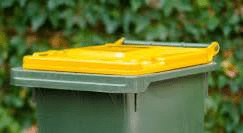
For many years my family has taken the use of our yellow bin seriously, giving careful consideration to deciding what can and can’t be placed in that bin. I have also wondered at times what happened to the contents of our yellow bin. For some reason, I’ve generally felt that most glass, aluminium cans, paper and cardboard, was probably recycled – without any real evidence of that. I’ve never had the same confidence that any of our plastic has in fact been put to any useful purpose.
To get a brief overview of Council’s kerbsite recycling operation, read this 2021 post in council’s own special website about its Waste Services. It says that “Council pays Veolia Environmental Services to empty our recycling bins and take the recyclables to the Materials Recovery Facility (MRF) in Derwent Park. Cleanaway Waste Management Ltd runs the MRF and is the contractor for all southern Councils.” Taswaste South, a Joint Authority established by the 12 Councils of Southern Tasmania, handles the contact with Cleanaway.
I started my search for information back in April 2024. To summarize what I’ve learnt so far:
- Council receives a report, originally written by Cleanaway and marked “Confidential”, containing some statistics.
- Council files those reports and appears to do nothing with them.
- It appears that Cleanaway decides what statistics it will provide and who will see them. Council has no say. It is not clear whether Taswaste South has any say.
- By the end of July, “Council had requested that volumes of recyclables received, and volumes of recyclables being recycled or reused be made available to the public and this has been agreed to be provided. The timeline for release has not been advised but we have been advised it will be soon.”
Latest question sent 19 December 2024. Waiting.
A brief history of Council and plastics
At the March 2019 Open Council meeting, Bob Pettit asked in public question time
“What is the position of Glenorchy City Council on the ban on petroleum based single use plastic products (which the City of Hobart recently moved to ban)?”
The question was taken on notice. Later in the same meeting, newly elected aldermen Bec Thomas and Peter Bull moved a motion without notice which after some discussion became
“That Council receives a report on the options for and impacts of reducing the use of single-use plastics in our community including a staged approach.”
Council finally received a report on “the potential options for regulating single-use plastics in Glenorchy City” at its November 2019 council meeting. The delay gives us some idea of council’s lack of interest. The report recommended that council “continue in accordance with our Waste Management Strategy including action to work with our business community to assist in the reduction, reuse, and recycling of waste.” It states “Officers do not recommend that Council moves to introduce any process or measures to reduce the use of single-use plastic in our municipality now.”
Ironically, it seems that Rosetta Primary School has done more than Council to reduce the use of plastics. They received a Glenorchy Community Award in 2022 in part because of their organization of Plastic Free Days in their school.
Public Question Time (April 2024)
At the April 2024 Open Council I asked in Public Question Time: “Can Council provide me with any evidence or statistics to reassure me that any of the plastic I put into my yellow bin is in fact being recycled or reused?”
In response, I was first given a brief synopsis of the recycling situation including Cleanaway and the Southern Tasmania Regional Waste Authority (STRWA). The second part of the response informed me that Council does indeed receive detailed statistics relating the amount of various types of material that are processed by Cleanaway. I was informed that the statistics were for “internal use”. When I asked if Council would publish those statistics, the answer was non-committal.
Not feeling particularly reassured, I followed up with some Questions on Notice so I could get answers in writing. In my experience Council has generally provided comprehensive answers to Questions on Notice (even if I wasn’t always happy with those answers).
Questions on Notice (May 2024)
Here is my first set of questions on notice with the answers as they appear in the May 2024 Open Council agenda.
Q1: What “internal use” are the statistics put to?
A1: They are provided to Councils for information on volumes of recyclables and comparisons across the various municipal areas.
Q2: Will council publish the most recent statistics and each new set of statistics as they are received by Council, and if not, why not?
A2: The reports include information on all of the Southern Councils, not just Glenorchy, as well as commercial information relating to the commodities and processors. The reports are received with a “confidential” marking. Council is happy to request if the reports, of a version of the reports, can be publicly released by the regional body each month.
I immediately sent back some clarification questions. They were included with the original questions and answers.
Q2a: I didn’t quite understand what Council actually did with the reports. Can you clarify that please?
A2a: They are simply provided as “for information” reports to Council. They provide GCC with information on volumes of recyclables and comparisons across the different Council areas.
Q2b: Is the confidentiality a provision of STRWA’s contract with Cleanaway? If not, who marks the reports as “confidential” – Cleanaway or STRWA or someone else?
A2b: Cleanaway.
Q2c: I would definitely like Council to follow up to find out if the entire reports (or portions) might be made publicly available. Can you make that followup happen?
A2c: Yes, these discussions have already been had with STRWA, and are currently underway between STRWA and Cleanaway.
Questions on Notice (July 2024)
In the absence of any further contact from Council on my questions, I sent another batch of questions on notice. They appear in the agenda of the July 2024 Open Council meeting. Here they are.
Most of the following questions relate to STRWA (now TasWaste South). That organization appears to be doing its best to be operationally invisible to the general public, dealing only with member councils. So, I ask these questions of my council.
Q1. What does Council know about the status of discussions between TasWaste South and Cleanaway regarding provision of statistics?
A1: The TasWaste South CEO has advised that a draft of the report for public viewing has been produced by Cleanaway and reviewed by the CEO, this is being progressed by Cleanaway for release in the near future (date unknown at this stage).
Q2. What has Council done to encourage or expedite those discussions?
A2: A publicly available report was requested by the previous Mayor when she was on the STRWA forum, and the Director of Infrastructure and Development has also requested its release.
Q3. Has Council received permission from either TasWaste South or Cleanaway to release any data? If so, which data and why haven’t we seen it?
A3: No
Q4. Has Council been informed by TasWaste South that public access to data is denied?
A4: The report in its current format includes commercially confidential information and Cleanaway’s intellectual property and cannot be released by any third party.
Q5. Will Council demand from TasWaste South details of any confidentiality provisions in their contract with Cleanaway? That should include provisions relating to publication of data for volumes of recyclables received, and volumes of recyclables being recycled or reused?
A5: Council has requested that volumes of recyclables received, and volumes of recyclables being recycled or reused be made available to the public and this has been agreed to be provided. The timeline for release has not been advised but we have been advised it will be soon.
Email to Taswaste South (30 August 2024)
I have now contacted Taswaste South using the “Contact” page in their website, saying this:
“My family and I are very interested in recycling in general, and in particular the recycling of whatever we place in our Glenorchy City Council recycling bin. Our specific interest at the moment is plastics. Earlier this year we asked our council if they had any statistics on how much of our plastics are in fact recycled or reused. We learnt that their data came from Cleanaway and they did not have the right to share the data. We then asked council to request through your organization some statistics. The last report from council (July 2024 open council agenda) said this:
“Council has requested that volumes of recyclables received, and volumes of recyclables being recycled or reused be made available to the public and this has been agreed to be provided. The timeline for release has not been advised but we have been advised it will be soon.”
What can you tell us about the “timeline for release” and when they may be provided?”
I followed up by sending the same text in an email directly to Taswaste South at their general address admin@taswastesouth.tas.gov.au on September 5.
Response by TasWaste South to September 5 email (21 October 2024)
After an apology for “the delay in responding”, the email went on to say
“I am pleased to let you know that we have published some data regarding the operation of the material recovery facility at Derwent Park that we have obtained from Cleanaway via the Rethink Waste website.
https://rethinkwaste.com.au/cleanaway-derwent-park-material-recovery-facility-mrf/
This information is being made available to the public broadly to answer similar questions to the one that you’ve asked below. We intend to keep this information update and hopefully we can include further information as it becomes available to demonstrate the positive impact from this facility.”
The information content appeared in the following image:
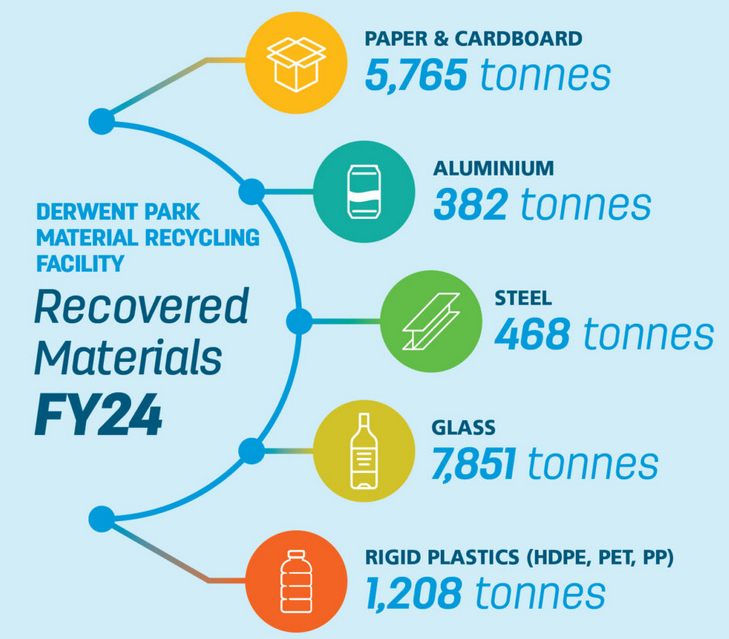
Downloaded 5 Jan 2025.
The alert reader will notice that the source was not the Cleanaway website. It was “Brought to you by Tasmania’s regional waste management groups in partnership with the Tasmanian Waste & Resource Recovery Board using the state waste levy.”
To be clear, the information relating to plastics can be summarized in a single sentence:
Cleanaway recovered during the 2024 financial year 1,208 tonnes of rigid plastics (HDPE, PET, PP).
I have since replied (19 December) to the email asking: What exactly does “recovered” mean in that context?

 Glenorchy City Observer